


Publications
INSS Insight No. 776, December 8, 2015
Follow us on Google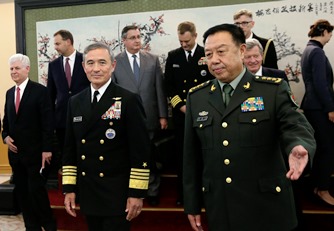
Interest in the tensions and incidents in the South China Sea region has increased recently, with a focus on military actions taken by the parties involved, primarily China and the United States. The events in East Asia constitute a fascinating example of a multi-faceted and multi-dimensional dialogue between the parties, as combined political, military, and economic tools complement each other into one communicatory whole. The use of military tools for strategic communications is a complex fine art, which in addition to the challenges of message clarity, misunderstandings, and effects on domestic and foreign audiences involves the risk of friction, escalation, and risk to human life. Although ostensibly not directly affected by events in this distant theater, Israel should take an interest in it, both because of the effect that United States-China relations has on Israel’s own relations with each power, and because the precedents, lessons, and implications of these interactions are relevant to Israel’s proximate environment.
The South China Sea is a critical region in the global marine and trade routes ($5.3 trillion in annual trade, a passageway for a third of the world’s volume of liquefied gas), and a regional focus for historical, sovereignty-related, and economic claims by coastal countries (China, the Philippines, Vietnam, Malaysia, Taiwan, and Brunei). In recent years, China has sharpened its claims to sovereignty over most of the marine space involved, by combining policy declarations; construction of artificial islands on reefs and rocks; preparation of military infrastructure on these islands (runways, ports, and other facilities); a military, naval, and air presence; announcement of identification areas for aerial defense; and the use of air and marine communications to emphasize its sovereignty claims to the territories. For their part, the other countries in the region are using diverse political and military means to back their claims and rights in the framework of an overall regional dynamic for consolidating spheres of influence, economic rights, and power relations.
At the global level, this conflict also contributes to tension between the United States and China in the economic, political, and military spheres. This tension results from the two superpowers’ respective policies, and affects their actions on broader issues, such as world order, international norms, economic and defense architectures, nuclear proliferation, alliances and partnerships, and naturally, the strategic power competition and relations over regional and global leadership. In view of China’s economic and military rise on the one hand and the United States pivot toward East Asia on the other, events in the South China Sea are enveloped by broad ripples of consequences and repercussions to powerful and long term interests, in a complex context that is difficult to manage.
From China’s perspective, the South China Sea constitutes a strategic sphere in which it has established historic rights. Sovereign control of this zone will give the Chinese government prestige at home, power and status abroad, extensive economic rights, and military freedom of action – while reducing the freedom of action of the United States and its allies – as well as improved defense capability of the main supply route for energy products and other materials vital to the Chinese economy.
From the perspective of the United States, the area constitutes a critical shipping route for free and undisturbed global trade and exhibition of military power, and a theater for demonstrating proven norms of respect for freedom of navigation, an international law-based world order, and the peaceful settlement of disputes through diplomacy, without military force or coercion by threat. China’s measures are perceived as a direct challenge to these principles, as well as to the status of the United States – as a Pacific Ocean power, in East Asia, regionally and globally, and among its partners and allies in the region.
The dialogue between the powers is conducted through public statements (and presumably through covert messages as well) between political leaders (e.g., the Leaders’ Summit in September 2015), ministers, and military commanders (e.g., USPACOM Commander’s visit to the Chief of Staff of the Chinese PLA on November 3, 2015). Besides these official and public diplomatic communications, however, communication is also exchanged extensively through military channels and means.
China’s warships sailed close to the Alaskan shore during President Obama’s visit to Alaska (in September 2015) as a demonstration of presence and a message of power. Aiming to establish sovereignty, China’s airplanes, ships, and air controllers on communications channels hail to foreign ships and planes traversing the South China Sea area, over which China claims sovereignty. The same communications channels are used by United States military vessels and aircraft to clarify its position that the South China Sea area is an international marine and air zone with guaranteed freedom of navigation, including for military craft. In late October, an American destroyer cruised the disputed region as a freedom of navigation operation, and American bombers passed through the South China Sea airspace in November, following a resolute statement by US Secretary of Defense Carter aboard the USS Theodore Roosevelt aircraft carrier.
The public communication between the two parties features the messages delivered through the use of military instruments, i.e., emphasis on the prevailing norms and determination to uphold them, as well as an analysis of concrete and detailed expressions of military activity: where they passed and at what distance from the actual or alleged sovereign boundaries (free passage in international waters or innocent passage in sovereign waters) and the profile of the activity (mere cruising, airplane takeoffs and patrols from vessels, use of radar, and so on). All of these are parameters in the quality and amplitude of the military messages in the eyes and ears of the signaling party, the addressee, and the audiences in the galleries.
The signaling military tools are meant to reinforce the parties’ positions on the disputed issues, highlight norms and determination, and outline the limits of the bargaining, but they are not exempt from risk management originating on the tactical level, and are under orders to avoid escalating the situation. Unplanned encounters between airplanes and ships of different nations involve a risk of operational friction, with dangerous potential for political fallout and strategic consequences. The parties have so far conducted an intelligent dialogue of “flags and flagships,” without resorting to actual use of munitions.
For Israel, the dynamic in the South China Sea is of interest on several levels, mainly in analysis of the emergent lessons and norms and how they are reflected in Israel’s strategic environment.
The construction of islands by China (which some in the United States refer to as the “Great Wall of Sand”) is part of a strategy aimed at changing the physical geography as a basis for expanded claims of sovereignty and political, economic, and military-strategic rights. In recent years, the possibility of establishing an artificial island off the coast of the Gaza Strip has been discussed on a number of occasions as a basis for a security monitored port, or even an airport. In view of the precedent set in the South China Sea, it would be correct to analyze the consequences of the construction of such an island in Israel’s territorial waters and the definition of its exclusive economic zones.
Encounters between Israeli aircraft and ships and those of regional and global powers have become frequent in recent years, and international military activity in the Syria-Iraq theater has also increased the likelihood of such encounters, more so since Russia began stationing naval, air, air defense, and land forces in Syria. As already seen from the recent downing of a Russian fighter plane by Turkey, tactical encounters ending in fatalities have far reaching consequences on all aspects of the relations between the countries involved.
In recent years Turkey has used warplanes and warships to buttress its claims for regional influence (in Cyprus, the eastern Mediterranean basin, the economic waters issue, and the Gaza Strip), and encounters between them and the military forces of other nations included aspects of communications, policy, and public diplomacy in military patterns similar to those in East Asia. It would therefore be wise for Israel to improve and perfect its expertise in strategic communications by military tools, to continue efforts at coordination, deconfliction, and prevention of friction with foreign air forces operating in the region, to expand the channels of communication with them, and to increase its efforts to build trust and establish a common language with military partners in the nearby aerial and marine environment.