


Publications
INSS Insight No. 990, November 15, 2017
Follow us on Google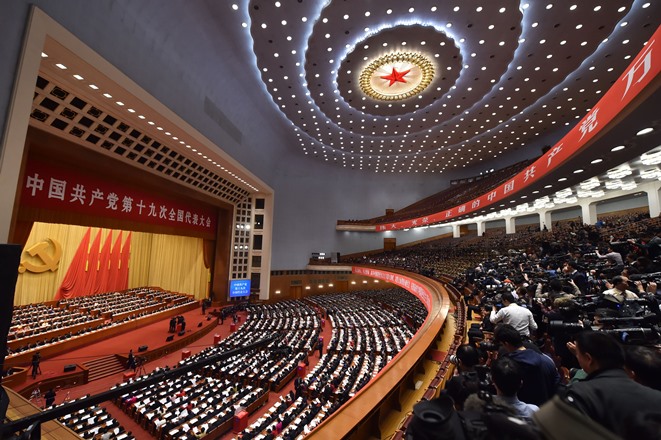
The 19th National Congress of the Communist Party, China’s most important political forum, met in Beijing in October. At the Congress, which was attended by thousands of senior representatives of the Party, the government, and the military, China’s future leadership was chosen and policy outlines were approved. At the opening session, President Xi Jinping sketched at length a roadmap for China for the coming decades in the areas of economics, politics, ecology, military, security, and foreign relations. The message from the Congress was that of a “new era” in China’s relations with the world. China’s increased openness to foreign investment and business activity, if it indeed materializes, will affect the economic horizon of China’s relations with Israel; this is likewise true for the moves to strengthen the Party’s rule. A more active Chinese role in the international arena could gradually expand China’s involvement in issues that concern Israel, and thus Israel’s leaders must pay more attention to this rising power’s intentions and aspirations.
The 19th National Congress of the Communist Party, China's most important political forum, met in Beijing on October 18-25, 2017. The Congress, which is held every five years, was attended by thousands of senior representatives of the Party, the government, and the military. At the event, which took place after a long, extensive purge of corruption within the Party, and against a background of economic challenges and tensions with North Korea, China's future leadership was chosen and policy outlines were approved. At the opening session, President Xi Jinping sketched at length a roadmap for China for the coming decades in the areas of economics, politics, ecology, military, security, and foreign relations. The message from the Congress was that of a "new era" in China's relations with the world. As this shift has potential implications for Israel, the emerging vectors, including changes at the top leadership as well as the projected economic and security trends, require Israel to monitor developments carefully and adjust its policies accordingly.
The President’s Speech: China Stands at the Dawn of a New Era
President Xi, who was reappointed chairman of the Central Military Comission early in the Congress, opened his speech by declaring the start of a "new era" in Chinese domestic and international policy. He said that China was at a crossroads and must become a leading world power. He also stressed that the Party would not agree to any political reforms that affected the nature of the regime, and that China would not allow the government of Taiwan to promote its aspiration for independence.
Xi declared that "a military is built to fight" and that China would continue to strengthen its forces through modernization and automation; promote the use of information technologies; and take a leap forward in its strategic capabilities. He said that by 2025, the Chinese security forces and military would achieve their modernization objectives, and by 2050 China would have world-class armed forces.
Regarding the economic arena, Xi declared that by 2035 China would achieve its goal of "socialist modernization," and by 2050 would beome a world power among the family of nations. Xi repeatedly stressed China's status as a responsible power that seeks to lead the countries of the world to a more economically stable future; he stated that China would open up its markets further to foreign investors and would continue its economic-structural reforms. The President noted with pride that China has achieved its development and modernization objectives without adopting Western values, and contended that therein lies its strength. He therefore proposed the Chinese development model as a global model.
Changes in the Constitution: Adding Xi Jinping's Thought
Party Congress delegates voted unanimously to amend the Chinese Constitution and include a clause on "socialism with Chinese characteristics towards a new era." This clause mentions President Xi by name, thus giving him equal status with the great Chinese figures Mao Zedong and Deng Xiaoping. In 2016 the Communist Party already declared Xi as a "core leader," like Mao Zedong, and Chinese publications have referred to the three leaders as the greatest leaders of modern China. The Congress was therefore another milestone reinforcing the status and power of the Party Chairman, President, and Commander in Chief of the People's Liberation Army, as the elected members of the Politburo added to his many titles that of lingxiu, which means "leader" in a spiritual sense. This title, which was previously given only to Mao Zedong and his heir for a short time, expresses a higher level than the normal term for leader, lingdao, which means "way leader" in a more practical sense. Western researchers believe this rise in the President's status hints at a possible intention of extending his term of office beyond the normal two terms, although in view of the system of checks and balances in the top Party echelons, this conclusion is premature.
Changes in the Political Power Structure of the Party
As expected, the president’s tenure, as well as the incumbent prime minister’s, was extended for another term of office. However, most of the senior leadership was replaced, led by five of the seven members of the Politburo Standing Committee. Contrary to earlier speculations, Xi's close associate and head of the Party's Disciplinary and Supervisory Committee, 69-year-old Wang Qishan retired, thus maintaining the Party's usual retirement age (68). Five new members were promoted to the Politburo, all are over the age of 60; introducing a younger member could have indicated a possible heir to the President in 2022. Western experts argue that this is a sign of the President's intention to continue for a third term in office. On the other hand, there have been precedents in China's recent history, where a president was appointed without first being announced at the Congress as the intended heir.
Of the 25 members of the Politburo, 15 were replaced, and now 14 of its members are ostensibly supporters of President Xi, including three potential heirs (Chen Min'er, Hu Chunhua, and Ding Xuexiang). Unlike previous generations of Politburo members, who came from a rural background or were engineers, the new members are political experts, economists, and theorists, indicating the Party’s priorities for the coming years. The new appointments at lower ranks are also important for an understanding of China's future leadership. Of particular interest are the promotions of younger party members (the sixth generation), whose numbers have doubled in the last two years, particularly among the leaders of outlying areas. This generation is less idealist than its predecessors and less connected to the Party's values. This is also the generation that will have to deal with the party’s shortcomings.
Implications and Recommendations for Israel
Naturally, most of China’s familiar characteristics will continue after the Party Congress, and it is therefore tempting to analyze China’s future directions on the assumption that "what has been is what will be." Nevertheless, the "new era" announced at the Congress deserves serious examination. President Xi Jinping left the Congress to begin his second term with extraordinary powers, and the messages from the Congress indicate ambitious horizons and outline planned changes in China’s economic, foreign, and security policies in the coming years.
China's increased openness to foreign investment and business activity, if it indeed materializes, will affect the economic horizon of China's relations with Israel; this is likewise true for the moves to strengthen the Party's rule. A more active Chinese role in the international arena could gradually expand China’s involvement in issues that concern Israel, and thus Israel's leaders must pay more attention to this rising power’s intentions and aspirations. Given China's military and defense growth and its expanded defense activity and influence worldwide, Israel must keep an eye on China's defense exports to the Middle East, including to Israel's enemies; on China as a competitor in the arms markets; and on the gradually growing presence of Chinese forces in Israel's strategic environment. The first signs of this can already be identified in the military base built by China in Djibouti, which opened in late 2015 as a logistical support base and was later staffed with Chinese military forces.
China's ascendance on the path toward a global power power in policy and security, in addition to its already significant economic power, is a significant challenge to the United States and to the post-World War II world order, which was molded when the People's Republic of China was taking its first steps. This challenge requires the Israeli government to conduct its policy meticulously within the complex triangle of relations between the two global superpowers and their respective relations with Israel, so that it can maximize the positive potential while minimizing the risk of harming its special strategic relationship with the United States.
As the new Chinese leadership establishes itself and completes the necessary Party and government appointments, Israel must examine the best way of to achieve its access and relevance to the new guard. Similarly, it should identify the likely circles of China’s future leadership and create channels of communication with them, in order to enable effective dialogue and promote Israel's national interests in the coming deca