


Publications
INSS Insight No. 825, May 31, 2016
Follow us on Google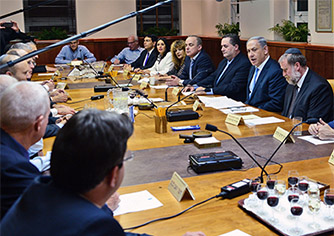
The demand by Minister of Education Naftali Bennett to broaden the professional knowledge of the members of the security cabinet so that they can fulfill their duties in optimal fashion is, in principle, correct. The security cabinet is of decisive importance in the decision making process on critical decisions related to Israel’s national security, and if its members lack the ability to perform properly then one of the most important institutions in the governmental system is impaired. Therefore, members of the cabinet, whether newcomers or veterans (as well as the rest of the ministers of the government, which has the authority over the IDF) need a system for learning and keeping abreast of developments in order to make informed strategic assessments and diplomatic and military decisions.
At issue is neither the supply of information nor intelligence updates alone, but rather information about Israel’s military capabilities, operational plans, IDF buildup, Israel’s relations with the world powers, primarily the United States, diplomatic moves, developments related to WMD proliferation, cyber threats and capabilities in cyberspace, and other important strategic issues. The tunnels dug along the Gaza Strip-Israel border, to which Bennett referred, is a good example of, on the one hand, the breadth of necessary knowledge and, on the other hand, the problematic nature of demanding specific information. Not only is intelligence about the existence of the tunnels important: equally important is an understanding of Hamas’s overall capabilities. The same is true of the challenges Hezbollah poses to Israel. Assessing the enemy’s intentions is more essential to decision making even than intelligence about its capabilities. Another problematic aspect in this context arose during Operation Protective Edge: the cabinet must understand the IDF’s operational capabilities as a response to threats and have a comprehensive idea about Gaza – i.e., the ramifications of “eliminating” Hamas or “preserving” it as a governing entity responsible and accountable for what happens in the area it controls. In other words, it is far more important for the cabinet to be able to delve into strategic issues in an in-depth manner than to know the location of a particular tunnel and the tactics the IDF will use to confront the threat. Similarly, cabinet members must address the significance of yet another round of fighting in Gaza or an all-out escalation in the Palestinian arena and/or the northern front for Israel’s relations with Egypt and for all the possible regional and international responses to such a development.
The need for the cabinet to delve deeply into the fundamental issues of national security was discussed by the Winograd Commission (in the partial 2007 report). Among other suggestions, the commission recommended that all government ministers enhance their knowledge about the core strategic issues Israel faces by means of workshops, seminars, and in-depth discussions. From time to time, in my position as the head of Military Intelligence, I held meetings with senior ministers in the Cabinet – including Shimon Peres, Tzipi Livni, Silvan Shalom, Dan Meridor, and Benny Begin – in order to keep them up-to-date and broaden their understanding of the issues at hand. These meetings were held with the Prime Minister’s blessing.
Minister Bennett undoubtedly found support for his position in the draft of the State Comptroller’s report on Operation Protective Edge leaked to the press, which states that the Prime Minister, Defense Minister and chief of staff alone directed most of the fighting on the ground while marginalizing the cabinet and hiding many of the details from the other ministers (Haaretz, May 5, 2016). The link between Bennett’s demand and Yisrael Beitenu’s joining the governing coalition with the appointment of MK Avigdor Liberman as Defense Minister may also reflect Bennett’s desire to strengthen his own oversight – and that of other cabinet members – of the Prime Minister and new Defense Minister, and perhaps even influence the security agenda.
For Bennett’s demand to have a positive effect on national security, rather than undermine it, it must meet four fundamental conditions: a) that no sensitive classified information leak from the cabinet; b) that ministers devote time to study the material so that it can prompt serious, professional debates; c) that the cabinet debates deal with strategy rather than tactics; d) that study and debates be coordinated by the National Security Council (not by a military secretary).
The inherent dangers of information security breaches: The Winograd Commission noted that routine leaks from the political-security cabinet and other closed meetings are typical of “an unprofessional, irresponsible governmental culture.” This critical point has not improved; on the contrary, the situation has only deteriorated over the past decade. It is obvious that leaks from cabinet sessions, including highly classified material and quotations from sensitive debates, provides the enemy with invaluable information. Minister Bennett’s assertion that “not sharing information with the cabinet is tantamount to causing loss of life” is countered by the opposite assertion: leaking sensitive information might also result in the loss of life. As publicly elected figures, cabinet members are not subject to security checks customary in the security establishment, and all of them have staffs and intimate advisors exposed to the information they have. Leaks are rarely, if ever, investigated and traced. Therefore, sharing sensitive, classified information with cabinet members would require a fundamental change in terms of confidentiality. Food for thought in this context is: why was “the octet” in the second Netanyahu government (2009-2013) a leak-free forum? The answer, possibly, is that its members had extensive political-security experience and the government itself was stable and free of extreme personal and political rivalries.
Study time: Experience demonstrates that even when they have much material at their disposal, the ministers, who tend to be heads of political parties and run large offices, commonly lack time to pay it sufficient attention. This gap can and should be filled by the National Security Council (NSC). The law (2008) defines the NSC as an institution of the security cabinet whose function is to make all the material needed for decision making – including operational alternatives and recommendations – available to that forum. The NSC provides a daily brief based on summaries prepared by the intelligence and security community to all cabinet ministers, and also submits intelligence surveys to ministers. The problem, as noted, is that the ministers, busy with their offices and personal political positioning, do not devote the time needed to study the critical security issues when they are appointed as members of the security cabinet or to delve into the current issues debated in that forum. In 2013, the Institute for National Security Studies proposed a curriculum for new security cabinet members, but the suggestion was only partially adopted. In 2015, the NSC tried to set up a study program for the new cabinet members, but in this instance too participation was very sparse.
Level of detail: Adopting Minister Bennett’s proposal is liable to lead to the cabinet becoming overly involved in the management of the security establishment and fighting on the ground. Cabinet debates must be kept at the strategic, fundamental level. The day-to-day tactical or even systemic running of security must remain the purview of the chief of staff and the General Staff, albeit under the instructions of the political echelon. Routine leadership of the security establishment and battles are to be left to the Defense Minister and Prime Minister (though in many cases they should be joined by the Foreign Minister; such a trio is common in many governments). But cabinet members exposed to a great deal of intelligence are liable to flood the system with parliamentary inquiries and stray beyond the strategic-operational dimension, thus impeding the ability of the Prime Minister, Defense Minister, and chief of staff to control the security agenda and run a military campaign.
Military secretary: The function of a military secretary or military assistant to a political figure is problematic from every aspect. These are military officers in uniform operating in a political environment who are supposed to return to a military career. The dual subordination to the chief of staff and the prime minister is problematic, to say the least. Multiple subordination – to the chief of staff, the prime minister (as head of the cabinet), and eight other security cabinet members – is a guaranteed recipe for organizational catastrophe. In many cases, military secretaries substitute for an organized process of in-depth study and staff work, and therefore represent a potential source for misrepresentation of the military’s or intelligence community’s positions. Even though a great deal of information flows through military secretaries, they are not an intelligence or operational authority that have to bear the responsibility for assessments. Moreover, an unnecessary expansion of involvement by IDF officers in political power struggles is a bad idea. Therefore, it is necessary to minimize the number of military secretaries, as their jobs are characterized by an extreme gap between authority and responsibility as well as by ongoing conflicted loyalties.
The political compromise proposed by Minister Yaakov Litzman and accepted by the Prime Minister and Education Minister is a step in the right direction: the solution to the problem described by Minister Bennett lies in the National Security Council. The NSC is already defined as the institution responsible for most of the work of the political-security cabinet in coordination with the government secretariat. The NSC is responsible for preparing discussions, net assessments, and operational alternatives, including intelligence analyses, with the Prime Minister’s approval. Therefore, there should be an orderly implementation of the existing instructions in the law; there is no need to invent new positions or processes. The Prime Minister can – indeed, must – instruct the NSC to create the conditions and procedures to ensure that cabinet members are exposed to intelligence relevant to their position, routine strategic assessments, and key national security issues.
Nevertheless, the Amidror Commission, charged with dealing with the challenge of improving cabinet members’ preparedness for their job, will have to address three fundamental issues that are left unsolved by the Litzman compromise:
a. Understanding that the problem is not organizational but rather political: The Prime Minister will continue to maneuver through a divided political system in which cabinet members are also political rivals, and it is therefore to be expected that in many cases he will avoid sharing sensitive information. Furthermore, the custom of discussing issues in alternate forums (“the farm,” “the octet,” “the trio,” “the kitchen cabinet,” or whatever particular forum the Prime Minister chooses) will likely continue. Another dubious “advantage” typical to restricted, unofficial forums such as these is the lack of minutes that can become important material for commissions of inquiry and the State Comptroller…
b. Strengthening the NSC by firmly establishing its centrality in the integrative staff work of the intelligence and security organizations and the decision making process on national security issues: As such, the Prime Minister must staff the position of NSC chief – empty for many months – as soon as possible. A senior, authoritative figure who can realize the purpose of the NSC as a body serving the cabinet, not only the Prime Minister, must be appointed to this position.
c. Improving legislation on cabinet leaks and enforcing this legislation fully.