


Publications
INSS Insight No.812, April 5, 2016
Follow us on Google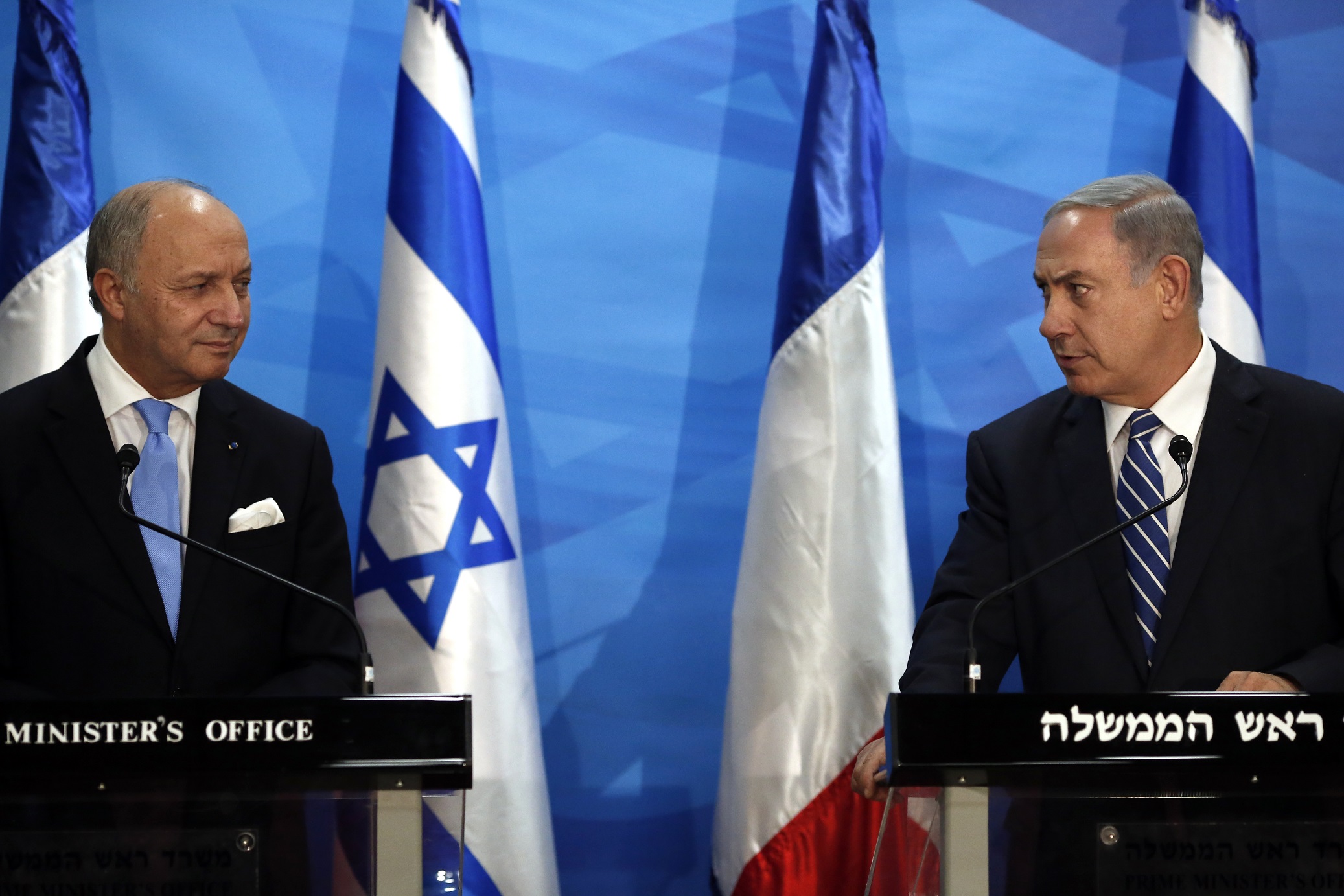
The decision by the US administration to refrain from further efforts to revive the Israeli-Palestinian political process following the failed attempt by US Secretary of State John Kerry to broker an agreement created a vacuum that since early 2014 France has sought to fill. In Israel, claims were sounded that the series of French initiatives proposed over the previous two years reflected the aspiration of outgoing French Foreign Minister Laurent Fabius to secure his own legacy in the realm of French foreign policy. The French effort, however, has survived Fabius’s term in office, and in fact seems primarily the result of ongoing frustration with the political stalemate (in particular, the conduct of the Israeli government); concern over the status quo and the lack of a horizon for the renewal of bilateral negotiations between Israel and the Palestinians; and the recent wave of violence, which appears to have no end in sight. Internal political considerations may also have prompted the French administration’s display of activism.
Already by late 2014, the French National Assembly resolved to recognize a Palestinian state. In a discussion preceding the vote, Foreign Minister Fabius clarified that if the efforts to achieve a negotiated solution were to fail, France would need to “fulfill its duty” by recognizing Palestine without delay. On a different occasion, when discussing the proposal to convene a conference on the Israeli-Palestinian conflict in the summer of 2016, with the aim of reaching an agreement within two years, Fabius emphasized that if by the end of that process the parties had not resolved their disagreements, France would recognize a Palestinian state. In December 2014, France considered submitting a draft resolution to the UN Security Council that would stipulate a timetable for negotiations and set a target date for the establishment of a Palestinian state. However, the idea was ultimately suspended due to the Palestinian decision to work toward the passage of a different Security Council decision that would stipulate an Israeli withdrawal within two years. In early 2015, the idea returned when France announced its intention to begin discussions in the Security Council aimed at adopting a new draft resolution regarding the renewal of negotiations. France retreated from this intention as a result of Israeli pressure and opposition to the imposition of a solution from the outside, as well as Palestinian opposition to the substance of the proposed resolution.
The visit to Israel and the Palestinian Authority by Fabius in June 2015 was part of the effort to secure international consensus for the passage of a Security Council resolution that would specify the parameters for negotiations and set a timetable for talks. The talks would be conducted within an international framework that would be convened for this effort. Prime Minister Benjamin Netanyahu, who rejected the initiative for advancing a draft resolution within the Security Council, reiterated Israel’s position regarding the need for direct negotiations and its opposition to international coercion. The Palestinians, on the other hand, expressed support for the French proposal, which served their interests regarding internationalization of the conflict and intervention by the international community toward a solution. The United States, which appears not to have rejected the French initiative outright, clarified that it was not interested in discussing a political process in the Middle East until after the conclusion of the negotiations with Iran over the nuclear issue. Aware of the United States position, Fabius emphasized that France would not propose a Security Council resolution if it was clear it would be vetoed by the United States. On another occasion, Fabius rejected the claim that France was determined to take independent action and reiterated the central role that the United States has played in seeking a solution to the conflict.
In February 2016, shortly before leaving office, Fabius announced France’s intention to convene an international conference in July, with the aim of jumpstarting the political process and salvaging the two-state solution. The conference was designed to constitute the third phase of the initiative, with the first phase including consultations with the two sides and other parties inside and outside the region, and following it, apparently in May 2016, preparatory meetings of the monitoring group that would plan the conference. As evidence that this was not merely Fabius’s personal ambition but rather an initiative that also enjoyed the support of the President of France, it was adopted by incoming Foreign Minister Jean-Marc Ayrault. Shortly after entering office, Ayrault visited a number of Arab countries to mobilize their support toward an effort to renew negotiations according to the plan. During these visits, he clarified that France would not automatically recognize a Palestinian state should the conference fail. He explained that France’s goal was to mobilize the international community in support of the only possible solution – i.e., a two-state solution – and that recognition of a Palestinian state would not necessarily be a precondition for convening conference. With this decision, Ayrault rejected Fabius’ intention of recognizing a Palestinian state in the event that the attempt to reignite the political process failed. This intention of Fabius drew intense criticism from Prime Minister Netanyahu, who during a joint news conference with German Chancellor Angela Merkel characterized it as “puzzling.”
In continuation of his visits to the Arab countries and as part of the effort to implement the first of the three phases – consultations with the relevant parties – Foreign Minister Ayrault appointed Pierre Vimont as his emissary, an experienced and highly respected diplomat who had already visited the region and held talks in a number of European Union capitals and Washington. Thus far European parties have indicated that the French plan is not sufficiently developed and that Vimont failed to provide clear answers to concrete questions, and therefore, some European officials preferred to wait for additional information before adopting positions on the issue. Reports also indicate that in the Washington talks, Vimont received no sign of the United States position. It therefore appears that France will have difficulty meeting the timetable it set for convening the monitoring group, not to mention the ambitious goal of convening a conference this coming summer to jumpstart the process.
In light of these developments, it is difficult to determine the prospects for the French initiative. Its complete or partial success depends on a significant number of entities on which France has no influence or is unable to impose its policy. The three-phase initiative reflects the sense that the approach whereby the United States maintained exclusive leadership has failed and that the time has come to try a different approach, revolving around the adoption of a Security Council decision. In practice, the proposed resolution would replace UN Security Council Resolutions 242 and 338, specify the parameters of a solution to the conflict based on the establishment of a Palestinian state alongside Israel, and establish an international support group to assist the parties through the negotiations. According to the French proposal, this group, which would replace the Quartet (the United States, Russia, the European Union, and the Secretary General of the United Nations), would include not only the Quartet but also a number of EU members and Arab countries.
The position of the United States will undoubtedly prove critical for the success of the initiative. Recent statements by President Obama regarding the Middle East (as reported in an interview with Jeffrey Goldberg of The Atlantic) could lead the French to the conclusion that the current US administration may refrain from vetoing a proposed decision whose content and timing is coordinated with it. As for Israel, the French initiative clearly runs counter to the government’s position, even after the linkage between the failure of the conference and the recognition of a Palestinian state no longer exists.
The failure of the French initiative, however, does not mean the end of international efforts to advance a solution to the conflict. The initiative reflects a concern shared by many in the international community that the stalemate could block any possibility of implementing a two-state solution designed to end the struggle and the bloodshed. Joining the continued violence and the fear of escalation to a full blown intifada is the near certainty that the political status quo will elicit additional international initiatives, including the possible advancement of a new initiative by President Obama between the US presidential elections and the inauguration of a new US administration. The French initiative illustrates once again that in the absence of Israeli decisions and initiatives, the existing vacuum is destined to be filled by the proposals of other parties that will not necessarily be consistent with Israeli needs. Moreover, American diplomatic protection against these proposals is not ensured, as a result of the prevailing sentiment in the international community that Israeli obstinacy remains the primary obstacle to progress toward an agreement. For this reason, the most effective means of meeting these challenges is an Israeli initiative that includes steps toward the renewal of negotiations, proposals for changes in the format and contents of the talks, and unilateral steps toward a settlement.