


Publications
INSS Insight No. 779, December 16, 2015
Follow us on Google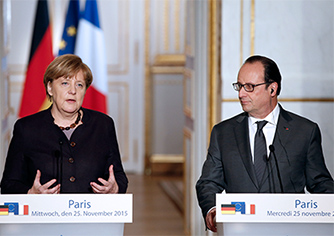
The high casualty coordinated terror attacks in Paris attributed to the Islamic State exposed severe intelligence failures and a lack of cooperation – or a willingness to cooperate – among European countries in the struggle against the Islamic State, and assigned the threat, yet once more, to a high position on the international agenda. French President François Hollande declared that France is at war, and in the wake of this declaration, French warplanes bombed Islamic State targets in Syria, and a French aircraft carrier was moved to the eastern Mediterranean. President Hollande also turned to EU members with a request for assistance, and began forming an international coalition for war against the Islamic State. The recruitment efforts included meetings with the Presidents of the US and Russia, German Chancellor Angela Merkel, and British Prime Minister David Cameron. This was in parallel to an attempt to pass a resolution in the UN Security Council that would clear the way for military action.
Hollande obtained declarations of support and expressions of readiness to extend any necessary aid. But will the Paris attacks, along with the downing of a Russian passenger plane over Sinai in October, and the shooting attack in California on December 2, 2015, mark a turning point in the struggle against the Islamic State, or will the response be simply “more of the same”? It is also unclear how the expanded coalition formed through the French efforts will fit with the US-led international coalition, or alternatively, with the Russian-led coalition in Syria incorporating Iran and Hezbollah, and last but not least the decision taken by Saudi Arabia to form an Islamic anti-terror coalition.
Ultimately, the issue is whether these recent terror attacks have changed the central parameters of the Syrian theater in general and the struggle against the Islamic State in particular; or whether these attacks are even capable of fundamentally changing the reality in these arenas. Has there been a change in the map of interests of the local, regional, and global parties involved in the Syrian crisis? If so, has such a change resulted in a willingness in principle to change the nature of the war against the Islamic State, and to move from low intensity aerial attacks (relative to the wars conducted in Afghanistan, Iraq, and – despite the differences – the action against Serbia), accompanied by limited commando activity, to a war with “boots on the ground,” i.e., significant ground forces of states in and outside the region? Is there an international consensus to temporarily abandon the struggle to remove the Assad regime (which, in the eyes of many, is the source of the Syrian crisis) for the sake of fighting the Islamic State, as well as to cooperate with the Russian-led coalition?
Saudi Arabia still sees Assad, an ally of Iran, as a major threat that must be removed; at the same time, it perceives the Islamic State not only not as a threat to be removed, but as an element that assists in the struggle against Assad. Iranian support for Assad and its participation in the war against the Islamic State are thorns in the Saudi side, and from Riyadh’s perspective the struggle against the Islamic State will harm its fight against Iran. For these reasons, even if Saudi Arabia expresses support for the French initiative, it is doubtful whether this will translate into any substantive measure. Beyond this, the ability of Saudi Arabia and its Gulf allies to send fighting forces to Syria is extremely limited, as long as they are invested in the war underway in Yemen.
Although Iran views the Islamic State as a threat, it is doubtful whether Tehran will focus efforts on a war against the Islamic State at this time, when its main energies in Syria, as well as those of Russia, are directed at military action to protect the territory controlled by the Assad regime – activity that is almost entirely directed against anti-Assad opposition forces other than the Islamic State. A further question is whether the eradication of the Islamic State is an Iranian interest, or whether it would be better for Iran to have a weakened Islamic State as opposed to a reconstitution of a Sunni coalition that would focus its struggle against Iran.
Regarding the US, despite the fact that there has been no change in the goal set by Obama – to contain and ultimately destroy the Islamic State – in practice, as the President expressed in his December 14, 2015 address, he prefers to continue a policy of controlled escalation. The administration fears a slippery slope that would drag the US into the Syrian morass, and it is thus doubtful whether the Paris and California incidents will generate a qualitative change in American military intervention in Syria. It thus follows that the US will continue to focus on aerial attacks, perhaps with an expanded presence and scope of activity for special forces. At the same time, Obama seems to be showing a willingness to give the diplomatic process a chance by delaying Assad’s removal – which until now had been a declared American objective. From his perspective, the Russian involvement in Syria, along with the Islamic State attacks in Europe and the United States, holds the possibility of creating a supportive background for promotion of a political settlement in Syria. This possibility was reflected in the somewhat broader consensus among the parties in at the November talks in Vienna on Syria.
Following Turkey’s downing of a Russian plane on November 24, there is even less chance that Turkey will interfere militarily in Syria, and certainly would not coordinate and cooperate with Russia. Moreover, the US willingness to suspend the direct fight against the Assad regime intensifies Turkish aversion to fighting against the Islamic State, out of a fear that this will increase the power and influence of Syria’s Kurds and strengthen their control over the Syrian territory bordering Turkey, as they are the only reliable ground force on the scene.
Regarding Russia, even prior to the downing of the airplane over Sinai and the Paris attacks, Moscow had decided to increase its profile significantly in the Syrian crisis. This decision itself was unrelated to action against the Islamic State, although it was presented as Russia’s declared objective. The purpose of the Russian intervention relates to the real threat of Syrian opposition forces on the territory controlled by Assad. Fear of the regime’s collapse and the subsequent loss of the Russian strategic stronghold in Syria are what propelled Moscow to military involvement. In other words, Russian military action against the Islamic State is only a secondary motive, undertaken as a minimal fulfillment of an ostensible obligation. Nevertheless, Russia intensified its aerial attacks against the Islamic State in the wake of the attack on the Russian airliner, and presumably if Russia succeeds in stabilizing the Assad regime’s military situation, it will reinforce its military struggle against the Islamic State, which has recruited several thousand Russian citizens, mainly from the Caucasus.
Continued Russian attacks in Syria, and the return of veterans of the war in Syria to Russia, will also likely increase the threat of Islamic terror within Russia itself, and hence the conflict between Russia and Islamic State. From the Russian perspective, despite the risk involved in increased military activity against the Islamic State, joining France in an anti-terror coalition – while the US continues to keep a low profile within the coalition it heads – will help drive a wedge between Europe and the US. Participating in the French coalition will also help President Vladimir Putin achieve some relief from the sanctions imposed on Russia due to its actions in Ukraine, even though at this stage, the West seems uninterested in linking the crises. These Russian considerations will apparently not translate into a Russian willingness to employ significant ground forces in Syria – even though such a decision can be taken in Moscow without any public debate on the matter.
In contrast to Russia, it is almost certain that the Paris attacks will change, to some extent, the conduct of the European countries in their struggle against terror within their borders, especially against the backdrop of the intelligence-security failures that have surfaced. However, due to a conflict of interests among the major players in the Syrian conflict, and due to their aversion to place ground forces in Syria, the current pattern of action of the European players will likely continue, at least for the foreseeable future – although perhaps with increased aerial and commando activities. While additional showcase attacks by the Islamic State in Europe, Russia, and the US may, in the longer term, lead to changes in the basic approach in the struggle, there are no current signs of this. Nor does it appear that the apparent US willingness to concede temporarily on the removal of Assad will indeed help advance a political process. One of the results of such a process would be a concentrated effort against the Islamic State. However, it is unclear whether the change in US policy is sufficient to launch a meaningful political process. After all, it is doubtful that it will be possible to initiate a concrete process in the absence of a fundamental change in the balance of power on the ground, especially when the opposition to Assad is so divided and the interests of external actors are diametrically opposed.
One month after the Paris attacks, it appears that the episode has not proven a formative event that will lead to a paradigm shift in dealing with the Islamic State – neither as to the fighting in Syria and Iraq, nor regarding the struggle with the internal European terror threat. Given this conspicuous gap between rhetoric and deed about fighting the Islamic State threat, one is reminded of the Carl Sandburg line, “Sometime they’ll give a war and nobody will come.”