


The First 100 Days of the New Israeli Government: Twenty Policy Recommendations on Issues of National Security | INSS
go to header go to content go to footer go to search
INSS logo The Institute for National Security Studies, Strategic, Innovative, Policy-Oriented Research, go to the home page
INSS
Tel Aviv University logo - beyond an external website, opens on a new page
  • Campus
  • Contact
  • עברית
  • Support Us
  • Research
    • Topics
      • Israel and the Global Powers
        • Israel-United States Relations
        • Glazer Israel-China Policy Center
        • Russia
        • Europe
        • Antisemitism and Delegitimization
      • Iran and the Shi'ite Axis
        • The Campaign Against Iran and the Shiite Axis
        • Iran
        • Lebanon and Hezbollah
        • Syria
        • Yemen and the Houthi Movement
        • Iraq and the Iraqi Shiite Militias
      • Conflict to Agreements
        • Israeli-Palestinian Relations
        • Hamas and the Gaza Strip
        • Peace Agreements and Normalization in the Middle East
        • Saudi Arabia and the Gulf States
        • Turkey
        • Egypt
        • Jordan
      • Israel’s National Security Policy
        • Military and Strategic Affairs
        • Israel's Security Strategy
        • Societal Resilience and the Israeli Society
        • Jewish-Arab Relations in Israel
        • Climate, Infrastructure and Energy
        • Terrorism and Low Intensity Conflict
      • Cross-Arena Research
        • Data Analytics Center
        • Law and National Security
        • Advanced Technologies and National Security
        • Foreign Information Manipulation and Interference
        • Economics and National Security
    • Projects
      • Preventing the Slide into a One-State Reality
      • India-Middle East-Europe Economic Corridor (IMEC)
  • Publications
    • -
      • All Publications
      • INSS Insight
      • Policy Research and Papers
      • Special Publication
      • Strategic Assessment
      • Technology Platform
      • Memoranda
      • Posts
      • Books
      • Archive
  • Database
    • Surveys
    • Spotlight
    • Maps
    • Dashboards
  • Events
  • Team
  • About
    • Vision and Mission
    • History
    • Research Disciplines
    • Chairman of the Board
    • Board of Directors
    • Fellowship and Prizes
    • Annual Reports
    • Internships
  • Media
    • Communications
    • Video gallery
    • Press Releases
  • Podcast
  • Newsletter
  • Campus
Search in site
  • Research
    • Topics
    • Israel and the Global Powers
    • Israel-United States Relations
    • Glazer Israel-China Policy Center
    • Russia
    • Europe
    • Antisemitism and Delegitimization
    • Iran and the Shi'ite Axis
    • The Campaign Against Iran and the Shiite Axis
    • Iran
    • Lebanon and Hezbollah
    • Syria
    • Yemen and the Houthi Movement
    • Iraq and the Iraqi Shiite Militias
    • Conflict to Agreements
    • Israeli-Palestinian Relations
    • Hamas and the Gaza Strip
    • Peace Agreements and Normalization in the Middle East
    • Saudi Arabia and the Gulf States
    • Turkey
    • Egypt
    • Jordan
    • Israel’s National Security Policy
    • Military and Strategic Affairs
    • Israel's Security Strategy
    • Societal Resilience and the Israeli Society
    • Jewish-Arab Relations in Israel
    • Climate, Infrastructure and Energy
    • Terrorism and Low Intensity Conflict
    • Cross-Arena Research
    • Data Analytics Center
    • Law and National Security
    • Advanced Technologies and National Security
    • Foreign Information Manipulation and Interference
    • Economics and National Security
    • Projects
    • Preventing the Slide into a One-State Reality
    • India-Middle East-Europe Economic Corridor (IMEC)
  • Publications
    • All Publications
    • INSS Insight
    • Policy Research and Papers
    • Special Publication
    • Strategic Assessment
    • Technology Platform
    • Memoranda
    • Posts
    • Books
    • Archive
  • Database
    • Surveys
    • Spotlight
    • Maps
    • Dashboards
  • Events
  • Team
  • About
    • Vision and Mission
    • History
    • Research Disciplines
    • Chairman of the Board
    • Board of Directors
    • Fellowship and Prizes
    • Internships
    • Annual Reports
    • Privacy Policy and Terms of Use
  • Media
    • Communications
    • Video gallery
    • Press Releases
  • Podcast
  • Newsletter
  • Campus
  • Contact
  • עברית
  • Support Us
bool(false)

Publications

Home Publications Memoranda The First 100 Days of the New Israeli Government: Twenty Policy Recommendations on Issues of National Security

The First 100 Days of the New Israeli Government: Twenty Policy Recommendations on Issues of National Security

May 28, 2015, Institute for National Security Studies

Follow us on Google
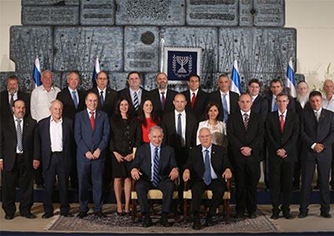
Israel’s 34th government, with President Reuven Rivlin, May 19, 2015. Photo: Avi Ohayon / Government Press Office of Israel; Wikipedia CC BY-SA 3.0
With the establishment of Israel’s new government and in consideration of the multiple challenges facing Israel at different levels of national security, INSS has prepared a set of recommendations designed to help the government navigate the key strategic issues before it. Prepared by members of the INSS research staff, this paper offers a concise review of the leading issues Israel must deal with, as well as the “top 20” policy recommendations to the new government. The recommendations refer to regional, international, and internal levels of Israeli national security policy, and focus primarily on matters that must be attended to immediately on six levels: (1) US-Israel relations; (2) Iranian influence in the Middle East; (3) the Israeli-Palestinian conflict; (4) Israel’s international standing; (5) regional cooperation; and (6) national security infrastructures.

The Institute for National Security Studies (INSS) analyzes issues relating to Israel’s national security. Research conducted at INSS is policy-oriented and intended to serve decision makers in Israel, as well as the general public. With the establishment of the new government and in consideration of the multiple challenges facing Israel at different levels of national security, INSS has prepared a set of recommendations designed to help the government navigate the key strategic issues before it.

Israel’s new government has no grace period. It is already called on to deal with a series of immediate challenges, significant issues, and policy decisions that if not handled within the first months will become far more difficult to solve down the road. The recommendations presented provide a firm base for policy shaping and for responses to the various challenges, with the goal of bolstering Israel's security and stability in the coming years.

This paper offers a concise review of the leading issues Israel must deal with, as well as the “top 20” policy recommendations to the new government formulated by the INSS research staff. The recommendations refer to regional, international, and internal levels of Israeli national security policy and focus primarily on matters that must be attended to immediately as the foundation for future action

A. Healing Israel-US Relatio
The current crisis between Jerusalem and Washington reflects the diverging perspectives of the two administrations regarding the central challenges in the Middle East and how to respond to them. Moreover, how the new government will attend to the bilateral relations has implications for Israel's long term interests, as well as its regional and international standing. Therefore, we recommend adopting the predominant goal of repairing relations and putting them back on track, reaching agreement on joint challenges, and acting in mutually considerate fashion toward the interests of the other side, in order to deal jointly with the common challenges facing the two countries.

1. Jumpstart anew the strategic dialogue between Israel and the US as soon as possible through a joint meeting between Israel's Prime Minister, Defense Minister, and Foreign Minister (if one is appointed) and their American counterparts. If this attempt to renew the fundamental dialogue between the US President and the Israeli Prime Minister proves overly complicated, then leading officials on both sides should be chosen with whom it will be possible to maintain a back channel (for example, Vice President Joe Biden, Secretary of Defense Carter, and figures such as Hillary Clinton and Senator Schumer).

2. Debate the Iranian issue with the most senior levels of the American administration (despite fears Israel might be perceived as coming to terms with the nuclear agreement). This dialogue would presumably pave the way to “compensate” Israel in the form of advanced weapon systems and explicit American commitments regarding the US response to an Iranian breach of the agreement.

3. Draft a list of measures Israel would be prepared to advance in the framework of returning to the political process with the Palestinians:  initiate economic projects in Area C; expand areas for the deployment and activity of Palestinian police in Area B; launch a multinational effort for Gaza reconstruction in exchange for a sustained period of calm; expand water allocation to the Palestinian Authority, and more.

4. Agree with heads of the American administration on a mutual halt to intervention in the internal political processes of both countries.  In addition, consideration should be given to the appointment of a new ambassador to the United States, signaling a “new page” to senior levels in the administration.

B. Curbing Iranian Influence in the Middle East
It appears that the emerging agreement on the nuclear issue between Iran and the world powers cannot be stopped.  Now is the time to focus efforts on establishing an effective supervision-verification mechanism for holding Iran to its commitments to the agreement, and developing a response in the event Iran breaches the agreement. It is essential to achieve regional and international agreement on preventing Iran's abuse of the nuclear agreement (for example, by funneling unfrozen money to terror elements and destabilizing forces across the Middle East, or by threatening that any international pressure exerted on it would constitute a breach of agreement and thus legitimize its surge toward achieving a military nuclear capability). Moreover, it is essential that Israel not be the party accused of torpedoing negotiations should they be halted.

5. Continue operating through secret and reliable diplomatic channels vis-à-vis the P5+1 in order to guarantee an effective supervision-verification mechanism for overseeing implementation of the nuclear agreement. Furthermore, Israel must devise a joint plan of action in cooperation with the US, permanent members of the Security Council, and Western countries in the event of Iran's breach of the agreement.

6. Prevent further establishment of the military infrastructure and terror capabilities of the Iranian axis, i.e., the Quds Force, Hizbollah, and additional proxies in the Golan Heights, southern Lebanon, and the Gaza Strip.  Issue a warning to Iran, through secret channels, against moves in this direction.

7. Prepare both militarily and on the civilian front for the possibility of a flare-up in the north – a military confrontation with Hizbollah, backed by Iran, on the Golan Heights and in Lebanon – subject to developments in Syria.

C. Pursuing a Political Initiative for the Palestinian Arena
We believe that a solution in the form of a permanent arrangement that puts an end to the Israeli-Palestinian conflict and resolves the mutual demands of the parties is not achievable in the near future. However, this political deadlock creates a grave problem for Israel, since it weakens the legitimacy of its political and military actions. For the sake of strengthening Israel's position as a democratic, responsible, and secure state with recognized borders and a Jewish majority that enjoys international recognition as a state of equal standing in the international community, the following is required:

8. Initiate a political plan aimed at advancing the strategic goal of “two states for two peoples.”  This plan would be based on a multilateral and multi-track approach to advance gradually and in a controlled manner. These parallel and complementary tracks, as an alternative to the sole track of a permanent arrangement, include: (a) establishing transitional arrangements for shaping a reality of two states for two peoples, founded on the principle of "what's agreed upon is implemented"; (b) enlisting international and regional assistance for building a basis for a responsible, stable, and functioning Palestinian state in the West Bank; (C) integrating a collaborative, multilateral approach to the political process with regional and international players that can provide guarantees for moving forward in the process and safeguarding Israel's security needs.

9. Promote the idea of reconstructing the Gaza Strip as a further step in the process that has begun, with the aim of formulating understandings with Hamas as to the establishment of a period of sustained calm. Such understandings would include clarifying that Hamas is responsible for preventing all aggressive actions and terror directed against Israel from Gaza. A continuous state of security calm will enable construction of a joint effort – Israeli, Palestinian Authority, Western, and Arab states – to restore the Strip.

10. Prepare – concurrently – for an additional round of escalation with Hamas.  The IDF must present recommendations for a different course of military action than in the previous rounds of the conflict. Such action must enable the long term neutralization, to the degree possible, of terror organizations' motivation to renew warfare against Israel, and prevent Hamas' ability to restore military capabilities over time. At the same time a comprehensive response must be developed to the increasing trend of terror (mainly on the part of lone individuals) in the West Bank, in order to prevent deterioration into a sweeping outbreak of violence in the region.

D. Improving Israel's International Standing and its Relations with the International Community
Israel must formulate a proactive policy in the face of the intensifying diplomatic, public, and legal campaign waged against it in the international arena based on the efforts to delegitimize Israel and impose boycotts, otherwise known as the Boycott, Divestment and Sanction (BDS) movement.

11. Devise and launch an offensive in the diplomatic, legal, economic, and academic arenas, based on comprehensive preparatory staff work at the Ministry of Foreign Affairs and the Ministry of Strategic Affairs. A leading entity must be determined (our recommendation – the National Security Council) to be responsible for synchronizing the various actions of government ministries and public bodies involved in fighting the boycotts and the delegitimization efforts.  In addition, it is necessary to develop an operational concept in the sphere of the new media and social networks to influence world public opinion and neutralize anti-Israel initiatives.

12. Initiate, as soon as possible, a visit by the Prime Minister to EU institutions and major European capitals.  Such a visit must follow the updating of policy for advancing the political process with the Palestinians along with the formulation of an Israeli response to the nuclear agreement with Iran.  Israel must issue clear statements concerning “two states for two peoples” and/or the division between Israel's policy for construction in Jerusalem and the settlements blocs, and the policy for building outside those areas.  Such statements would likely boost international willingness to support an Israeli political initiative for the political process with the Palestinians.

13. Challenge the international community – particularly France, which intends to propose an initiative for an UN Security Council resolution in determining the parameters for solving the Israeli-Palestinian conflict – through an Israeli motion submitted to the Security Council regarding the Israeli-Palestinian conflict. The Israeli draft resolution would express Israel's vital needs, headed by non-violation of its security and citizens, recognition of Israel as the national home of the Jewish people, and recognition of Palestine (once it is established) as the national home of the Palestinian people. In addition, the resolution must express consideration for conditions that have come about in the conflict arena over the past 50 years.

E. Promoting Regional Cooperation
The multi-system shockwaves in the Arab world in recent years have led to the overthrow of five regimes (including in Iraq, where the regime was toppled through American intervention).  Presumably the Assad regime in Syria will likewise not return to the status it enjoyed before the outbreak of the civil war.  Following the change in the regional balance of power, the increased level of security threats to countries in the region, and Iran's increasing involvement in the region, there is an overlap of interests between Israel and the pragmatic Arab states – despite the political deadlock between Israel and the Palestinians. Accordingly:

14. Propose a new Israeli initiative for regional cooperation within the framework of a comprehensive plan founded on the common interests of Israel and the pragmatic Arab states.  Concomitantly, Israel must articulate its willingness to proceed in the political process. The proposal would convey readiness to examine the Saudi Peace Initiative as a framework for regional negotiation with necessary adjustments in light of the new situation in the region in recent years.

15. Give priority to tightened cooperation with Egypt and Jordan in fighting terror and securing the common borders.  Assist (indirectly) in bolstering the stability of the regimes in the two countries via support in the areas of economy, energy, water, and technology.

16. Increase humanitarian support for stricken population groups in Syria and for refugees who have fled the regions of fighting. At the same time identify organizations and players with the potential to fulfill a positive role in shaping a post-Assad Syria and invest resources in creating understandings with those groups while assisting them.

F. Attending to the Economy and National Security Infrastructures
The economy on all levels constitutes a central tier of Israel's national security policy. A stable mechanism is needed for the process of determining the security budget.  Moreover, it is necessary to attend to the issue of energy as a vital Israeli asset and as a resource with strategic implications for its regional status.  A further important aspect of Israel's power is the civilian front and its functional capability in anticipated future clashes with its enemies.

17. A mechanism must be set in place that will regulate the drafting of the security budget between the Finance and Defense Ministries.

18. Establish a ministerial committee to discuss all aspects – economic, legal, and strategic – of the extraction of natural gas and other natural resources. A balance must be struck between competitive gas prices, Israel as a country that honors international commitments, and exports to neighboring countries for the purpose of strengthening strategic ties.

19. Strengthen capabilities for defending vital Israeli infrastructures, with an emphasis on cyber security and defense of the electricity and energy system.

20. Formulate a comprehensive plan for improving the strength of the Israeli civilian front, in advance of possible future confrontations, including severe impact to the home front and to strategic infrastructures. In this framework it is necessary to prepare a plan for evacuating civilians from communities adjacent to the border under immediate risk of being targets of rocket/missile fire or a ground incursion. With that, the time has come to formulate a national plan for dealing with natural disasters and multi-casualty events of a non-military nature.

The opinions expressed in INSS publications are the authors’ alone.
Publication Series Memoranda
TopicsMilitary and Strategic Affairs

Events

All events
Israel’s National Security Conference
27 July, 2026
10:00 - 14:00

Related Publications

All publications
A “Traffic Light” Model for Implementing the Board of Peace Framework in the Gaza Strip: Policy Recommendations for Israel
How can the Board of Peace plan for the future of the Gaza Strip be implemented in a way that does not jeopardize Israel’s security?
26/09/26
YIFAT MAHAL (CC BY 4.0)
Strategic Alert: Jewish Terrorism and Nationalist Crime Are Accelerating the Breakdown of Israel’s State Institutions
Jewish terrorism has evolved from a local enforcement problem into a distinct strategic threat to the State of Israel and its democratic character. The destructive combination of inadequate enforcement, a lack of political backing for the security agencies, and the weakness of the judicial and law enforcement systems is creating a reality marked by lawlessness, non-recognition of state institutions, and the loss of the state’s monopoly on the use of force. The lack of a decisive Israeli response to this phenomenon constitutes evidence that it is a policy directed from above. This reality poses a multidimensional threat to Israel: a security threat—diverting the IDF’s attention and forces toward confronting Jewish terrorism at the expense of defense needs in other arenas, while subjecting the military to ongoing operational strain. In addition, the risk of a violent uprising in Judea and Samaria is growing, alongside the collapse of Palestinian stabilizing mechanisms; a governance and societal threat—weakening law enforcement systems, eroding respect for state-mindedness and allowing violence to seep dangerously into Israeli society in a manner that could paralyze the functioning of the state; and an international threat—Israel’s portrayal as an aggressive, oppressive, and racist state is undermining the legitimacy of its use of force, severely damaging its standing in the region and worldwide, and raising the risk of acute diplomatic isolation. We warn of a threat to Israel’s very ability to govern and function. As history teaches us, democracies that fail to restrain radical forces within them do not survive.
14/09/26
Reuters and GPO (modifies by INSS)
"The New Security Strategy" – Flawed Logic and a Threat to National Security
What does the new security strategy entail, as reflected in statements by Israel’s political leadership and actions on the ground, and why does it pose a threat to Israel's character and national security?
18/08/26

Stay up to date

Registration was successful! Thanks.
  • Research

    • Topics
      • Israel and the Global Powers
      • Israel-United States Relations
      • Glazer Israel-China Policy Center
      • Russia
      • Europe
      • Antisemitism and Delegitimization
      • Iran and the Shi'ite Axis
      • The Campaign Against Iran and the Shiite Axis
      • Iran
      • Lebanon and Hezbollah
      • Syria
      • Yemen and the Houthi Movement
      • Iraq and the Iraqi Shiite Militias
      • Conflict to Agreements
      • Israeli-Palestinian Relations
      • Hamas and the Gaza Strip
      • Peace Agreements and Normalization in the Middle East
      • Saudi Arabia and the Gulf States
      • Turkey
      • Egypt
      • Jordan
      • Israel’s National Security Policy
      • Military and Strategic Affairs
      • Israel's Security Strategy
      • Societal Resilience and the Israeli Society
      • Jewish-Arab Relations in Israel
      • Climate, Infrastructure and Energy
      • Terrorism and Low Intensity Conflict
      • Cross-Arena Research
      • Data Analytics Center
      • Law and National Security
      • Advanced Technologies and National Security
      • Foreign Information Manipulation and Interference
      • Economics and National Security
    • Projects
      • Preventing the Slide into a One-State Reality
      • India-Middle East-Europe Economic Corridor (IMEC)
  • Publications

    • All Publications
    • INSS Insight
    • Policy Research and Papers
    • Special Publication
    • Strategic Assessment
    • Technology Platform
    • Memoranda
    • Database
    • Posts
    • Books
    • Archive
  • About

    • Vision and Mission
    • History
    • Research Disciplines
    • Chairman of the Board
    • Board of Directors
    • Fellowship and Prizes
    • Internships
    • Annual Reports
    • Support
    • Privacy Policy and Terms of Use
  • Media

    • Communications
    • Video Gallery
    • Press Release
    • Podcast
  • Home

  • Events

  • Database

  • Team

  • Contact

  • Newsletter

  • עברית

INSS logo The Institute for National Security Studies, Strategic, Innovative, Policy-Oriented Research, go to the home page
40 Haim Levanon St. Tel Aviv, 6997556 Israel | Tel 03-640-0400 | Fax 03-744-7590 |
Developed by Daat ,Yael Group.
Accessibility Statement
This site is protected by reCAPTCHA and the Google Privacy Policy and Terms of Service apply.