


Publications
How the massive wave of migration from Morocco to the Spanish enclave of Ceuta turned into a multidimensional political crisis—and even an anti-Israel tool
INSS Insight No. 2229, November 29, 2026
Follow us on GoogleOn July 30, thousands of people crossed from Morocco into the Spanish exclave of Ceuta within a matter of hours. The dramatic images of the crossing rapidly spread in global media, strengthening the emotional and political repercussions of the event. As migrants were still crossing the border, commentators hurried to give a political interpretation of their move. The situation in Ceuta also quickly became a point of contention between European countries. Eventually, accusations of Israeli involvement in fabricating the crisis surfaced in social media, transforming the events in Ceuta into components of anti-Israeli campaigns. These different layers of politicization, and even weaponization, are analyzed in this article.
The Events in Ceuta
The massive wave of migrants in Ceuta (Sebta in Arabic) on July 30, 2026 was the consequence of long-term trends, as well as more immediate political and judicial decisions in Spain, whose impact was amplified by social media.
Trends and Immediate Causes
Spain's southern border has become one of the main entry points into Europe for illegal migration. The so-called “Western Mediterranean route” of migration between Africa and Europe reached a peak in 2018 – following stricter control of crossings in the eastern and central Mediterranean – and then declined. The decrease since then was linked among others to greater efforts by the Moroccan government to fight illegal immigration and improve cooperation between Morocco, Spain, and the EU. As a result, the flow of illegal migrants from Morocco dramatically decreased, and Algeria has become the main country of origin of migrants on the Western Mediterranean route. Only ten percent of illegal crossings on this route in 2025 happened in the Spanish exclaves of Ceuta and Melilla. However, attempts to cross the border between Morocco and Spain have continued.
In this context, the immigration policy adopted in April 2026 by the Spanish government led by Socialist Pedro Sánchez has acted as an incentive for people attempting to access a better life in Europe. Madrid has been implementing a large-scale regularization of roughly 500,000 undocumented migrants already inside Spain, a measure justified on demographic and labor-market grounds. This move, however, has sent a broader signal that Spanish migration policy was entering a more permissive phase. Crossing attempts rose steadily through mid-July, though Moroccan forces intercepted the large majority of attempts during this window.
On top of this, a ruling by Spain’s Supreme Court, which was amplified by social media, served as a catalyst. On June 29, the court ruled that migrants intercepted while swimming toward Ceuta or Melilla cannot be summarily rejected at sea and must instead undergo the ordinary deportation process, with its due-process guarantees—identification, access to a lawyer, and screening for asylum and vulnerability. The ruling narrowed a specific administrative procedure; it did not open the border, and it granted no right to remain in Spain.
Within days, however, a broadened version of the ruling spread across Moroccan and Spanish social media, notably in Darija (Moroccan colloquial Arabic), hardening by July 10 into the false claim that simply reaching international waters guaranteed protection. A video from July 28 showing two Moroccan women celebrating their arrival reinforced the belief that the route now worked, drawing more than 32 million views. Analysis by counter-disinformation groups indicates that the mobilization was driven by "peer-to-peer logistics chatter" on social media. Online rumors led many young people to believe the border was "open." Unlike previous incidents, this coordination started organically, emerging from small, individual accounts rather than a single recruiter channel.
The Mass Crossing of July 30
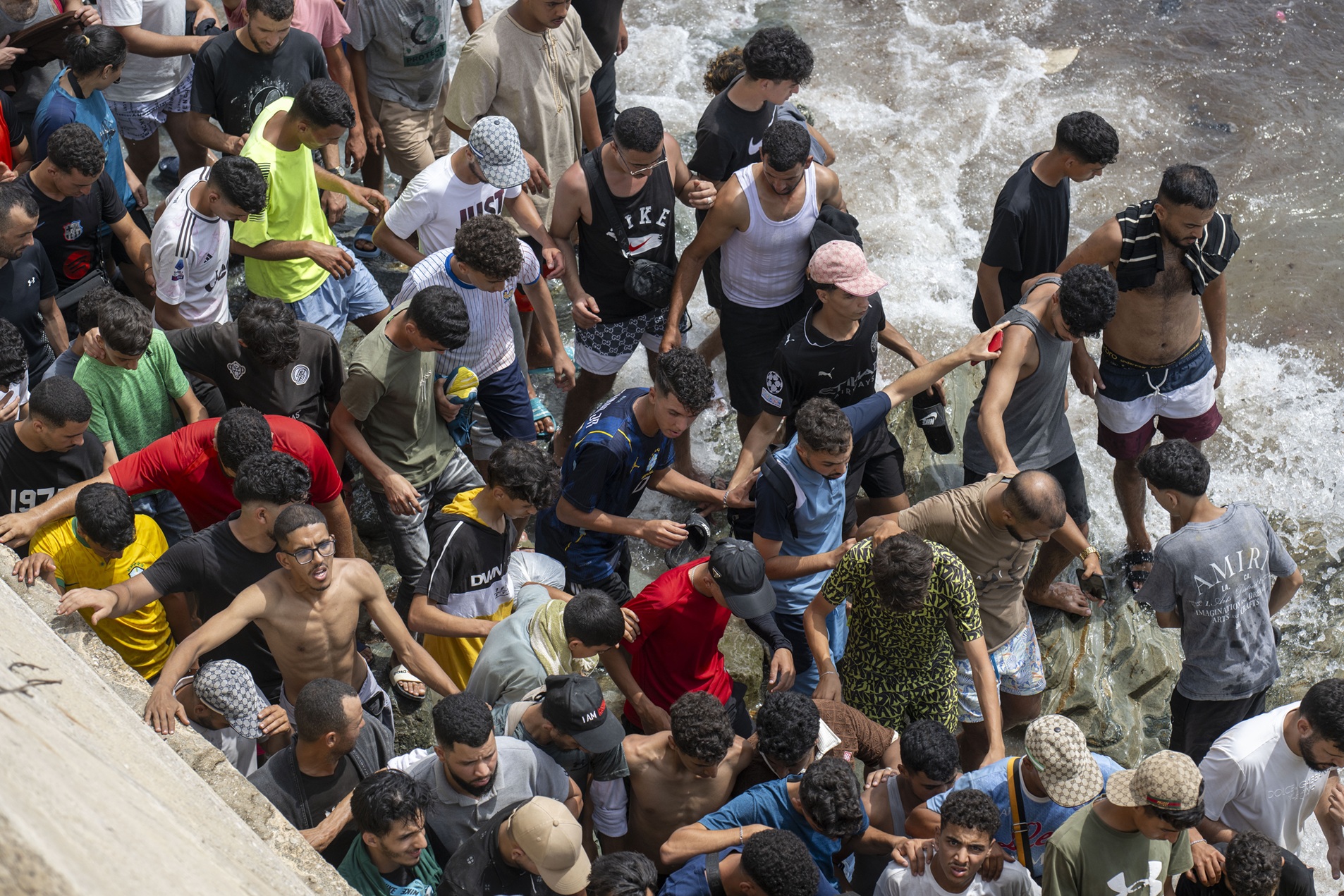
On July 30, shortly after low tide exposed a walkable stretch of the Tarajal breakwater, thousands of people crossed within hours into Ceuta, either by swimming around the fence or clambering over rocks. According to the latest estimate, about 80,000 migrants reached Ceuta on July 30-31. By evening, Moroccan forces had reasserted control over the border, and Spanish authorities claimed that 69,500 people who had crossed were back in Morocco. Meanwhile, as Moroccan authorities strengthened their control of the border, the Spanish government began installing a 500-meter floating barrier in the sea, in order to respond to the legal vacuum created by the June 29 ruling.
The human cost of the event remains disputed and, on both sides, imprecisely tracked. On August 2, Morocco's Interior Ministry issued a single figure, which has not been revised: 11 dead; independent Moroccan sources—the Moroccan Association for Human Rights, local rights observatories, and outlets such as Medias24 and Enass—have cited figures ranging from roughly 60 to 141 dead. Spain's own count changed repeatedly before Ceuta's Institute of Legal Medicine reported 82 completed autopsies on August 7, the most recent and most precisely sourced figure available as of this writing. Neither government has produced a number the other side, or independent observers, fully accepts.
As of November 2026, the situation in Ceuta has not returned to what it was before July 30. Despite the return to Morocco of the majority of migrants who had crossed the border that day, several thousand of them are still in the Spanish exclave. This reality creates an ongoing humanitarian crisis and maintains tensions, while the Spanish authorities still struggle to stabilize the situation.
The Politicization of the Crisis
The humanitarian crisis in Ceuta became immediately politicized. First, domestic opponents of Sánchez presented it as proof that the Spanish government’s migration policy was a failure or used it to criticize the decision of the judiciary. As Spain enters the campaign for the snap elections called by the Prime Minister for November 29, immigration has become a major flashpoint in public debate. While right-wing parties have seized on the issue to attack Sánchez’s left-wing government, it has also fueled tensions between the center-right Popular Party (PP) and the far-right Vox. According to current polls, Vox’s support will be essential to building any viable coalition to replace Sánchez. The continued importance of the Ceuta issue in Spanish public debate, even weeks after the July 30 crisis, was embodied by the Spanish king’s visit to the exclave on October 13, the first visit of a monarch to Ceuta since 2007.
Beyond Spanish domestic politics, the immediate politicization of the crisis also took an international dimension, both in the framework of Moroccan-Spanish relations and as part of the European debate on immigration.
Immigration in Moroccan-Spanish Relations
Both the place and the timing of the Ceuta crisis led various commentators to explain the events through the lens of Moroccan-Spanish relations and their complexity.
Historically, Spain’s presence along the Moroccan coast has been a point of contention between Madrid and Rabat: Spain holds several territories there (Ceuta, Melilla, seven islands and a tied island, the plazas de soberanía), which Madrid regards as Spanish. Rabat regards them as occupied and has never accepted the issue as settled. The dispute resurfaced explicitly on August 12, when Moroccan Justice Minister Abdellatif Ouahbi told Asharq News that Morocco's “historic claims” over the two exclaves Ceuta and Melilla remain “on the table.” Madrid's response was immediate: touring Ceuta the same week, Defense Minister Margarita Robles said the city was “hyper-Spanish,” warning that any aggression against Ceuta or Melilla “is an aggression against Spain as a whole.”
Tensions between Spain and Morocco are also linked to the attempt by Madrid, like other European capitals, to navigate relations between Rabat and Algiers, two regional rivals. An important part of this rivalry is the question of Western Sahara—a former Spanish colony whose sovereignty Morocco claims, and whose independence is sought by the Polisario Front, an Algeria-backed movement that has claimed self-determination there since the 1970s. In recent years, momentum has shifted toward Rabat: the United States, France, Spain, and the United Kingdom now back Morocco’s autonomy plan, and U.N. Security Council Resolution 2797 (October 2025) endorsed it for the first time as the basis for negotiations, dropping any reference to an independence referendum and leaving Algeria further isolated.
Within this move, Spain has long hesitated: Madrid’s 2021 reception of Polisario’s leader on humanitarian grounds strained ties with Rabat, before the 2022 Spanish shift toward Morocco’s autonomy plan restored them. A 2026 rapprochement with Algiers, capped by Sánchez’s visit on July 20, reopened that balancing act, although it was announced in early October that a high-level summit between Spain and Algeria had been postponed sine die.
Within this complex context in Moroccan-Spanish relations, accusations surfaced, notably in Spanish media and opposition circles, against Rabat, claiming that Morocco had played an active role in fabricating the crisis in Ceuta, and had used the migration issue as a political tool against Spain. The accusation is not new and had also emerged in 2021, following a similar yet smaller crisis in the exclave that coincided with a deterioration of Moroccan-Spanish relations.
While Rabat dismissed the accusations as unfounded, the Spanish government also strikingly attempted to downplay the potential role of Moroccan authorities in the events in Ceuta. This line has not been unanimously adopted. The Spanish press has echoed statements by former leaders and current politicians, including Ceuta’s president, pointing to a direct Moroccan responsibility in the events. It has also published an alleged report of the Spanish security services blaming Rabat for the crisis. Madrid’s own government did not change position after the leak, with Sánchez telling Congress on September 3 that no evidence had been provided to his government of Moroccan design or execution. At the European level, some circles affiliated with the right have called for sanctions against Morocco regardless.
While it is complicated to assess the specific role of Moroccan authorities on July 30, the debate surrounding Morocco’s involvement and the possible use of migrants as a political tool, in the context of a complex intertwining of relations between Madrid, Rabat, and Algiers, underlines the delicacy of the links between Europe and the Maghreb. European countries have to navigate between Morocco and Algeria—both major sources of immigration that also wield strategic leverage through assets that have become increasingly critical to Europe in the current international environment: Algeria’s oil and gas reserves, and Morocco’s natural resources and deep integration into international networks.
European countries must also take into account the high tensions between the two countries, which see their relations with Europe as a zero-sum game. Finding the point of balance that will make Europe benefit from each country’s strength without alienating the other requires fine tuning whose failure means dramatic potential consequences. More generally, the Ceuta crisis is another illustration of the way migration affects balances of power between European countries and their neighbors, as it did in earlier events (in Libya, Tunisia, or Turkey, for example).
European Politics
The Ceuta crisis also echoed broader European politics and intra-EU tensions and thus quickly became an issue of European political debate. Although the exclave of Ceuta has a specific status, Spain is part of the Schengen Area, which aims to abolish border controls among 29 European countries.
The management of the area has been a point of debate between European countries as immigration has become an issue of European politics in recent decades, particularly following the 2015 refugee crisis. Key points of friction between Schengen Area countries have been the responsibilities of South European countries forming the border between the area and the origins of migration flows; the solidarity of other countries towards the border states; and the means of common actions against illegal immigration. To manage these frictions, in June 2026, following a long legislative process, the EU Pact on Migration and Asylum went into effect, to give the Union better tools to deal with the issue.
Among these discussions, Sánchez’s decision to massively regularize illegal immigrants had already raised criticism among his European partners, especially from the governments led by the right, who saw it as an uncoordinated move. The Ceuta crisis further increased tensions between European countries. While Madrid made numerous calls for European solidarity in dealing with the migrant flow, the majority of European leaders expressed reservations, if not open hostility towards the Spanish government and its handling of the crisis.
Among those leaders, Italian Prime Minister Giorgia Meloni was the most virulent. She led joint initiatives against Madrid and even reintroduced border control on arrivals from Spain. Sánchez reciprocated the move and both leaders attacked each other verbally. This Spanish-Italian feud is the result of various dynamics: both governments, at the front line of the immigration crisis, have adopted radically different policies to deal with the issue. Sánchez adopted a more permissive approach while Meloni, one of the leaders of the European radical right, defended a firmer approach. With both leaders facing contested elections, Sánchez in November and Meloni in 2027, the crisis in Ceuta gave each of them the opportunity to promote their vision against the other’s, and to score domestic political gains. After weeks of feuding, the two heads of government finally agreed to end the punitive measures against each other’s countries at the end of October.
Between these two visions, the majority of European leaders sided with Italy. Criticism over Madrid’s migration policy, pointing at it as one of the direct causes for the crisis, rose from numerous European governments and some of them even supported the idea of suspending Spain from the Schengen Area. Notably, 22 heads of government joined a statement initiated by Italy and Denmark presenting the Spanish government as having created a “pull factor” for migrants with its regularization policy. France and Germany did not sign the statement, preferring to put a greater emphasis on European solidarity, although France reintroduced border controls with Spain. The European Parliament, where right-wing parties have a majority, passed a motion at the renewal of debates in September also using the expressions “pull factor” and “wrong signal” to explicitly point at Spanish responsibility.
As a whole, numerous commentators have presented the Ceuta crisis as a failed test for European crisis management. Despite some general statements, and some limited actual support on the ground, the events in Ceuta have above all shown the limits of European solidarity. They exacerbated internal European tensions driven by leaders, some of them in the midst of election campaigns, who sought to leverage the crisis over one of Europe’s most sensitive issues.
Hybrid Warfare and Accusations Against Israel
Among the heated European debates on the situation in Ceuta, one of the general points of agreement has been to describe the crisis in the exclave as part of “hybrid warfare.” The use of the term fits the current geopolitical atmosphere in Europe, characterized by the rise of the Russian threat on the continent, and the growing number of incidents in Poland, the Baltic countries, the North Sea, as well as hybrid attacks on other countries, above all Germany. In this context, the weaponization of immigration is not an idea disconnected from reality, since Belarus did try to create a flow of migrants from the Middle East to the European Union through its own territory.
If there is a consensus in framing the events in Ceuta as an act of hybrid warfare, the power standing behind these hostile activities remains an issue of debate in Europe. While some have accused Morocco (see above), others have pointed to different suspects. Among those, two main hypotheses have been put forward. The first pointed at the role of Russian or Russia-linked actors in the crisis, as part of the more general tensions between Moscow and the EU.
The second accused Israel, at times in cooperation with the Trump administration, of standing behind the rise in illegal crossings into Ceuta—a narrative that gained traction after Israeli U.N. Ambassador Danny Danon’s tweet calling Ceuta and Melilla “colonial enclaves in Africa.” According to these accusations, based on the strengthening relations between Morocco, Israel, and the U.S., the Israeli government created the Ceuta crisis to punish Sánchez for being one of the most anti-Israeli European leaders. Some of these accusations claimed that Israel did so with the support of Washington, where the attitude of the Spanish government towards the U.S. and NATO is perceived negatively. The role of Morocco in these accusations varies, from being a victim of Israeli disruptions, like Spain, to being complicit with Israel against Madrid.
These accusations against Israel, bordering conspiracy theories, have first appeared on social networks. A report by the Antisemitism Research Centre (ARC) of the Combat Antisemitism Movement (CAM) provides a quantitative look at how social media platforms functioned as "engines of demonization" of Israel during the emergency in Ceuta, with four main characteristics:
- Quantitative Reach: 173 high-impact posts from 119 influencers reached 103.1 million people within 72 hours.
- Amplification Machinery: A 7:1 share-to-comment ratio indicates that audiences were focused on amplification rather than critical inquiry. X’s recommendation engine treated the overlap between different extremist groups as an "engagement signal."
- Ideological Convergence: The report documented a convergence of far-right ("Great Replacement"/Kalergi Plan), far-left ("anti-imperialist"/Western objectives), and Islamist ("Zionist puppet") narratives.
- Fabrications: High-impact "fakes" included the fabrication of a Netanyahu threat and a completely fabricated quote attributed to actor Javier Bardem, which was subsequently amplified by social media personality Mia Khalifa without a source.
Anti-Israeli accusations were also made by European commentators and politicians. Spanish officials have, as a general line, reconciled their downplaying of Moroccan responsibility with an emphasis on interference attempts by foreign elements trying to divide the EU or attack Spain. Among them, the most significant was the statement made by Sánchez himself in an interview on August 31. Sánchez alleged that "Russia- and Israel-linked networks" were weaponizing migration to attack Spain’s "territorial integrity." He framed the influx as a punitive measure against Madrid’s recognition of a Palestinian state in May 2024 and its vocal support for Ukraine. Israeli Foreign Minister Gideon Sa'ar responded by characterizing the claims as a "brazen lie" and "defamatory," arguing that Sánchez was attempting to distract from the "disgraceful failure" of Spanish domestic border enforcement. This exchange escalated bilateral tensions.
Regarding the role of Russia in the Ceuta crisis, most analysts now agree that Moscow did not play a direct role in creating the flow of migrants to the Spanish exclave. However, once the crisis unfolded, Russia used its "privileged superhighway" of disinformation to amplify far-right and Islamophobic narratives on social media in seven languages and to exacerbate the internal European divide over the incident. This "machinery" ensured that nationalist groups were mobilized to Ceuta’s squares significantly faster than in the May 2021 crisis. This amplification further strained relations between Spain and its neighbors, while reinforcing the perception that the EU’s efforts to address immigration had failed.
As for Israel’s involvement, no fact supports Sánchez’s accusations. Admittedly, some Israeli analysts and officials did not hide a certain Schadenfreude in seeing the loss of control by the unfriendly Spanish government over its territory or its isolation in Europe. Similarly, on August 6, the U.S. State Department publicly blamed Madrid for the crisis, calling it a consequence of Spain's “shameful refusal to defend their sovereignty.”
Some Israeli representatives also adopted an anti-colonial discourse, both to side with Morocco and to attack Spain—as Israeli Ambassador to the U.N. Danny Danon did in his aforementioned tweet. These comments were immediately seized upon by Spanish officials to frame Israeli political sentiment as proof of state complicity. However, there is no proof that Israel went beyond these comments on the situation, either to create the crisis or to inflate it. Israel’s envoy in Madrid, Dana Erlich, publicly disavowed Danon’s remark, stating it did not represent the position of the State of Israel.
Therefore, the weaponization of the Ceuta crisis continued even after the situation in the exclave was brought back under relative control. On the one hand, pro-Russian elements tried to inflate the debate on immigration ignited by the events in Ceuta to widen European divisions. On the other hand, elements in Europe and the Spanish government used the fear of hybrid warfare, at a time when Madrid was under harsh criticism, to deflect blame and attack Israel, despite little proof to support this accusation.
Conclusion and Policy Recommendations
The events in Ceuta reflect the delicate situation of Europe.
The scale of the crossing and the confusion that followed illustrate several overlapping dynamics: a legal ruling whose narrow scope was lost while it spread on social media, a Spanish migration policy environment already primed by a permissive regularization decree, and a Morocco-Spain relationship whose long-standing frictions made the crisis harder to manage once it began (and possibly made Moroccan authorities more lenient for a while).
The event occurred at the crossroads of various political and international trends in Europe: divisions within the EU; a heated debate on immigration as several countries enter an election period; the EU’s delicate relations with its southern neighbors; the intensifying conflict with Russia; and complex relations with Israel and the U.S. This overlap of events transformed what was already a large-scale humanitarian crisis into a political failure for European governments. This failure has highlighted the level of division and has been used by Russia and other hostile external actors.
There is a lot Israel can learn from the still-ongoing crisis. First, it illustrated the impact of social media—from the organic distortion of the Spanish ruling on Moroccan social media to the a-posteriori inflation of European divisions by Russian elements. It was a clear example of a Foreign Information Manipulation and Interference (FIMI) operation, which has played a key role in shaping the events and their repercussions. More broadly, the Ceuta incidents and their repercussions in European public debates underline the importance of hybrid warfare, and the various forms it can take.
Beyond the reality of hybrid warfare itself, the accusations leveled against Israel on European social media and within Spanish official discourse also illustrate how the very fear of hybrid attacks can be politicized and weaponized by European leaders and opinion-makers, in this case to deflect responsibility or direct blame towards Israel. Conspiracy theories implying Israeli involvement in the crisis appeared quickly, were inflated by politicians, and artificially involved Israel in a crisis it was not part of. While official accusations need to be officially rebutted, Israeli efforts should also focus on fighting these kinds of accusations on social networks, to avoid being a collateral victim of European crises and Russia’s FIMI operations. That said, the expression of joy at Spain’s situation or the open attacks on Madrid during the crisis proved counterproductive. At a time when the Spanish government was domestically weakened and internationally isolated, Israeli comments only served Madrid, which used them to frame the crisis as an Israeli operation.