De-Hamasification of the Gaza Strip: Learning from Western and Arab Models of Deradicalization | INSS
go to header go to content go to footer go to search
INSS logo The Institute for National Security Studies, Strategic, Innovative, Policy-Oriented Research, go to the home page
INSS
Tel Aviv University logo - beyond an external website, opens on a new page
  • Campus
  • Contact
  • עברית
  • Support Us
  • Research
    • Topics
      • Israel and the Global Powers
        • Israel-United States Relations
        • Glazer Israel-China Policy Center
        • Russia
        • Europe
        • Antisemitism and Delegitimization
      • Iran and the Shi'ite Axis
        • Iran
        • Lebanon and Hezbollah
        • Syria
        • Yemen and the Houthi Movement
        • Iraq and the Iraqi Shiite Militias
      • Conflict to Agreements
        • Israeli-Palestinian Relations
        • Hamas and the Gaza Strip
        • Peace Agreements and Normalization in the Middle East
        • Saudi Arabia and the Gulf States
        • Turkey
        • Egypt
        • Jordan
      • Israel’s National Security Policy
        • Military and Strategic Affairs
        • Societal Resilience and the Israeli Society
        • Jewish-Arab Relations in Israel
        • Climate, Infrastructure and Energy
        • Terrorism and Low Intensity Conflict
      • Cross-Arena Research
        • Data Analytics Center
        • Law and National Security
        • Advanced Technologies and National Security
        • Foreign Information Manipulation and Interference
        • Economics and National Security
    • Projects
      • Preventing the Slide into a One-State Reality
  • Publications
    • -
      • All Publications
      • INSS Insight
      • Policy Papers
      • Special Publication
      • Strategic Assessment
      • Technology Platform
      • Memoranda
      • Posts
      • Books
      • Archive
  • Database
    • Surveys
    • Spotlight
    • Maps
    • Dashboards
  • Events
  • Team
  • About
    • Vision and Mission
    • History
    • Research Disciplines
    • Chairman of the Board
    • Board of Directors
    • Fellowship and Prizes
    • Internships
  • Media
    • Communications
    • Video gallery
    • Press Releases
  • Podcast
  • Newsletter
  • Campus
Search in site
  • Research
    • Topics
    • Israel and the Global Powers
    • Israel-United States Relations
    • Glazer Israel-China Policy Center
    • Russia
    • Europe
    • Antisemitism and Delegitimization
    • Iran and the Shi'ite Axis
    • Iran
    • Lebanon and Hezbollah
    • Syria
    • Yemen and the Houthi Movement
    • Iraq and the Iraqi Shiite Militias
    • Conflict to Agreements
    • Israeli-Palestinian Relations
    • Hamas and the Gaza Strip
    • Peace Agreements and Normalization in the Middle East
    • Saudi Arabia and the Gulf States
    • Turkey
    • Egypt
    • Jordan
    • Israel’s National Security Policy
    • Military and Strategic Affairs
    • Societal Resilience and the Israeli Society
    • Jewish-Arab Relations in Israel
    • Climate, Infrastructure and Energy
    • Terrorism and Low Intensity Conflict
    • Cross-Arena Research
    • Data Analytics Center
    • Law and National Security
    • Advanced Technologies and National Security
    • Foreign Information Manipulation and Interference
    • Economics and National Security
    • Projects
    • Preventing the Slide into a One-State Reality
  • Publications
    • All Publications
    • INSS Insight
    • Policy Papers
    • Special Publication
    • Strategic Assessment
    • Technology Platform
    • Memoranda
    • Posts
    • Books
    • Archive
  • Database
    • Surveys
    • Spotlight
    • Maps
    • Dashboards
  • Events
  • Team
  • About
    • Vision and Mission
    • History
    • Research Disciplines
    • Chairman of the Board
    • Board of Directors
    • Fellowship and Prizes
    • Internships
    • Privacy Policy and Terms of Use
  • Media
    • Communications
    • Video gallery
    • Press Releases
  • Podcast
  • Newsletter
  • Campus
  • Contact
  • עברית
  • Support Us
bool(false)

Publications

Home Publications Memoranda De-Hamasification of the Gaza Strip: Learning from Western and Arab Models of Deradicalization

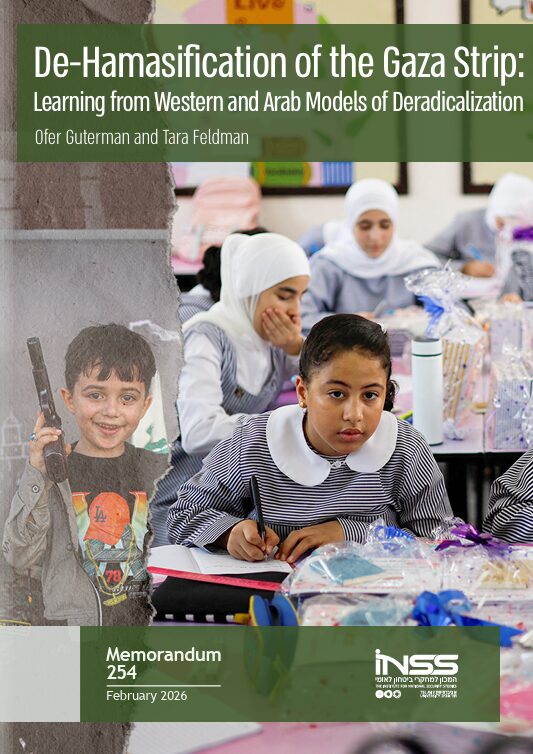
De-Hamasification of the Gaza Strip: Learning from Western and Arab Models of Deradicalization

Memorandum 254, February 2026

עברית
Ofer Guterman
Tara Feldman

The radicalization of Palestinian society in the Gaza Strip is not a new phenomenon, but the process has accelerated and deepened dramatically since Hamas’ takeover of the territory in 2007. Under its rule, an extremist religious-nationalist ideology has been systematically embedded across all spheres of Gaza life—from education and religious institutions to welfare and the media—producing a profound “Hamasification” of public consciousness.


The war that erupted on October 7 brought unprecedented ruin to the Gaza Strip, both physically and institutionally, posing a monumental reconstruction challenge, but also a rare historic opportunity. This memorandum argues that military disarmament and physical rehabilitation alone will not ensure long-term security and stability, and that a far deeper process of “de-Hamasifcation” is required: dismantling Hamas’ ideological and institutional hegemony and replacing it with a more moderate civic and normative infrastructure.


The study presents a comparative analysis of Western and Arab deradicalization models and finds that Western approaches—such as those implemented in Germany and Japan—struggle to provide an adequate response to Gaza’s cultural and political context. Instead, we propose adopting operational principles drawn from contemporary Arab models, particularly the “civic-transformative” model applied in the Gulf states, which combines a firm crackdown on extremist actors with re-education toward religious tolerance and broad-based economic rehabilitation.


The paper outlines an integrative strategy encompassing sustained security demilitarization, the mobilization of an Arab coalition to provide religious and political legitimacy, and the establishment of a credible political horizon as a counterweight to the ethos of “resistance.” Only the combination of these elements can generate a viable governing and ideological alternative to Hamas and lead to a more stable long-term security environment for the State of Israel.


Click here to download the full Memorandum

Table of Contents:

The radicalization of Palestinian society in the Gaza Strip has been driven by decades of collective trauma, which since the mid-twentieth century have created the conditions for the rise of extremist nationalist and religious ideologies. Hamas, under the leadership of Sheikh Ahmed Yassin, began shaping public consciousness in the Strip toward its ideological doctrine already in its earlier incarnation as a social movement rooted in the Muslim Brotherhood (within the framework of al-Mujama‘ al-Islami). This process accelerated from the First Intifada onward and following the establishment of Hamas as an organized movement...
Read more

The Gaza Strip has today emerged—more than ever—as one of the world’s most complex arenas with respect to the political and religious radicalization of its population. This radicalization has been shaped over decades of conflict with Israel, collective trauma, and a reality of external occupation and internal rivalries—from the 1950s, through decades of Israeli control over Gaza, and culminating in further intensification since Hamas’ takeover of the Strip in 2007. Together, these dynamics have produced an extremist religiousnationalist environment that permeates all spheres of life and profoundly shapes public consciousness in Gaza...
Read more

Radicalization is a process of “gradual change in beliefs, feelings, and behaviors that justify intergroup violence and demand sacrifice in defense of the ingroup” (McCauley & Moskalenko, 2008). While “radicalism” can be understood more broadly as support for profound social change of any kind, radicalization in the sense of extremism is inherently defined as anti-democratic and antipluralist (Schmid, 2013)....
Read more

Radicalization in Gaza predates Hamas’ takeover in 2007, with roots reaching back to the mid-twentieth century and decades marked by national trauma, accumulating grievances, political exclusion, economic decline, and recurring cycles of violent confrontation. The harsh realities of life in the Gaza Strip, of course, are also embedded within the broader framework of the Palestinian national struggle and the Muslim Brotherhood’s vision of reshaping the region under religious rule...
Read more

The literature offers varying definitions of deradicalization. Schmid (2013) defines it as “an ideological distancing from violent extremism, involving a cognitive and emotional disengagement from beliefs that justify violence.” Demant et al. (2008) describe it as “the cessation of violent behavior accompanied by a renewed commitment to democratic values and social integration.” Rabasa et al. (2010) view it as “a process of abandoning extremist worldviews and accepting gradual change within a pluralistic framework...
Read more

This chapter reviews five case studies that recur as the principal historical examples of deradicalization processes in the modern era: Germany, Japan, Iraq, Afghanistan, and Bosnia. These cases—and the lessons derived from them—have underpinned many of the proposals advanced for the “day after” in the Gaza Strip, formulated in the period immediately following October 7. In all of these cases, deradicalization processes were constructed around externally driven ideological change led by outside actors (the occupying powers) and included extensive institutional reform and security stabilization. Collectively, these cases exemplify a Western model of deradicalization, in the sense that the states that designed and implemented them were Western (most notably the United States)....
Read more

Against the backdrop of escalating jihadist violence across the Arab world in the early 2000s—including major attacks in Saudi Arabia, Morocco, Egypt, Jordan, and Tunisia—regimes in the region implemented a range of deradicalization strategies aimed at suppressing violent extremism and reshaping the ideological space in which it had flourished...
Read more

The Gaza Strip constitutes an arena of deep and extensive radicalization that has developed over several decades, driven by underlying structural push factors, and has undergone a further significant intensification of radicalization processes under Hamas rule. Deradicalization in the Gaza Strip should not be conceived as an effort to “restore the status quo ante,” but rather as an objective of comprehensive institutional and cultural reengineering of the entire sphere of life in this area. This must be considered alongside the catastrophic condition of the Strip following the war: an unprecedented number of fatalities, near-total destruction of infrastructure, mass displacement, and pervasive collective trauma....
Read more
The opinions expressed in INSS publications are the authors’ alone.
Publication Series Memoranda
TopicsHamas and the Gaza StripIsraeli-Palestinian RelationsSwords of Iron War
עברית

Events

All events
Iraq – What Looms Ahead?
20 January, 2026
12:00 - 13:00

Related Publications

All publications
REUTERS / Jonathan Ernst
Trump’s Board of Peace: An Initiative for the Gaza Strip or an Alternative to the UN?
What is the mission of the international board established by the US president as part of his plan to end the war in the Gaza Strip—and what are the implications of Trump’s move?
04/02/26
From Jihad to Justice: Hamas’s Outreach to the International Arena
Rebranding as “freedom fighters,” shifting responsibility and blame, and appropriating the language of international law: examining Hamas’s appeal to the Western world through war-summary document
02/02/26
Harun Ozalp / Anadolu via REUTERS
The Transition to Phase II in the Gaza Strip—An Unprecedented Challenge for Israel
What challenges and concerns have arisen—both in Jerusalem and in Ramallah—following the announcement of the transition to the second phase of the Trump plan for stabilizing the Gaza Strip, and how should Israel act?
27/01/26

Stay up to date

Registration was successful! Thanks.
  • Research

    • Topics
      • Israel and the Global Powers
      • Israel-United States Relations
      • Glazer Israel-China Policy Center
      • Russia
      • Europe
      • Antisemitism and Delegitimization
      • Iran and the Shi'ite Axis
      • Iran
      • Lebanon and Hezbollah
      • Syria
      • Yemen and the Houthi Movement
      • Iraq and the Iraqi Shiite Militias
      • Conflict to Agreements
      • Israeli-Palestinian Relations
      • Hamas and the Gaza Strip
      • Peace Agreements and Normalization in the Middle East
      • Saudi Arabia and the Gulf States
      • Turkey
      • Egypt
      • Jordan
      • Israel’s National Security Policy
      • Military and Strategic Affairs
      • Societal Resilience and the Israeli Society
      • Jewish-Arab Relations in Israel
      • Climate, Infrastructure and Energy
      • Terrorism and Low Intensity Conflict
      • Cross-Arena Research
      • Data Analytics Center
      • Law and National Security
      • Advanced Technologies and National Security
      • Foreign Information Manipulation and Interference
      • Economics and National Security
    • Projects
      • Preventing the Slide into a One-State Reality
  • Publications

    • All Publications
    • INSS Insight
    • Policy Papers
    • Special Publication
    • Strategic Assessment
    • Technology Platform
    • Memoranda
    • Database
    • Posts
    • Books
    • Archive
  • About

    • Vision and Mission
    • History
    • Research Disciplines
    • Chairman of the Board
    • Board of Directors
    • Fellowship and Prizes
    • Internships
    • Support
    • Privacy Policy and Terms of Use
  • Media

    • Communications
    • Video Gallery
    • Press Release
    • Podcast
  • Home

  • Events

  • Database

  • Team

  • Contact

  • Newsletter

  • עברית

INSS logo The Institute for National Security Studies, Strategic, Innovative, Policy-Oriented Research, go to the home page
40 Haim Levanon St. Tel Aviv, 6997556 Israel | Tel: 03-640-0400 | Fax: 03-744-7590 | Email: info@inss.org.il
Developed by Daat ,Yael Group.
Accessibility Statement
This site is protected by reCAPTCHA and the Google Privacy Policy and Terms of Service apply.
No audio version available for this podcast