


Publications
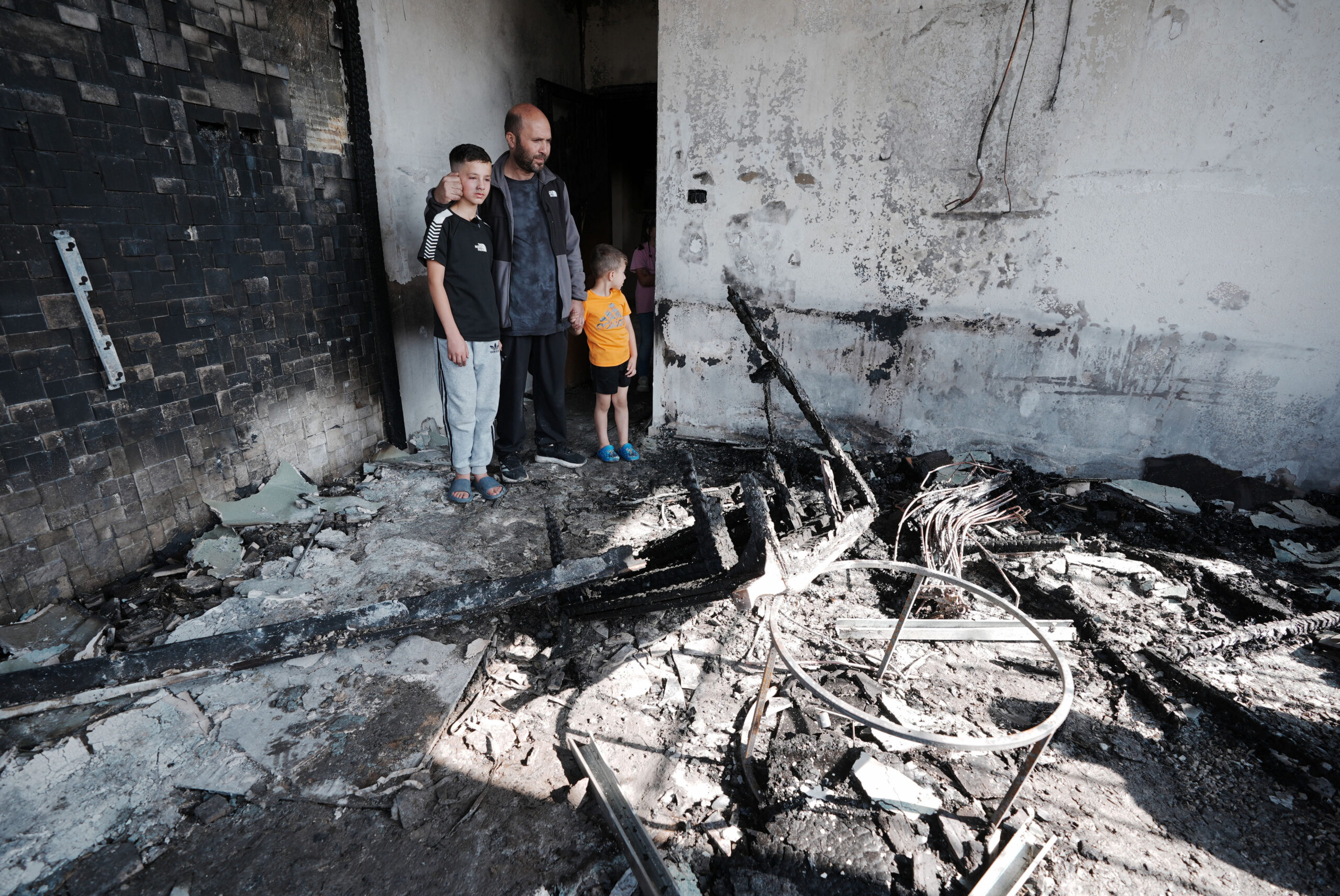
According to recent reports, over the past year there has been a significant increase in both the scope and severity of nationalist violence perpetrated by Jews against Palestinians. Nevertheless, the government has chosen not to confront the phenomenon decisively, despite its potential to lead to serious escalation
INSS Insight No. 2088, January 22, 2026
Follow us on GoogleThe scope of Jewish terrorism against Palestinians living in Judea and Samaria has evolved from marginal, localized incidents into a widespread phenomenon occurring within the broader struggle for control of the area and a growing effort to uproot the Palestinian presence, primarily from Area C. The number and scale of violent attacks have increased in recent years, with greater intensity since October 7, 2023. Despite this, the Israeli government and the security establishment—including the Judea and Samaria District of the Israel Police—have not mobilized decisively to confront and suppress the phenomenon, while the Israeli public appears largely indifferent to acts of Jewish violence against Palestinians in Judea and Samaria. Given the expansion of the phenomenon to its current dimensions and the danger that it could lead to greater violence and terrorism on both sides—including an escalation in security as well as further erosion of Israel’s international standing—a multi-system response led by the Israeli government is necessary, involving security, law enforcement, education, and welfare authorities.
Scope of the Phenomenon and Recent Trends
Data from various sources indicate a sharp escalation in the scope of Jewish terrorism against Palestinians in Judea and Samaria (see Figure 1). A recent report by the IDF’s Central Command points to an increase of approximately 27% in nationalist crime in 2025 (around 870 incidents), alongside a worsening in the nature of the violence—120 incidents were classified as severe, compared to 83 in 2024. Data from the UN Office for the Coordination of Humanitarian Affairs (OCHA) present an even bleaker picture: In 2024, approximately 1,420 attacks against Palestinians were documented—an increase of 16% compared to 2023 and the highest level since documentation began in 2006. These incidents resulted in the deaths of five Palestinians, injuries to approximately 350, and the displacement of more than 300 Palestinian families (around 1,700 people) from their homes. This trend continued in 2025: The record set in 2024 was surpassed, with more than 1,770 attacks recorded. The data show that violence by Jewish extremists is not merely a “price-tag” retaliation in response to attacks by Palestinians. For example, in the first quarter of 2025, attacks against Palestinians surged by approximately 30% compared to the same period the previous year, even though during that time the number of Palestinian terrorist attacks declined by about 44%.
At the same time, some Israeli sources dispute the reliability of these figures, claiming that the reports are biased and “inflate” the number of incidents. A 2025 report by the organization Regavim argued that approximately 98% of the incidents classified by the UN as “settler violence” are not initiated Jewish attacks but rather confrontations with Palestinians in which settlers or IDF forces were involved.
Note on data limitations: There is an inherent difficulty in producing a unified picture of this phenomenon (see Figure 1), stemming from substantial gaps among the different sources regarding the definitions of “extremist violence” and “Jewish terrorism.” Palestinian and international bodies tend to over-report and include a broad spectrum of incidents under the definition of “violence.” Official Israeli data suffers from under-reporting, due both to the low number of complaints filed with the police by Palestinian victims and to stringent classification definitions (separating “terrorism,” “nationalist crime,” and “violence”). Nevertheless, even official IDF data paints a troubling picture. Israeli security officials agree that the phenomenon is real and worsening, and given the escalation trend, an inter-agency task force (IDF, Israel Police, and Israel Security Agency [Shin Bet]) was established last May to thwart and investigate those involved in this violence.
Figure 1.

Patterns of Violence and Entrenchment on the Ground
Most incidents of Jewish terrorism occur in northern Samaria (the Nablus and Jenin districts, and the northern and central Jordan Valley) and in the South Hebron Hills (see Figure 2). “Hilltop Youth”—gangs of extremist young people—raid Palestinian villages, sowing destruction and fear. Attacks include stone-throwing and physical assaults on farmers, arson of fields, uprooting of olive trees, burning of homes and vehicles, and at times shooting live fire. Many of the attacks are “price-tag” actions—revenge following an attack by Palestinians—such as the raid carried out in Huwara in February 2023, when hundreds of Jewish extremists set fire to dozens of homes and cars and murdered a Palestinian, or following Hamas’s murderous attack on October 7, 2023, after which more than 400 attacks by Jews were documented within three months—an unprecedented scale (see Figure 3). However, violence in the area also continues without a specific trigger, with the aim of making the Palestinian presence on the ground untenable and bringing about displacement and migration, primarily of those living in Area C.
Figure 2.
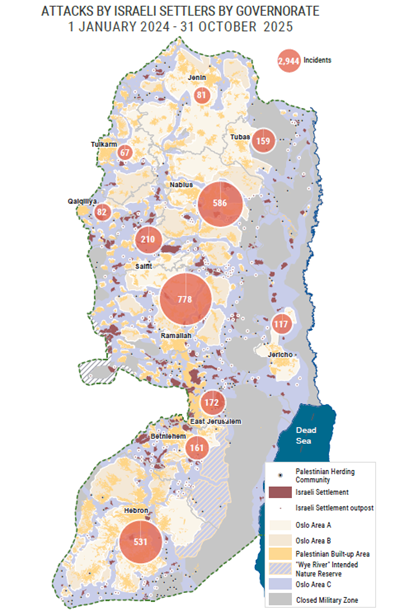
Note. From OCHA, “West Bank Monthly Snapshot: Casualties, Property Damage and Displacement” October 31, 2025.
Figure 3.
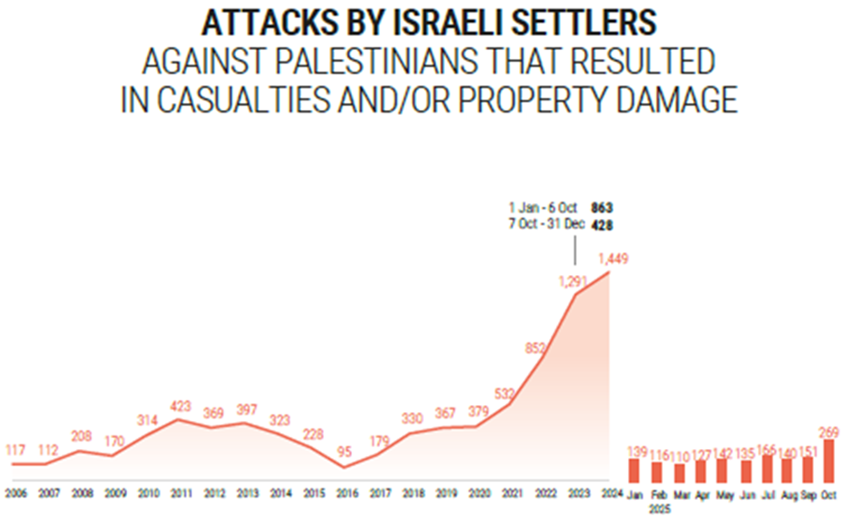
Note. From OCHA, “West Bank Monthly Snapshot: Casualties, Property Damage and Displacement” October 31, 2025.
Seizure Through Farms and Illegal Outposts
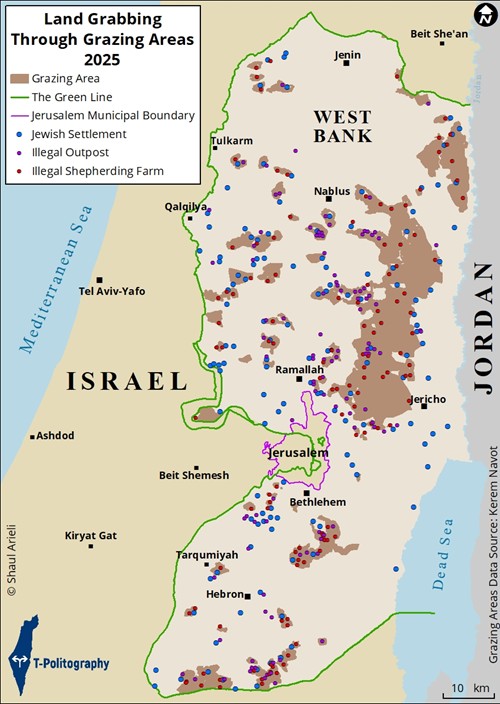
A prominent trend in recent years, constituting a complementary phenomenon, is the seizure of land by establishing illegal agricultural or shepherding farms and outposts on Palestinian grazing and agricultural lands (see Figure 4). A 2025 report by Peace Now estimated that settlers have seized approximately 14% of the total area of the West Bank through farms and outposts—a figure reflecting a shift in the balance of territorial control. This phenomenon enjoys ideological and political support from parties within the settlement movement, the government, and even the security establishment, as part of the struggle over control of Area C and an effort to create irreversible facts on the ground.[1]
Figure 4.
The current government provides broad backing for the expansion of outposts and farms: granting retroactive approvals to legalize outposts as recognized communities, funding them, and even promoting the proactive establishment of new farms. The Ministry of Settlement and National Missions allocated more than NIS 100 million to support farms, including security measures coordinated with the IDF’s Central Command and their integration into regional defense frameworks.
Social characteristics and links to terrorism: Many of the young people who perpetrate Jewish terrorism operate from isolated farms and outposts. The farms often attract “Hilltop Youth”—young men on the margins of society who have dropped out of normative frameworks—who live in small communes under extremist leadership. Some are children of settler families and receive covert support from their communities, which struggle to restrain them. They are also motivated by extremist elements in Israeli politics, who express sympathy for the “wonderful youth who strayed out of anger.” By contrast, some outposts have been created around core groups of ideological settlement and include families, yeshivas, or educational institutions, seeking to establish full-fledged communities.
Although farms and outposts constitute a minority within the settlement enterprise, their activity generates severe daily friction with the Palestinian population. A study based on documentation by the organization Yesh Din found that most violent incidents (63%) over the past decade occurred in proximity to illegal outposts. Of these, approximately 46.5% were physical attacks on Palestinians, and about 44.6% involved property damage, alongside cases of land confiscation. Some new outposts have been deliberately established in the heart of Palestinian areas to instill fear and cause residents to leave. For example, Palestinian shepherds in the Jordan Valley have testified that new outposts, encouraged by regional councils and even assisted by soldiers, are part of a campaign of harassment designed to force Palestinians to abandon their lands. Harassment has included sabotage of water sources, reduction of grazing areas, and violent “home visits” by Jewish extremists who damage property.
Extremist Ideology
The hard core of this group—several hundred young people—holds a radical theocratic worldview that rejects the authority of the state. For them, Jewish sovereignty in the land of Israel is a divine command that cannot be limited, and any relinquishment of territory by the government or the IDF constitutes a betrayal of that command. Some even refer to the Israeli government as a “hostile Zionist regime.” This ideology, fueled by extremist rabbis and the racist doctrine of Rabbi Meir Kahane, sometimes leads them to clash with IDF and police forces—including stone-throwing at soldiers and damage to military vehicles. In their view, state authority loses legitimacy when it prevents them from acting on behalf of what they call the “redemption of the land,” and they regard the security forces as an “enemy from within” when those forces protect Palestinians. This phenomenon undermines the rule of law and constitutes an internal threat to governance and democracy in the State of Israel.
Thus, feelings of de facto immunity and moral righteousness have become entrenched among these perpetrators of Jewish terrorism. Indeed, former Shin Bet head Ronen Bar warned in August 2024 that this “Jewish terrorism” had spiraled out of control, posing a severe threat to Israel and causing it “incalculable damage.”
Government Attitudes Toward the Phenomenon
Since 2023, the Israeli government has chosen not to decisively confront this problematic phenomenon, and some coalition members have even shown leniency toward those who have engaged in terrorism in Judea and Samaria. Several ministers in the current government effectively support the annexation of territory in Judea and Samaria and the expulsion of Palestinians from their communities while disregarding the violence employed to advance these goals. At the same time, the practical regularization of settlements promoted by the government further blurs the line between legal and illegal activity. Ministers such as National Security Minister Itamar Ben-Gvir have declared that “harassment of the Hilltop Youth” must stop. Defense Minister Israel Katz announced in November 2024 the cancellation of administrative detention against Jews in Judea and Samaria and even revoked existing detention orders on the grounds that it was a severe measure that should not be applied to settlers. In contrast, the use of administrative detention against Palestinians continues as a matter of routine. The result is that extremists, sometimes armed, operate freely on the ground in Judea and Samaria, while security forces are required to divert efforts in counterterrorism to separating Jewish extremists from Palestinians. The issue is receiving growing international attention and provoking harsh criticism of Israel, as the government shows neither determination nor willingness to address the phenomenon.
Failure of Enforcement and Damage to Israel’s Image
More than 90% of ideological crime cases involving Jews against Palestinians are closed without indictments, and the conviction rate is negligible (see Figure 5). Many Palestinian victims do not file complaints at all (in 2024, about two-thirds refrained from doing so) due to lack of trust in the Israeli justice system and fear—which deepens the perpetrators’ sense of immunity. In general, the Judea and Samaria District of the Israel Police does not allocate sufficient policing resources to points of friction between Jews and Palestinians, and IDF soldiers do not arrest violent settlers—sometimes removing Palestinians from the scene instead—and in extreme cases, assistance to Jewish rioters has even been documented. The sense of immunity given has fueled the cycle of violence. It is therefore essential to break this cycle and make clear that the state is sovereign and that its laws apply to all Israeli citizens—including in Judea and Samaria. This is the only way that the transformation of areas into ungoverned enclaves beyond the reach of the law can be prevented.
Figure 5.
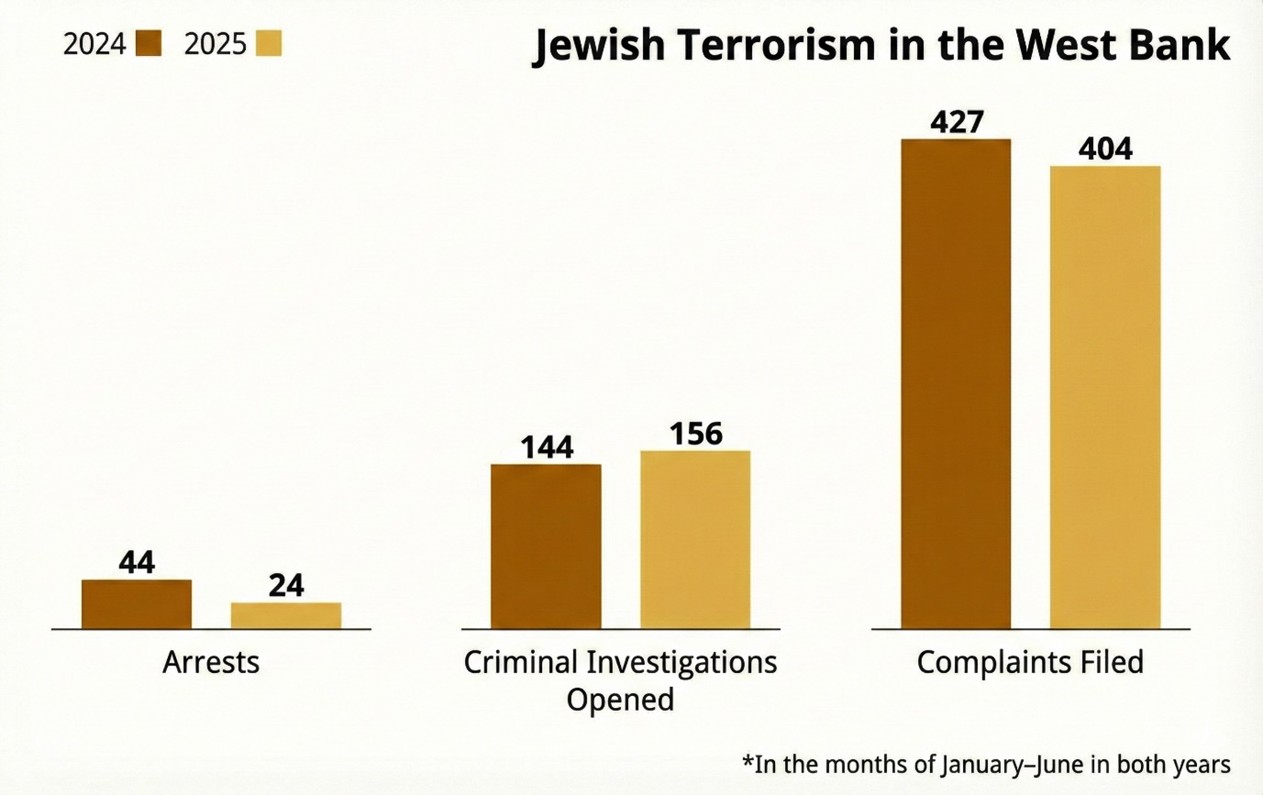
Note. From The Movement for Freedom of Information, “Monitoring of the Movement: Nationalist Crime in the Territories in 2024–2025,” October 7, 2025.
At the same time, it should be noted that the leadership of the settlement movement does not stand as a unified bloc behind these extremists and, at times, voices reservations and condemnation. For example, after the settler attack in the village of Jit (August 2024), heads of the Yesha Council and leading rabbis in the religious Zionism community were quick to define the acts as a “moral crime” and an “anti-Zionist” action that harms the settlement enterprise itself. However, these condemnations are often perceived as weak or merely lip service, as they are almost always accompanied by harsh criticism of the Shin Bet’s and police’s methods against the violent youths. This dual message—condemning the act while showing leniency toward “misguided marginal youth”—erodes deterrence and makes it difficult to draw a clear red line.
One particularly negative phenomenon in this context is the participation of members of local emergency squads or reserve soldiers from regional defense units, wearing uniforms and carrying IDF weapons, alongside the violent settlers. These incidents are sometimes documented and publicized worldwide as institutionalized IDF violence against the Palestinian population. The absence of clear procedures, soldiers’ fear of confronting settlers, and lack of political backing for combating violence and rioting effectively create areas where the law is not enforced.
Conclusion and Recommendations
Public awareness about the situation in Judea and Samaria should be increased, particularly regarding Jewish terrorism, which the Israeli government and the security establishment, across their various branches, do not address decisively. The government should issue unequivocal instructions to enforce the law against extremist Jewish settlers. To this end, the Judea and Samaria District police should be reinforced with manpower and resources, and joint task forces with the IDF should be activated to enable rapid responses to incidents and prevent the outbreak of widespread violence. Clear procedures must be established requiring soldiers to intervene when Palestinians are attacked by Jews, and it must be clarified that soldiers are obligated to protect the Palestinian population, even when the attacker is Jewish.
The reapplication, in exceptional cases and in accordance with the law, of deterrent tools such as restraining orders and administrative detention against violent Jewish extremists who pose an immediate danger should be examined. In parallel, legislative amendments should be considered to define nationalist violence by Jews as terrorism under the law, thereby removing legal obstacles to investigative and preventive actions by the Shin Bet and the police.
The leadership of the settlement movement in Judea and Samaria and the political right must openly oppose Jewish terrorism. Rabbis, local authority heads, Knesset members, and ministers need to acknowledge the phenomenon of Jewish terrorism and condemn it. At the same time, investment is required in education to prevent radicalization, instill values of respect for the rule of law and human dignity across all streams of the Israeli education system, and integrate marginalized youth into national service or non-formal education programs that can steer them away from violence and terrorism.
In conclusion, inaction and turning a blind eye to the expanding phenomenon of Jewish terrorism in Judea and Samaria may fuel a severe escalation: the outbreak of large-scale clashes between Jews and Palestinians in Judea and Samaria and beyond, waves of retaliatory attacks on both sides, and further deterioration of Israel’s international standing. Addressing this challenge must be grounded in data and, above all, in the rule of law. Courageous leadership willing to confront an extremist minority is required. In the long term, curbing this phenomenon will also benefit the settlement enterprise in Judea and Samaria by removing the grave stigma of terrorist activity and preventing criticism and diplomatic damage in the international arena.
___________________
[1] It is important to distinguish between agricultural farms and illegal outposts in terms of their characteristics, the degree of state backing they receive, and their links to Jewish terrorism. Agricultural farms are generally established by the private initiative of a family or a small core group of people and are based on agricultural activity (sheep and cattle herding). Although their manpower is limited, their grazing areas are extensive. By contrast, illegal outposts are small areas of settlement (usually consisting of a few caravans) intended to establish a new settlement in practice, sometimes as an expansion of an existing settlement. As of the end of 2025, there are 151 illegal outposts and 175 agricultural farms scattered throughout Judea and Samaria—most of them without official authorization.