Drifting into a One-State Reality: Active Accelerators and Possible Halts | INSS
go to header go to content go to footer go to search
INSS logo The Institute for National Security Studies, Strategic, Innovative, Policy-Oriented Research, go to the home page
INSS
Tel Aviv University logo - beyond an external website, opens on a new page
  • Campus
  • Contact
  • עברית
  • Support Us
  • Research
    • Topics
      • Israel and the Global Powers
        • Israel-United States Relations
        • Glazer Israel-China Policy Center
        • Russia
        • Europe
      • Iran and the Shi'ite Axis
        • Iran
        • Lebanon and Hezbollah
        • Syria
        • Yemen and the Houthi Movement
        • Iraq and the Iraqi Shiite Militias
      • Conflict to Agreements
        • Israeli-Palestinian Relations
        • Hamas and the Gaza Strip
        • Peace Agreements and Normalization in the Middle East
        • Saudi Arabia and the Gulf States
        • Turkey
        • Egypt
        • Jordan
      • Israel’s National Security Policy
        • Military and Strategic Affairs
        • Societal Resilience and the Israeli Society
        • Jewish-Arab Relations in Israel
        • Climate, Infrastructure and Energy
        • Terrorism and Low Intensity Conflict
      • Cross-Arena Research
        • Data Analytics Center
        • Law and National Security
        • Advanced Technologies and National Security
        • Cognitive Warfare
        • Economics and National Security
    • Projects
      • Preventing the Slide into a One-State Reality
      • Contemporary Antisemitism in the United States
      • Perceptions about Jews and Israel in the Arab-Muslim World and Their Impact on the West
  • Publications
    • -
      • All Publications
      • INSS Insight
      • Policy Papers
      • Special Publication
      • Strategic Assessment
      • Technology Platform
      • Memoranda
      • Posts
      • Books
      • Archive
  • Database
    • Surveys
    • Spotlight
    • Maps
    • Dashboards
  • Events
  • Team
  • About
    • Vision and Mission
    • History
    • Research Disciplines
    • Chairman of the Board
    • Board of Directors
    • Fellowship and Prizes
    • Internships
  • Media
    • Communications
    • Video gallery
    • Press Releases
  • Podcast
  • Newsletter
  • Campus
Search in site
  • Research
    • Topics
    • Israel and the Global Powers
    • Israel-United States Relations
    • Glazer Israel-China Policy Center
    • Russia
    • Europe
    • Iran and the Shi'ite Axis
    • Iran
    • Lebanon and Hezbollah
    • Syria
    • Yemen and the Houthi Movement
    • Iraq and the Iraqi Shiite Militias
    • Conflict to Agreements
    • Israeli-Palestinian Relations
    • Hamas and the Gaza Strip
    • Peace Agreements and Normalization in the Middle East
    • Saudi Arabia and the Gulf States
    • Turkey
    • Egypt
    • Jordan
    • Israel’s National Security Policy
    • Military and Strategic Affairs
    • Societal Resilience and the Israeli Society
    • Jewish-Arab Relations in Israel
    • Climate, Infrastructure and Energy
    • Terrorism and Low Intensity Conflict
    • Cross-Arena Research
    • Data Analytics Center
    • Law and National Security
    • Advanced Technologies and National Security
    • Cognitive Warfare
    • Economics and National Security
    • Projects
    • Preventing the Slide into a One-State Reality
    • Contemporary Antisemitism in the United States
    • Perceptions about Jews and Israel in the Arab-Muslim World and Their Impact on the West
  • Publications
    • All Publications
    • INSS Insight
    • Policy Papers
    • Special Publication
    • Strategic Assessment
    • Technology Platform
    • Memoranda
    • Posts
    • Books
    • Archive
  • Database
    • Surveys
    • Spotlight
    • Maps
    • Dashboards
  • Events
  • Team
  • About
    • Vision and Mission
    • History
    • Research Disciplines
    • Chairman of the Board
    • Board of Directors
    • Fellowship and Prizes
    • Internships
    • Privacy Policy and Terms of Use
  • Media
    • Communications
    • Video gallery
    • Press Releases
  • Podcast
  • Newsletter
  • Campus
  • Contact
  • עברית
  • Support Us
bool(false)

Publications

Home Publications Memoranda Drifting into a One-State Reality: Active Accelerators and Possible Halts

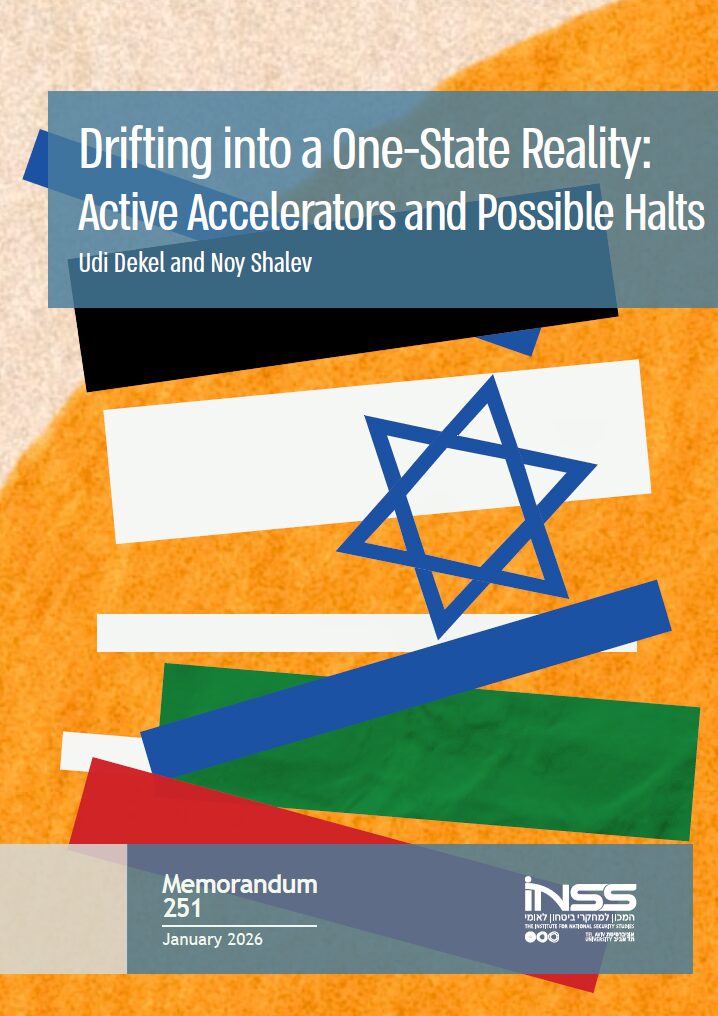
Drifting into a One-State Reality: Active Accelerators and Possible Halts

Memorandum 251, January 2026

עברית
Udi Dekel
Noy Shalev

The memorandum proposes a research framework for analyzing and understanding a major strategic challenge facing the State of Israel: an accelerating slide toward a “one-state” reality between the Jordan River and the Mediterranean Sea. Such an outcome is expected to severely undermine the Zionist vision of a Jewish, democratic, secure, and prosperous state.


The memorandum examines the main drivers pushing Israel toward a one-state model. These include the erosion of the two-state paradigm; the weakening of the Palestinian Authority; settlement, outposts and farms expansion in Judea and Samaria; and the growing intermingling of Israeli and Palestinian populations.


The memorandum outlines several plausible scenarios for a one-state reality, concluding that such a development would likely trigger violent escalation, severely damage Israel’s international standing, and lead to a breakdown of Israeli social cohesion and economic stability.


To prevent this trajectory, the authors recommend advancing political, geographic, and demographic separation steps from the Palestinians; strengthening the Palestinian Authority as the only viable partner for cooperation; maintaining Israel’s overriding security responsibility; and mobilizing moderate Arab states to promote normalization, support and improve the Palestinian economy.


Click here to download the full Memorandum

Table of Contents:

The central trend evident in the past decade within the Israeli–Palestinian conflict is a consistent and accelerated drift toward a one-state reality characterized by either Jewish supremacy or defined as binational, whether in principle or in practice, or a state for all its citizens. As this trend progresses and the complexity and intermingling between the Israeli and Palestinian populations expand, increased friction is expected between the two peoples vying for control over the same piece of land west of the Jordan River. This will pose significant challenges in establishing conditions for a political settlement based on separation into two distinct and separate political entities. Some argue that the two nations can coexist, but this assumption contradicts the historical narrative of the two nations, political logic, and common sense, following decades of a bloody national and religious conflict culminating on October 7, 2023...
Read more

The central trend evident over the past decade in the Israeli–Palestinian conflict is a consistent and increasingly accelerating drift toward a one-state reality—characterized either by Jewish supremacy or defined as binational—if not de jure then de facto, or a state for all its citizens. As this trend progresses and the complexity and intermingling between the Israeli and Palestinian populations expand, it is expected to become increasingly challenging to outline conditions for a political settlement based on political, geographical, and demographic separation between them, as well as escalating friction between the two nations vying for control over the same territory west of the Jordan River. Some argue that the two nations can coexist, but this assumption contradicts the two nations’ historical narrative, political logic, and common sense. This contrast was illustrated in the barbaric attack carried out by Hamas on October 7, 2023 against the western Negev communities—a further step in the bloody national and religious conflict...
Read more

Theoretically, a one-state scenario could emerge as an agreed-upon solution to the Israeli–Palestinian conflict, either through one side’s unilateral pursuit of this reality or due to the development of a single state in the territory, with both parties acquiescing to processes and actions that entrench this reality on the ground. It is possible to distinguish between two main patterns of a single state...
Read more

The State of Israel effectively controls the area between the Mediterranean Sea and the Jordan River: the entry and exit of people and goods; responsibility and monopoly over security, maintaining freedom of security operations throughout the territory; the ability to impose its decisions and policies on approximately three million Palestinians without their consent. The Palestinian Authority depends on the Israeli economy and the movement regime for Palestinians enforced by Israel, thereby determining the fabric of life and Palestinian freedom of movement. However, Israel chooses not to assume full responsibility for the territory and the Palestinian population in Judea and Samaria...
Read more

To assess how far we are (if at all) from the one-state reality, an imaginary continuum was drawn between two poles: On one end, the one-state reality, and on the other, a separation into two distinct and separate political entities. To assess the current position on the continuum, criteria were examined in an attempt to derive as accurately as possible metrics to identify and indicate the point of no return...
Read more

In Judea and Samaria, a reality is emerging that endangers the Zionist vision of a Jewish, democratic, secure, and prosperous state. In practice, a complex and intertwined life between Jews and Palestinians is established, compounded by a political deadlock, with no ability to break through it, discuss options for a political settlement based on division and separation, and implement the one agreed upon by the parties. So far, the American administration, which is generally supportive of Israel, expects it to refrain from unilateral actions, particularly annexation and the application of sovereignty over territories in Judea and Samaria, thereby preserving the feasibility of the two-state solution option. Similarly, the moderate Arab states, led by Saudi Arabia, are willing to cooperate with Israel and even expand and deepen normalization with it, provided that it does not close the door on the possibility of establishing a Palestinian state in the future and does not embarrass them by taking overt annexation steps....
Read more

Implementing the plan may manifest an optimal balance between Israel’s security needs and what Israel is prepared to allow the Palestinians in order to alleviate the burden of civil control over the Palestinian population, as well as to outline political prospects. This is despite the fact that implementation is expected to involve addressing significant challenges to security and political stability, as well as socio-political considerations within Israel...
Read more
The opinions expressed in INSS publications are the authors’ alone.
Udi Dekel
Brigadier General (res.) Udi Dekel joined the Institute for National Security Studies (INSS) in 2012. He served as Managing Director of INSS for ten years and is currently the Director of the research program "Conflict to Agreements". Dekel was the head of the negotiating team with the Palestinians under Prime Minister Ehud Olmert during the 2007-8 Annapolis process.
Noy Shalev
Noy Shalev is a research assistant in the Israel-Palestinian Relations program at the Institute for National Security Studies. She holds a bachelor's degree in Political Science and Middle Eastern and Islamic Studies from the University of Haifa and is currently an undergraduate student in Psychology at the Open University.
Publication Series Memoranda
TopicsIsraeli-Palestinian Relations
עברית

Events

All events
Iraq – What Looms Ahead?
20 January, 2026
12:00 - 13:00

Related Publications

All publications
Shutterstock
The Gaza Strip: Strategic Alternatives for Israel
What options are available to Israel with regard to its conduct in the Gaza Strip in 2026—and how should it act?
13/01/26
Majdi Fathi/NurPhoto via REUTERS
Hamas’s New Document: A Narrative of Confidence, Disregard for Criticism, and an Attempt to Return to Routine
How Hamas Assesses Two Years of War with Israel – And the Key Takeaways
07/01/26
REUTERS/Jose Luis Gonzalez (illustration)
Doing the Right Thing Done Right: The Challenges Facing the International Stabilization Force (ISF) in the Gaza Strip
What challenges are facing the force designated to maintain the ceasefire in the Gaza Strip—and why is the process of its establishment critical to addressing these challenges?
01/01/26

Stay up to date

Registration was successful! Thanks.
  • Research

    • Topics
      • Israel and the Global Powers
      • Israel-United States Relations
      • Glazer Israel-China Policy Center
      • Russia
      • Europe
      • Iran and the Shi'ite Axis
      • Iran
      • Lebanon and Hezbollah
      • Syria
      • Yemen and the Houthi Movement
      • Iraq and the Iraqi Shiite Militias
      • Conflict to Agreements
      • Israeli-Palestinian Relations
      • Hamas and the Gaza Strip
      • Peace Agreements and Normalization in the Middle East
      • Saudi Arabia and the Gulf States
      • Turkey
      • Egypt
      • Jordan
      • Israel’s National Security Policy
      • Military and Strategic Affairs
      • Societal Resilience and the Israeli Society
      • Jewish-Arab Relations in Israel
      • Climate, Infrastructure and Energy
      • Terrorism and Low Intensity Conflict
      • Cross-Arena Research
      • Data Analytics Center
      • Law and National Security
      • Advanced Technologies and National Security
      • Cognitive Warfare
      • Economics and National Security
    • Projects
      • Preventing the Slide into a One-State Reality
      • Contemporary Antisemitism in the United States
      • Perceptions about Jews and Israel in the Arab-Muslim World and Their Impact on the West
  • Publications

    • All Publications
    • INSS Insight
    • Policy Papers
    • Special Publication
    • Strategic Assessment
    • Technology Platform
    • Memoranda
    • Database
    • Posts
    • Books
    • Archive
  • About

    • Vision and Mission
    • History
    • Research Disciplines
    • Chairman of the Board
    • Board of Directors
    • Fellowship and Prizes
    • Internships
    • Support
    • Privacy Policy and Terms of Use
  • Media

    • Communications
    • Video Gallery
    • Press Release
    • Podcast
  • Home

  • Events

  • Database

  • Team

  • Contact

  • Newsletter

  • עברית

INSS logo The Institute for National Security Studies, Strategic, Innovative, Policy-Oriented Research, go to the home page
40 Haim Levanon St. Tel Aviv, 6997556 Israel | Tel: 03-640-0400 | Fax: 03-744-7590 | Email: info@inss.org.il
Developed by Daat A Realcommerce company.
Accessibility Statement
This site is protected by reCAPTCHA and the Google Privacy Policy and Terms of Service apply.
No audio version available for this podcast