


Publications
“A roadmap” for reshaping the reality in the Palestinian arena
INSS Insight No. 2072, December 23, 2025
Follow us on GoogleThis article sets out an integrated “roadmap”—security, governance, economic, and social—for reshaping the reality in the Gaza Strip specifically and the Palestinian arena in general. A return to the situation that prevailed before October 2023 is impossible; there is a need to accelerate the positive momentum to avoid stalling the process and to prevent Hamas from reestablishing itself in the Gaza Strip. Therefore, a new organizing concept is required. The proposed concept combines: (1) responses to Israel’s essential security interests, which enjoy international understanding; (2) a phased response to aspirations for Palestinian political self-determination, supported by the international community and the regional system; (3) reliance on President Trump’s 20-point framework and UN Security Council Resolution 2803; and (4) a transition process in the Gaza Strip through an approach of Disarmament, Demobilization, Deradicalization, and Reintegration (DDDR) as a pathway to shaping a demilitarized, moderate, and functional Palestinian entity, in accordance with the principle of “one authority, one law, one weapon.”
A Framework for Rebuilding the Palestinian System
The proposed framework is a process, not a “single move” or a “magic solution.” It rests on the principles of “security first”—the dismantling of terrorist capabilities—and reconstruction—physical, institutional, and social—conditioned on demilitarization and responsible Palestinian governance with a monopoly on the use of force; reform of Palestinian Authority institutions in order to advance its ability to reassert effective control over Gaza; the systematic exclusion of armed organizations from the arena; and the embedding of deradicalization processes. The framework will be implemented first in the Gaza Strip and, contingent upon positive outcomes, later expanded to the territories of the Palestinian Authority in the West Bank.
Principles
- The Gaza Strip will be demilitarized and free of terrorism, with reconstruction conditioned on the demilitarization and the dismantling of all armed organizations.
- The Gaza Strip will be administered by a technocratic transition authority (Gaza Administrative Committee [GAC]), under the supervision of the international Board of Peace (BoP), in coordination with the Palestinian Authority, alongside a Palestinian police force for Gaza without Hamas, operating with the guidance, support, and oversight of an International Stabilization Force (ISF).
- The Palestinian Authority will implement comprehensive reforms enabling and catalyzing its return to governance in the Gaza Strip. Effective and moderate Palestinian governance is necessary, with the Palestinian Authority having a monopoly on the use of force, in line with President Abbas’s vision of “one authority, one law, one weapon,” without militias possessing military capabilities.
- Financial demilitarization—establishing a supervised digital financial system to prevent the diversion of funds to Hamas and terrorist organizations.
- A matrix of conditions will be presented, the fulfillment of which will open a “political track” toward Palestinian statehood—a demilitarized Palestinian state.
Architecture of Control Mechanisms for Managing the Process
At present, an architecture is taking shape composed of several mechanisms intended to steer and control the process:
- Board of Peace (BoP): With the participation of global leaders (and likely chaired by President Trump), the BoP defines the overarching political framework, the stages of implementation, and the criteria for transitions between stages; manages Gaza reconstruction funds; oversees—via the Civil-Military Coordination Center (CMCC)—a Palestinian technocratic committee governing Gaza and the ISF; and reports to the UN Security Council.
- Gaza Administrative Committee (GAC): An apolitical, technocratic civilian administration for transitional governance of the Strip, linked to the Palestinian Authority. It will be responsible for delivering civilian services, implementing the DDDR process, initial recovery and reconstruction efforts, and operating the Gaza Palestinian Police to enforce public order.
- International Stabilization Force (ISF): A temporary international force led by the United States, in cooperation with Egypt and ideally leading Arab states. The force will enforce—or at least verify—the demilitarization of the Strip; assist the Palestinian police in building forces and capabilities for disarmament and public order; conduct security inspections at border crossings to prevent arms smuggling; and ensure that areas vacated by the IDF remain free of Hamas and terrorism.
- Civil-Military Coordination Center (CMCC): This is the only mechanism already operational. Affiliated with US Central Command (CENTCOM), the mission of the CMCC is to supervise the ceasefire, monitor developments in the Gaza Strip, coordinate the entry of humanitarian aid, and advance initial recovery efforts.
- Palestinian Authority (PA): To integrate as an effective actor, the PA must implement governance, security, legal, and economic reforms in accordance with UN Security Council Resolution 2803 of November 2025. The goal is exclusive civilian and security control by the PA in the Gaza Strip, based on the principle championed by PA President Mahmoud Abbas of “one authority, one law, one weapon.”
- International Reconstruction Fund: A trust fund for Gaza’s reconstruction, subordinate to the World Bank and the BoP, with stringent transparency and oversight mechanisms. It will supervise the transition to a digital economy—digital wallets and stablecoins—to prevent the diversion of funds to Hamas and other terrorist actors.
Required Synchronization across Operational Axes
For effective implementation, synchronization will be required across several axes:
- Security Axis: Weapons dismantlement; the disbanding of militias; weapons registration and control; establishment of units to dismantle terrorist infrastructure, tunnels, weapons production, assembly, and storage complexes; Palestinian legislation imposing severe penalties on unauthorized weapons possession or harm to the governance of the GAC.
- Governance Axis: Initially via a technocratic administration, followed by the transfer of authority to the PA after reforms are implemented. Local elections will take place, followed by presidential and Palestinian Legislative Council elections.
- Economic Development Axis: Restoration of essential infrastructure and humanitarian assistance for Gaza’s population; financial demilitarization; private-sector development; establishment of a free trade zone and an economic development program.
- Deradicalization and Social Resilience Axis: Resume education for children in Gaza who have been out of school through investment in a reformed education system that promotes moderation and tolerance; religious reform—ending religious incitement and agitation; support for trauma victims; integration of women into the labor market and civil service. This axis incorporates “four pillars”: demilitarization, deradicalization, democratization, and economic and personal development.
- Political–Regional Axis: If tangible and verifiable progress is achieved—security stabilization, demilitarization, and effective PA governance—the framework can be expanded to the territories of the PA in the West Bank, and subsequently, a political process toward Palestinian statehood can be launched with the involvement of the United States, Arab states, and the European Union.
Phases of Implementation
Phase I—Security Stabilization
A full ceasefire and the return of the last Israeli fallen captive held by Hamas; a principled commitment by all parties to the full demilitarization of Gaza; establishment of the BoP as an international transitional body with a clear mandate for Gaza’s reconstruction and the accompaniment of PA reforms; the establishment of the ISF, the Palestinian police, and a technocratic administration as the basis for ending the war (anchored in Resolution 2803); intensified humanitarian efforts and broad assistance for the recovery of the population in Gaza.
Phase II—Focus on Demilitarization and Recovery
- Security: Activation of DDDR components focused on disarmament—“weapons for incentives”—to encourage terrorist operatives to renounce violence and surrender their weapons; a buy-back program funded by an international fund managed by the BoP; deployment of the Palestinian police with ISF support; emphasis on collecting heavy and offensive weapons and their delivery to the ISF; destruction of the tunnel infrastructure as well as weapons production and weapons storage facilities.
- Infrastructure: Restoration of basic infrastructure—water, electricity, sewage, hospitals, temporary schools.
- Economic: Establishment of a Gaza trust fund managed by the World Bank and the BoP as the sole, supervised channel for reconstruction funds; gradual transition to digital payments (aid, salaries, vouchers) via supervised digital wallets; reduction of cash and disconnection from Hamas-controlled banks and money changers.
- Social–Deradicalization: Institutionalization of trauma care, especially for children and persons with disabilities, as part of the recovery approach; resumption of education for children in Gaza; establishment of school infrastructure with curricula promoting tolerance and countering radicalization.
Phase III—Continued Transition toward Demilitarization, Moderate and Effective Palestinian Governance, and Initial Reconstruction
- Security: Shift from collecting heavy weapons to small arms; dismantling remnants of Hamas’s military wing, Palestinian Islamic Jihad, and other factions; implementation of a “voluntary weapons surrender plus targeted enforcement” mechanism by the Palestinian police and ISF.
- Reintegration: “Weapons in exchange for a future”—employment packages for those abandoning terrorism, surrendering weapons, and committing to non-violence (public works, reconstruction, debris removal, construction); vocational training; conditional amnesty tracks contingent on non-recidivism to violent activity.
- Economy and Reconstruction: Transition from survival to growth—launch of the economic development program formulated by the BoP; planning and initial implementation of major infrastructure projects (housing, transportation, energy); establishment of a free trade zone/special economic zone; full implementation of financial demilitarization—digital-only payments for reconstruction projects with monitoring of every dollar.
- Deradicalization and Democratization: Prevention of incitement across media and social networks; oversight of mosque activities and sermons; public participation in political activity; enabling civil society to provide necessary services to reach those in need; involvement of the United Arab Emirates in embedding deradicalization processes within Palestinian society.
- Political: Periodic BoP updates to the UN Security Council on reform and reconstruction progress—as a basis for integrating the PA into Gaza governance and encouraging compliance through the prospect of joining the Abraham Accords.
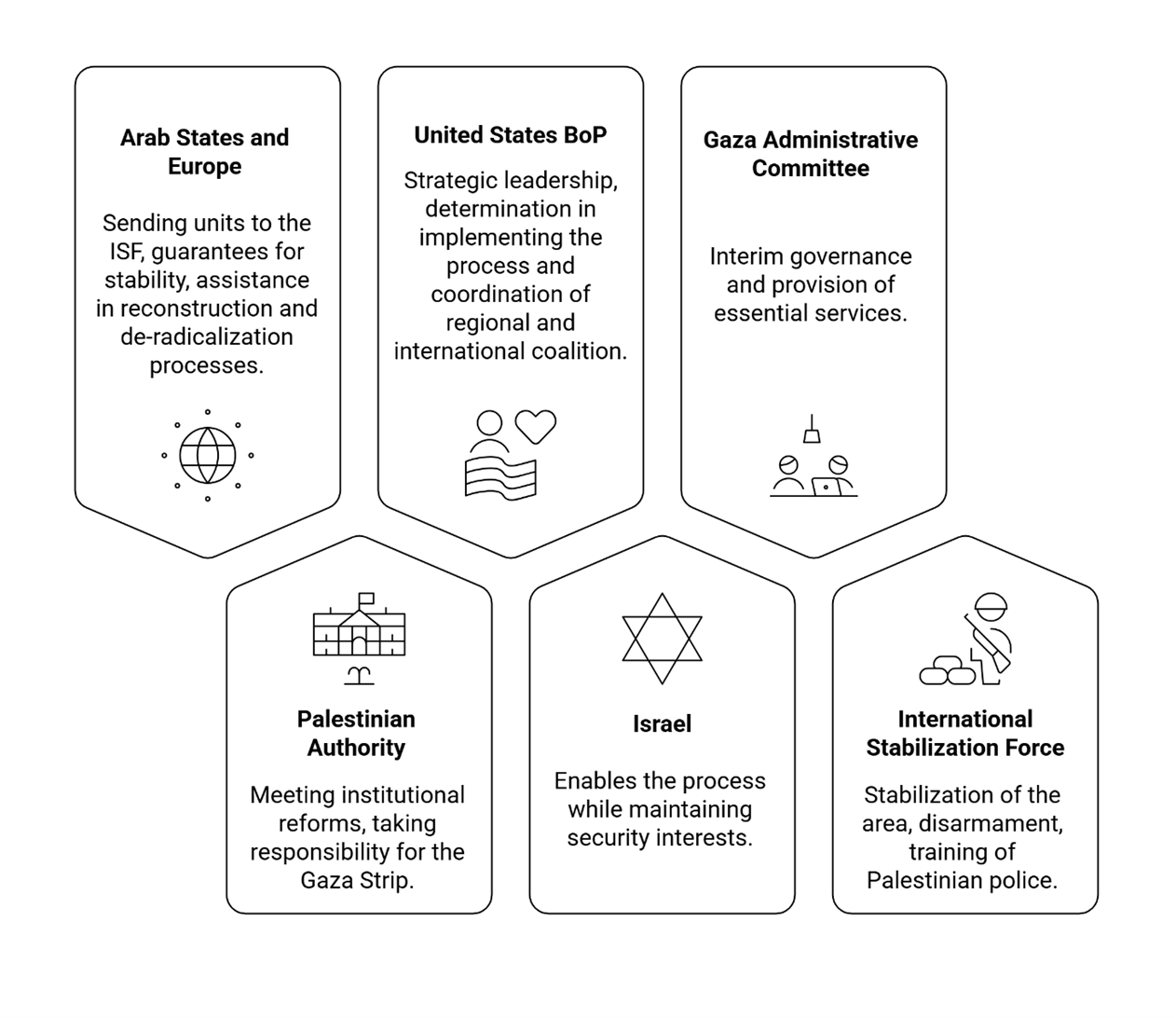
Figure 1. Key Actors in Gaza’s Recovery
Phase IV—Gradual Transition to a Reformed Palestinian Authority and Opening the Political Track
Threshold conditions: Completion of a core set of PA reforms (rule of law, transparency, cessation of providing monthly financial stipends to Palestinians imprisoned in Israeli jails for terror offenses, and to the families of those killed during terror activity; legislation for “one weapon”); demobilization of militias and armed bodies; reform of PA security services and their reduction to an intelligence body and an effective Palestinian police force enforcing demilitarization and public order.
- Institutional: The technocratic administration (GAC) is integrated into the PA, which becomes the direct civilian sovereign in Gaza. The BoP continues to oversee demilitarization and manage and finance reconstruction.
- Security: The ISF reduces its presence and shifts primarily to monitoring and verification while retaining rapid intervention capability. The IDF withdraws according to agreed milestones while maintaining a security perimeter.
- Economic and Reconstruction: Transition from basic reconstruction to economic development—empowerment of a Palestinian private sector; integration into regional markets; the port of El-Arish in the Sinai Peninsula serves as a direct supply route to Gaza; adjustment of economic arrangements with Israel (revision of the Paris Protocol) to increase Palestinian economic independence.
- Political Track: Drawing on lessons from implementation in Gaza, development of a plan to apply the framework in PA territories in the West Bank, led by the United States with the participation of Israel and Arab states—Jordan, Egypt, Saudi Arabia, and the United Arab Emirates.
Phase V—Long-Term Stabilization
- Security: Completion of demilitarization—no armed organizations in Gaza; weapons held solely by Palestinian police forces; an effective monitoring and verification mechanism in place.
- Infrastructure and Full Reconstruction: Restoration of “hard” infrastructure (housing, transportation, energy, water) and completion of public buildings. Gaza transitions from “aid” to “conflict-preventive development”: employment, exports, innovation.
- Deep Deradicalization: Embedding a strong civil society; cultivating alternative moderate leadership; cleansing the education system and reforming curricula and textbooks; creating religious legitimacy against extremism; dismantling refugee camps; Israeli–Palestinian civil dialogue.
- Political Track: The United States formally opens Israeli–Palestinian political dialogue for comprehensive agreement.
Conclusion: The Road to Palestinian Statehood
The “roadmap” outlined in this article includes clear stages—from initial security stabilization, through demilitarization and infrastructure reconstruction, to the consolidation of a functional, demilitarized Palestinian entity. It charts a gradual path—not a single move—for addressing the dilemmas and challenges of the current Israeli–Palestinian arena. At each stage, objectives, oversight mechanisms, and threshold conditions for progression will be defined based on demonstrated performance, without a predetermined timetable.
Moreover, the framework does not commit to a predetermined final outcome; rather, it establishes a “conditions matrix” that could open the way to Palestinian statehood. The conditions include (1) the full dismantling of terrorist organizations and armed factions in the Palestinian arena; (2) the removal of most heavy weapons from Gaza and the placement of most light weapons in the hands of the Palestinian police; (3) a professional Palestinian police operating under effective civilian rule with a monopoly on the use of force; (4) implementation of PA reforms, including the separation of powers and an independent judiciary; (5) legislation against militias and incitement; (6) free elections for the presidency and legislature; (7) effective and stable governance; (8) a transparent digital financial system with no diversion of funds to terrorism; (9) sustainable economic growth; (10) a significant reduction in dependence on external aid and on customs collection by Israel; and (11) the protection of basic human rights, freedom of expression, and an active civil society. Fulfillment of these conditions would enable the United States to recommend to the UN Security Council recognition of an independent demilitarized Palestinian entity.
It is recommended that Israel present the proposed framework while demonstrating readiness to implement it, contingent on the fulfillment of the binding conditions required for its completion and success. The process may collapse due to underlying constraints—primarily on the Palestinian side—related to limited capacity to neutralize Hamas’s destructive power and to establish a demilitarized Palestinian space free of military and terrorist capabilities, with stable, effective, and moderate governance in line with the vision of “one authority, one law, one weapon.” Yet even in the event of such a collapse, placing the framework on the agenda would help Israel restore its regional and international legitimacy and, on that basis, demand—backed by the Trump administration—the expansion and deepening of the Abraham Accords and broad, multi-domain regional cooperation.