“The Day after Abbas”: Strategic Implications for Israel | INSS
go to header go to content go to footer go to search
INSS logo The Institute for National Security Studies, Strategic, Innovative, Policy-Oriented Research, go to the home page
INSS
Tel Aviv University logo - beyond an external website, opens on a new page
  • Campus
  • Contact
  • עברית
  • Support Us
  • Research
    • Topics
      • Israel and the Global Powers
        • Israel-United States Relations
        • Glazer Israel-China Policy Center
        • Russia
        • Europe
      • Iran and the Shi'ite Axis
        • Iran
        • Lebanon and Hezbollah
        • Syria
        • Yemen and the Houthi Movement
        • Iraq and the Iraqi Shiite Militias
      • Conflict to Agreements
        • Israeli-Palestinian Relations
        • Hamas and the Gaza Strip
        • Peace Agreements and Normalization in the Middle East
        • Saudi Arabia and the Gulf States
        • Turkey
        • Egypt
        • Jordan
      • Israel’s National Security Policy
        • Military and Strategic Affairs
        • Societal Resilience and the Israeli Society
        • Jewish-Arab Relations in Israel
        • Climate, Infrastructure and Energy
        • Terrorism and Low Intensity Conflict
      • Cross-Arena Research
        • Data Analytics Center
        • Law and National Security
        • Advanced Technologies and National Security
        • Cognitive Warfare
        • Economics and National Security
    • Projects
      • Preventing the Slide into a One-State Reality
      • Contemporary Antisemitism in the United States
      • Perceptions about Jews and Israel in the Arab-Muslim World and Their Impact on the West
  • Publications
    • -
      • All Publications
      • INSS Insight
      • Policy Papers
      • Special Publication
      • Strategic Assessment
      • Technology Platform
      • Memoranda
      • Posts
      • Books
      • Archive
  • Database
    • Surveys
    • Spotlight
    • Maps
    • Dashboards
  • Events
  • Team
  • About
    • Vision and Mission
    • History
    • Research Disciplines
    • Chairman of the Board
    • Board of Directors
    • Fellowship and Prizes
    • Internships
  • Media
    • Communications
    • Video gallery
    • Press Releases
  • Podcast
  • Newsletter
  • Campus
Search in site
  • Research
    • Topics
    • Israel and the Global Powers
    • Israel-United States Relations
    • Glazer Israel-China Policy Center
    • Russia
    • Europe
    • Iran and the Shi'ite Axis
    • Iran
    • Lebanon and Hezbollah
    • Syria
    • Yemen and the Houthi Movement
    • Iraq and the Iraqi Shiite Militias
    • Conflict to Agreements
    • Israeli-Palestinian Relations
    • Hamas and the Gaza Strip
    • Peace Agreements and Normalization in the Middle East
    • Saudi Arabia and the Gulf States
    • Turkey
    • Egypt
    • Jordan
    • Israel’s National Security Policy
    • Military and Strategic Affairs
    • Societal Resilience and the Israeli Society
    • Jewish-Arab Relations in Israel
    • Climate, Infrastructure and Energy
    • Terrorism and Low Intensity Conflict
    • Cross-Arena Research
    • Data Analytics Center
    • Law and National Security
    • Advanced Technologies and National Security
    • Cognitive Warfare
    • Economics and National Security
    • Projects
    • Preventing the Slide into a One-State Reality
    • Contemporary Antisemitism in the United States
    • Perceptions about Jews and Israel in the Arab-Muslim World and Their Impact on the West
  • Publications
    • All Publications
    • INSS Insight
    • Policy Papers
    • Special Publication
    • Strategic Assessment
    • Technology Platform
    • Memoranda
    • Posts
    • Books
    • Archive
  • Database
    • Surveys
    • Spotlight
    • Maps
    • Dashboards
  • Events
  • Team
  • About
    • Vision and Mission
    • History
    • Research Disciplines
    • Chairman of the Board
    • Board of Directors
    • Fellowship and Prizes
    • Internships
    • Privacy Policy and Terms of Use
  • Media
    • Communications
    • Video gallery
    • Press Releases
  • Podcast
  • Newsletter
  • Campus
  • Contact
  • עברית
  • Support Us
bool(false)

Publications

Home Publications Memoranda “The Day after Abbas”: Strategic Implications for Israel

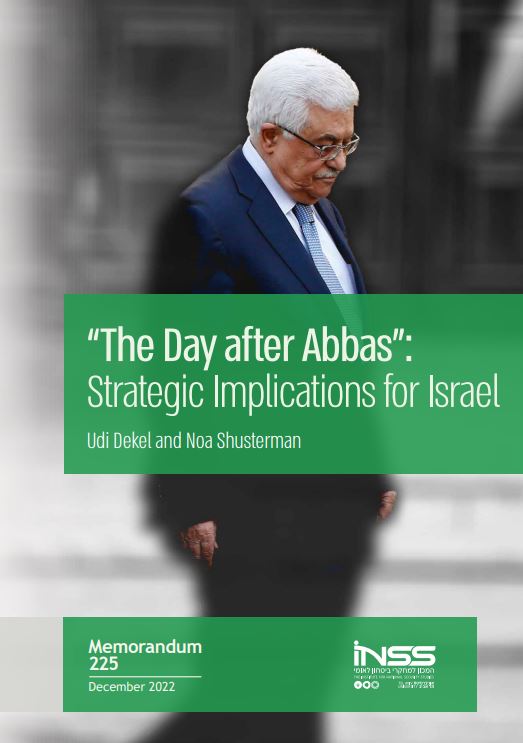
“The Day after Abbas”: Strategic Implications for Israel

Memorandum 225, December 2022

עברית
Udi Dekel
Noa Shusterman

Since 2005, Mahmoud Abbas (Abu Mazen) has worn three hats, serving as President of the Palestinian Authority (PA), General Secretary of the PLO, and Chairman of Fatah. Along with scoring several achievements for the Palestinians during his tenure, Abbas is also accountable for a number of failures, foremost among them the split between the PA in the West Bank and Hamas, which took over the Gaza Strip in 2007. The difficulty caused by this internal rift compounds the lack of progress toward the long-sought goal of an independent Palestinian state. Despite the criticism, Abbas’s position has not been challenged, and during his term stability has prevailed in the West Bank most of the time. In recent years, there have been growing rumors of his expected exit from the stage, whether willingly or unwillingly, and there is much anticipation in the Palestinian arena.


A team of experts in the Palestinian Research Program at the Institute for National Security Studies (INSS) examined the possible scenarios after Abbas’s departure and the implications for Israeli-Palestinian relations.


The goal of this memorandum is not to predict who will replace Abbas, but rather to outline various potential scenarios, with the goal of understanding the challenges and implications for Israel that stem from each of them. The focus is on three main scenarios: the orderly transfer of power to a leader or leadership group from within Fatah, which would thereby maintain the PA as a functional entity; a prolonged struggle for succession that will weaken the PA and strengthen Hamas; and chaos and a loss of control by the PA to the point of collapse and a return of the keys to Israel.


In this policy-oriented research study, the authors formulate policy recommendations for the Israeli government for the “day after Abbas.” Some of the recommendations are already relevant, while Abbas is still in power. The ability of the Palestinian system to deal with the sudden exit of Abbas will be largely determined by the ability of the Palestinian Authority to execute an orderly and stable transfer of power, without a struggle for succession. Israel has tools to support this process, such as support for the Palestinian Authority and its governance.


Click here to read the full Memorandum

Table of Contents:

The question of who will replace or succeed Mahmoud Abbas (Abu Mazen) as President of the Palestinian Authority (PA) is one of the most urgent and important issues in the Palestinian arena. It intensifies the rivalry between the main elements of power, namely, Fatah and Hamas, and undermines the PA’s control. Once Abbas has left the stage, there will be political turmoil and perhaps even a crisis in the Palestinian camp...
Read more

Mahmoud Abbas, 87 years old at the time of this writing, has filled three senior leadership positions for the last 17 years, serving as Chairman of the Palestine Liberation Organization (PLO); President of the Palestinian Authority (PA); and Chairman of Fatah...
Read more

Abbas’s departure from the political stage is expected to be a shock to the Palestinian political system, since it will create a leadership vacuum, without any fundamental institutional infrastructure for the transfer of power and the appointment of successors...
Read more

The optimistic scenario involves an orderly and stable process in which a leader or leadership emerges to succeed Abbas. In this scenario, Abbas will prepare the way ahead of time by choosing a candidate or candidates to replace him in all three positions, based on the understanding that his time as rais is limited. He will start to transfer power and strengthen individuals that are loyal to him within the ruling bodies of Fatah, the PLO, and the PA....
Read more

Jordan, Egypt, and the Gulf states have an interest in a quick and peaceful succession within the Palestinian leadership. Each has a particular interest in the makeup of the Palestinian leadership, and each has a different—though limited—degree of influence on the identity of Abbas’s successor or successors....
Read more

In view of the multiplicity of players and scenarios, the future of the Palestinian system cannot be predicted. Therefore, Israel needs to prepare for four basic situations after Abbas departs the stage: a functioning PA that will maintain coordination with Israel; a functioning but hostile PA; a non-functioning or even failed PA; and the collapse of the PA...
Read more

________

The ideas in the memorandum are the result of work by researchers at INSS with considerable experience in the Israeli-Palestinian conflict: Dr. Anat Kurz, Yohanan Tzoreff, Dr. Kobi Michael, Adv. Pnina Sharvit Baruch, Dr. Haggay Etkes, Amb. Dr. Oded Eran, Dr. Ofir Winter, Dr. Yoel Guzansky, Noa Shusterman, and Brig. Gen. (res.) Udi Dekel.

The opinions expressed in INSS publications are the authors’ alone.
Publication Series Memoranda
TopicsIsraeli-Palestinian Relations
עברית

Events

All events
Iraq – What Looms Ahead?
20 January, 2026
12:00 - 13:00

Related Publications

All publications
Issam Rimawi / Anadolu via REUTERS
Jewish Terrorism in Judea and Samaria—A Strategic-Security Threat
According to recent reports, over the past year there has been a significant increase in both the scope and severity of nationalist violence perpetrated by Jews against Palestinians. Nevertheless, the government has chosen not to confront the phenomenon decisively, despite its potential to lead to serious escalation
22/01/26
Drifting into a One-State Reality: Active Accelerators and Possible Halts
The memorandum proposes a research framework for analyzing and understanding a major strategic challenge facing the State of Israel: an accelerating slide toward a “one-state” reality between the Jordan River and the Mediterranean Sea. Such an outcome is expected to severely undermine the Zionist vision of a Jewish, democratic, secure, and prosperous state. The memorandum examines the main drivers pushing Israel toward a one-state model. These include the erosion of the two-state paradigm; the weakening of the Palestinian Authority; settlement, outposts and farms expansion in Judea and Samaria; and the growing intermingling of Israeli and Palestinian populations. The memorandum outlines several plausible scenarios for a one-state reality, concluding that such a development would likely trigger violent escalation, severely damage Israel’s international standing, and lead to a breakdown of Israeli social cohesion and economic stability. To prevent this trajectory, the authors recommend advancing political, geographic, and demographic separation steps from the Palestinians; strengthening the Palestinian Authority as the only viable partner for cooperation; maintaining Israel’s overriding security responsibility; and mobilizing moderate Arab states to promote normalization, support and improve the Palestinian economy.
21/01/26
Shutterstock
The Gaza Strip: Strategic Alternatives for Israel
What options are available to Israel with regard to its conduct in the Gaza Strip in 2026—and how should it act?
13/01/26

Stay up to date

Registration was successful! Thanks.
  • Research

    • Topics
      • Israel and the Global Powers
      • Israel-United States Relations
      • Glazer Israel-China Policy Center
      • Russia
      • Europe
      • Iran and the Shi'ite Axis
      • Iran
      • Lebanon and Hezbollah
      • Syria
      • Yemen and the Houthi Movement
      • Iraq and the Iraqi Shiite Militias
      • Conflict to Agreements
      • Israeli-Palestinian Relations
      • Hamas and the Gaza Strip
      • Peace Agreements and Normalization in the Middle East
      • Saudi Arabia and the Gulf States
      • Turkey
      • Egypt
      • Jordan
      • Israel’s National Security Policy
      • Military and Strategic Affairs
      • Societal Resilience and the Israeli Society
      • Jewish-Arab Relations in Israel
      • Climate, Infrastructure and Energy
      • Terrorism and Low Intensity Conflict
      • Cross-Arena Research
      • Data Analytics Center
      • Law and National Security
      • Advanced Technologies and National Security
      • Cognitive Warfare
      • Economics and National Security
    • Projects
      • Preventing the Slide into a One-State Reality
      • Contemporary Antisemitism in the United States
      • Perceptions about Jews and Israel in the Arab-Muslim World and Their Impact on the West
  • Publications

    • All Publications
    • INSS Insight
    • Policy Papers
    • Special Publication
    • Strategic Assessment
    • Technology Platform
    • Memoranda
    • Database
    • Posts
    • Books
    • Archive
  • About

    • Vision and Mission
    • History
    • Research Disciplines
    • Chairman of the Board
    • Board of Directors
    • Fellowship and Prizes
    • Internships
    • Support
    • Privacy Policy and Terms of Use
  • Media

    • Communications
    • Video Gallery
    • Press Release
    • Podcast
  • Home

  • Events

  • Database

  • Team

  • Contact

  • Newsletter

  • עברית

INSS logo The Institute for National Security Studies, Strategic, Innovative, Policy-Oriented Research, go to the home page
40 Haim Levanon St. Tel Aviv, 6997556 Israel | Tel: 03-640-0400 | Fax: 03-744-7590 | Email: info@inss.org.il
Developed by Daat ,Yael Group.
Accessibility Statement
This site is protected by reCAPTCHA and the Google Privacy Policy and Terms of Service apply.
No audio version available for this podcast