


Strategic Assessment
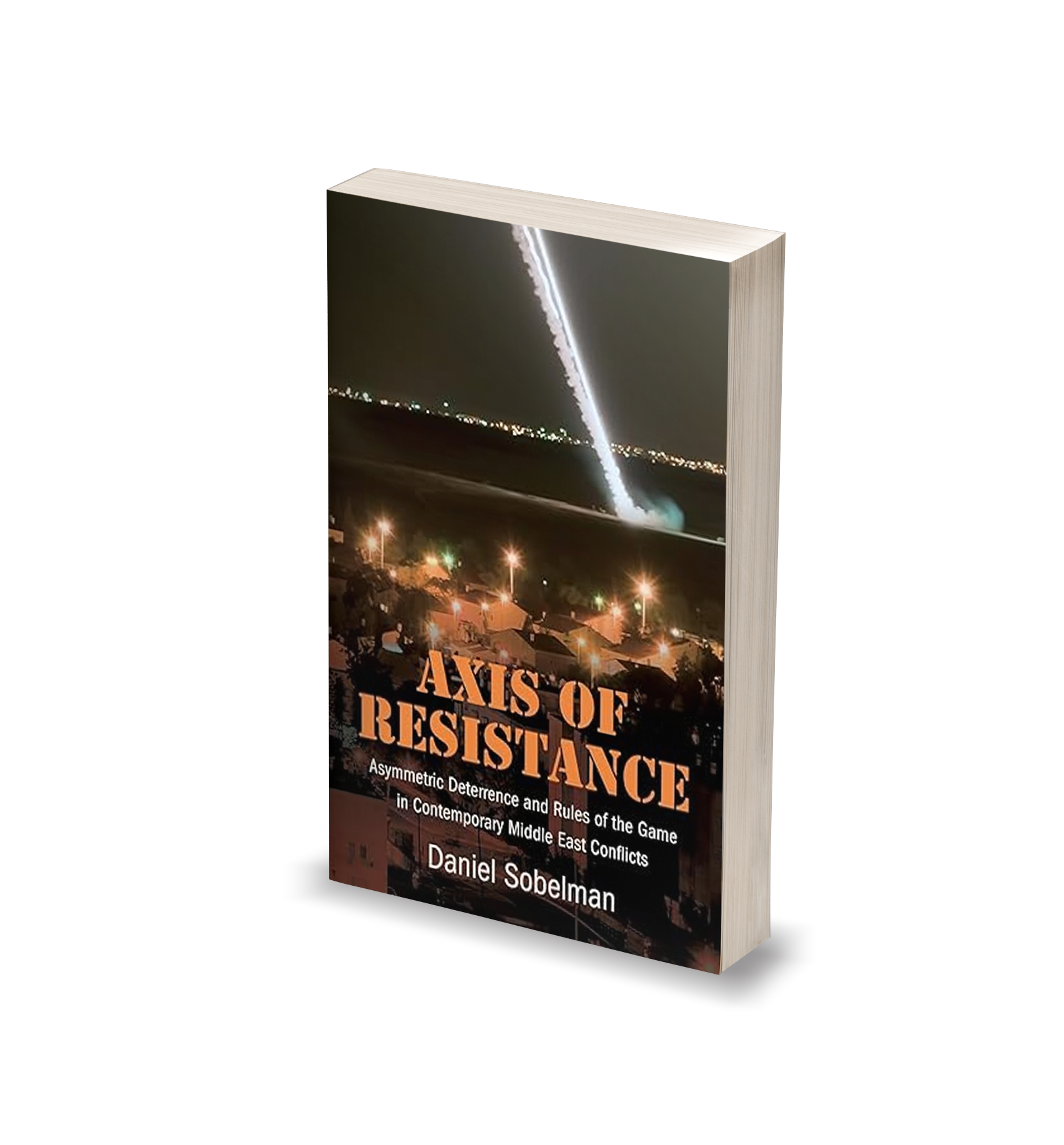
- Book: Axis of Resistance – Asymmetric Deterrence and Rules of the Game in Contemporary Middle East Conflicts
- By: Daniel Sobelman
- Publisher: State University of New York
- Year: 2025
- pp: 280
The decision by Yahya Sinwar, Hamas’ leader in the Gaza Strip, to launch the deadly surprise attack of October 7, 2023, caught not only Israel off guard, but also Hamas’ partners in the Shiite axis, foremost among them Iran and Hezbollah. Nearly two years later, it is clear that members of the so-called Axis of Resistance were unaware of the precise timing of the attack and were dragged into a direct war with Israel at a moment determined by Sinwar, without either the desire or the readiness to do so, and in which they paid a very heavy price.[1] Daniel Sobelman’s book, which analyses the joint strategy of the Axis of Resistance as it has evolved over the years, provides an answer to anyone asking why these actors nevertheless chose to join the war, and what drove them to do so in a limited manner, rather than to launch a broad, coordinated offensive against Israel as Sinwar had hoped.
Dr. Daniel Sobelman, a senior lecturer in the Department of International Relations at the Hebrew University, has for many years studied the strategic conception of the Shiite Axis and its various components, foremost among them Hezbollah. His book constitutes an important and current academic study of the evolution of the Axis and the strategy of its members, at the center of which stands the concept of “resistance” that serves as the compass guiding all Axis activity. The book makes a significant contribution to understanding the developments that led to the October 7 attack and to the subsequent war waged by Axis actors against Israel. His study serves a dual purpose: It presents the conceptual framework for the Axis of Resistance through analytical tools drawn from the field of international relations, and it also serves as a historical document that brings together—in detail—all of the major events in the evolution of the confrontation between Axis actors and Israel from 2000 until the date of publication.
There is a need to address the timing of the book’s publication, which—like any work dealing with very recent events—faces the risk that rapid developments may render it less relevant. This book was actually written before October 2023 and was about to be published when the war broke out. Sobelman was therefore compelled to update it while the war was still unfolding. The result is that the protracted war in Gaza receives preliminary analysis in the book’s epilogue and concluding chapter; and the most recent update concerning the war with Hezbollah was added in September 2024, following Nasrallah’s assassination though preceding the ceasefire with Lebanon.
Although some of the book’s topics will now be regarded as historical description, it nonetheless retains substantial value and serves as an important resource for understanding the region’s shifting landscape, as well as a useful point of reference for continued research on these issues (p. 3). Indeed—as one would expect when dealing with actors driven by a radical religious ideology, and as is evident today—Iran and its regional proxies continue to adhere to the concept of resistance.[2] The central question now facing analysts is what strategy they will adopt going forward, in comparison to the previous strategy described in detail in this book.
Sobelman presents the consolidation of the Axis of Resistance as a cross-sectarian strategic network of state and non-state actors that, on the eve of the war, included Iran and its proxies: Hezbollah, the Assad regime in Syria, Shiite militias in Iraq, the Houthis in Yemen, and Hamas in Gaza. Iran—seeking strategic depth and credible deterrence vis-à-vis Israel—plays a central role in the Axis and provides military support to its various components. All Axis actors seek to shape a new regional reality that enhances their standing and advances their interests, particularly in opposition to the competing alliance composed of Israel, the United States, and their regional partners. At the same time, the analysis in the book makes clear that despite this shared vision, the Axis is not monolithic. Each of its members is driven by distinct interests and calculations, an insight that was exposed during the war in Gaza.
According to the author’s approach, the concept of resistance pursued by the Iran-led Shiite axis in contemporary Middle Eastern politics is the strategy of weak actors who seek to avoid choosing between full-scale war and peace. Instead, they work to create asymmetric deterrence by imposing rules of engagement on the stronger side, while managing a protracted, low-intensity confrontation designed to weaken it, while remaining below the threshold of all-out war. In this strategy, active and asymmetric deterrence plays a central role. Unlike classical deterrence, whose purpose is to prevent violence, the deterrence employed by the resistance aims to weaken the stronger actor and restrain it from employing its full capabilities by imposing rules of the game and highlighting the costs it would incur were it to choose war. Consequently, the strategy developed by the resistance seeks to confine active confrontation to within certain parameters—an approach reflected in the varying degrees of involvement displayed by the Axis partners during the war. This logic underpinned Nasrallah’s decision to engage in a limited war along the northern border during the first eleven months of the Gaza war—a decision that ultimately resulted in his own assassination and severe damage to Hezbollah once Israel broke the established rules of the game. The same applies to Iran, which hoped to conduct the war outside of its borders but was eventually pushed into direct conflict with Israel.
A central principle in the Axis strategy to which Sobelman refers is the effort to alter the balance of vulnerability. The weaker actor’s success in changing this balance vis-à-vis a stronger rival depends on its ability to render its opponent vulnerable while simultaneously enhancing its own resilience against the stronger side’s advantages, thereby increasing its prospects for long-term strategic gains.[3] This approach took shape among the components of the Shiite Axis in parallel with major developments in which they were involved since 2000: Israel’s withdrawal from the security zone in Lebanon, perceived as a tremendous achievement for Hezbollah (2000); the outbreak of the Second Intifada as an expression of the failure of the Oslo Accords (2000); the rise of Bashar al-Assad, which enabled the expansion of Iran’s involvement in Syria; the US invasion of Iraq (2003); the IDF’s withdrawal from Gaza (2005); the Second Lebanon War (2006); Hamas’ takeover of Gaza (2007); the weakening of states in the region following the “Arab Spring” (2010 onward); and the rise of ISIS (Da’esh), which created opportunities to consolidate the Axis’ components and to advance the resistance strategy.
Sobelman assigns great importance to Hezbollah’s contribution, and particularly that of its leader, Nasrallah, to the crystallization of the resistance strategy, arguing that Hezbollah functioned as the “primary laboratory of resistance” (p. 20). In his view, while Iran is the keystone of the Axis and notwithstanding its central role in supporting resistance groups across the region, it does not surpass Hezbollah in terms of direct strategic experience. Indeed the latter’s very significant achievements in the eyes of the Axis —the IDF’s withdrawal from Lebanon in 2000 and the outcomes of the Second Lebanon War in 2006—serve as a model and as a basis for sharing operational knowledge among all actors in the resistance axis. The main lessons from the 2006 war that were adopted by the Axis’ member organizations included: the dispersal of military assets and extensive use of the underground domain (the tunnels in Gaza and southern Lebanon, and the concealment of Iranian nuclear sites underground); the development of the rocket and missile threat as a means of altering the “balance of vulnerability” vis-à-vis Israel and of generating deterrence through the threat to the home front; the sustained and calibrated use of force to establish a “balance of deterrence” and rules of the game; and the active coordination and sharing of knowledge among all members of the Axis. This new strategy threatened Israel’s military superiority and led to changes and adaptations within the IDF.
The book includes an empirical analysis of the Axis’ actors and is based on academic studies, interviews with Israeli officials, public statements, and media reports in Hebrew and Arabic. The second chapter describes the sources of the resistance model and its historical development, followed by a detailed historical analysis of four case studies:
- The conflict between Israel and Hezbollah from 1992 to the present, in which rules of the game were established and Hezbollah, over the years, succeeded in deterring Israel and constraining its freedom of action in a manner that enabled its continued build-up without interference.
- The conflict between Israel and Hamas in the Gaza Strip, during which Hamas and Palestinian Islamic Jihad adopted the resistance model developed by Hezbollah. Hamas expanded the rules of the game and consistently raised the escalation threshold while deterring Israel through attrition, in parallel to its continued force build-up. In the epilogue, Sobelman also adds an analysis of the circumstances surrounding Hamas’ shift from defensive deterrence to offensive resistance on October 7, 2023.
- The war between Saudi Arabia and the Houthis in Yemen—a chapter of historical value due to its detailed and unprecedented presentation in contemporary scholarship of the Houthi movement’s (Ansar Allah) development in Yemen and of its ongoing war against the Saudi-led coalition since March 2015. Sobelman shows that the resistance model was also adopted by the Houthis, although they were unable to bring about a change in Saudi Arabia’s balance of vulnerability due to its strategic depth and economic resilience.
- The war between Iran and Israel in the Syrian arena. Here, too, the case is one of failure, this time on Iran’s part. Iran exploited the Syrian civil war from 2011 onward, yet it did not succeed in its efforts to establish deterrence equations and rules of the game in this arena, given Israel’s zero-tolerance policy (the “campaign between wars” strategy) and the vulnerability of Iran’s presence in Syria.
The book was finalized (August–September 2024) before the ceasefire between Israel and Hezbollah (November 2024), the collapse of the Assad regime (December 2024), and the Twelve-Day War between Israel and Iran (June 2025). At that point, the extent of the resistance Axis’ failure in its decision to join Hamas was still unclear. Accordingly, Sobelman concludes by underscoring the threat posed by the Axis’ actors—foremost among them Iran and Hezbollah—and in particular their success in implementing the concept of a “convergence of arenas,” which amplified the threat to Israel. One year later, the picture looks quite different. The Axis has unravelled and its weaknesses have been exposed for all to see: Iran emerged battered from a war with Israel that was imposed upon it; Hezbollah suffered a severe defeat, was significantly weakened, and did not fulfill its role in assisting Iran and Hamas; Syria is no longer a link in the axis; and the Gaza Strip lies in ruins following the war.
Nevertheless, looking ahead, Sobelman is right to conclude that “the struggle between the Axis of Resistance and its adversaries will remain a central feature of Middle Eastern geopolitics” (p. 192). Indeed, at this stage the Axis’ components still adhere to the ideology of resistance and focus on rebuilding their capabilities. At the same time, the postwar regional configuration appears likely to undergo changes (including the rise of a Sunni Muslim Brotherhood axis and new regional alliances), and strategic adjustments will be required on the part of all those involved. From Israel’s perspective, the most important lesson—already emerging in its conduct in the Lebanese arena and one that the IDF must incorporate into Israel’s security doctrine—is not to allow terrorist actors to rebuild along its borders, even at the cost of quiet and stability. In particular vis-à-vis the Shiite axis, Israel must no longer permit the imposition of rules of the game that tie the IDF’s hands and prevent it from fully leveraging its military superiority against weaker adversaries.
In sum, Sobelman’s book is of considerable importance. It offers an unparalleled and in-depth analysis of the evolution of the Axis of Resistance and its strategy to date. It is recommended reading for anyone engaged in intelligence, military, diplomatic, or political work in the Middle East.
[1] The surprise lay in the timing chosen by Sinwar—he did not forewarn either Iran or Nasrallah—but not in the intentions or the shared plans to advance a coordinated move against Israel. For the surprise regarding the timing, see, for example, the Iranian Supreme Leader’s remarks on the matter in October 2023: https://tinyurl.com/44fk7krt; as well as the statement by the commander of Iran’s Quds Force, who said this explicitly in a recent interview: https://www.iranintl.com/en/202510033187.
[2] The continued adherence to the resistance doctrine is demonstrated by all components of the Axis, and particularly by Hezbollah, as evident in the speeches of Nasrallah’s successor, Naim Qassem. See, for instance, his address marking the anniversary of the assassination of the organization’s chief of staff, Fuad Shukr: (2025, 5 August). Terror Perspective: Hezbollah and Lebanon (28 July–5 August 2025). Meir Amit Intelligence and Terrorism Information Centre, p. 7. https://tinyurl.com/4sea66ta [Hebrew].
[3] An article analysing the vulnerability of strong actors, to which Sobelman also refers:
Goldsmith, J., & Russell, S. (2018). Strengths Become Vulnerabilities. Hoover Institute Essay, Aegis Series Paper No. 1806. https://tinyurl.com/4dpdccwu.