


Publications
How is the term “Zionism” presented across three different knowledge platforms—and what can be learned from this?
INSS Insight No. 2080, January 15, 2026
Knowledge bias on English Wikipedia and political tendentiousness in discourse surrounding sensitive topics have generated growing criticism, manifested, among other things, in the rise of digital alternatives such as Grokipedia and Justapedia. This article offers a qualitative case study of how the encyclopedic entry on Zionism is designed and framed across the three platforms, highlighting differences in emphasis and narrative structure. Focusing on the opening sentences, the analysis examines four axes of comparison: the implied tone, the interpretive rationale, anchors of legitimacy, and the placement of the conflict within the implied narrative. The findings indicate that in the English-language Wikipedia, the principle of neutrality has been abandoned and replaced by a critical post-colonial framing that casts the Israeli–Palestinian conflict as inherent to the Zionist movement and as a component in defining its identity. By contrast, Grokipedia and Justapedia offer more balanced narratives that emphasize self-determination, a historical-cultural affinity, and an existential need for survival. Wikipedia’s ideological biases, presented as neutrality in coverage of sensitive topics, combined with its dominance in search engine results, can narrow readers’ interpretive space and independent thought. Taken together, these dynamics underscore the need for structural change in how search engines retrieve and prioritize information. Presenting results on sensitive matters from multiple encyclopedias may restore the public’s capacity for critical judgment and prevent the entrenchment of a single, biased narrative in the post-truth era.
With its launch in 2001, Wikipedia represented a significant innovation in the production and dissemination of knowledge. It leveraged the advantages of the digital space and enabled linking between topics via hypertext. Additionally, it offered an alternative to the traditional view of knowledge as grounded in recognized experts by adopting a model based on communal editing and real-time updating of entries. The lofty ethos on which it was founded promised free and accessible knowledge for all, a commitment to a neutral point of view, and a participatory model of knowledge production, encapsulated in the principle that “anyone can edit.” All these factors contributed to its phenomenal success and, within a few years, its emergence as one of the most popular websites in the world. Yet in recent years, the English-language Wikipedia, initially perceived as a platform working to democratize and decentralize knowledge, has come under growing criticism.
Among its most prominent critics is co-founder Larry Sanger, who warned that the platform has become a propaganda tool, managed by a small group of veteran editors. This narrow group is perceived by critics of Wikipedia as shaping the narrative presented to the broader public while making decisions that affect the omission of information, its framing, and the marginalization of viewpoints that do not align with its positions. This occurs in part by classifying information sources that are not aligned with the agenda it advances, such as the Daily Mail, the New York Post, and Fox News, as unacceptable or of limited reliability. This has produced a situation in which Al Jazeera is classified as a reliable source, while the Anti-Defamation League (ADL) is deemed an unacceptable source in the context of the Israeli–Palestinian conflict. The open editing space that characterized Wikipedia in its early years has become centralized and controlled. On politically sensitive topics, the gap between the declared ethos and the actual practice continues to widen, particularly in entries concerning Israel and the conflict.
Notably, these issues were raised in an official letter from Congress addressed to the Wikimedia Foundation, sent by James Comer (Chair of the Oversight Committee in the US House of Representatives) and Nancy Mace (Chair of the Subcommittee on Cyber, Technology, and Innovation) on August 27, 2025, announcing the opening of an investigation into knowledge bias on the platform. The lawmakers noted that a series of studies indicated that systematic attempts are being made to skew information on Wikipedia for propaganda purposes. In addition, the letter raises troubling questions regarding organized efforts to promote antisemitic and anti-Israel content in entries dealing with the conflict, as well as the involvement of hostile state actors in injecting anti-Western messages through manipulation.
In light of these critiques, practical initiatives have also emerged that challenge Wikipedia’s dominance in the online knowledge market by establishing competing encyclopedias presenting alternative editorial approaches. This article aims to present the new platforms, their strengths and weaknesses, and to examine how each presents the same entry comparatively, as a way of assessing how competing knowledge platforms can shape readers’ understanding of reality in different ways.
Justapedia and Grokipedia: New Players in the Digital Knowledge Field
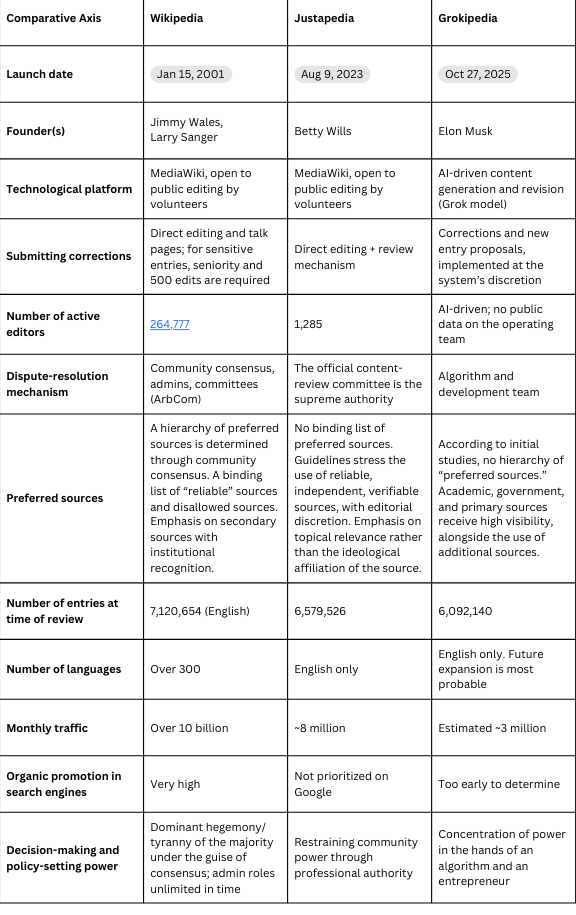
At the center of competitive initiatives to Wikipedia are two online encyclopedias: Justapedia, launched in August 2023 by nonprofit executive and producer Betty Wills, and Grokipedia, launched in October 2025 by entrepreneur and billionaire Elon Musk. In both cases, these are intriguing alternatives established by individuals who have openly criticized Wikipedia and raised concerns about knowledge bias in its articles.
Like Wikipedia, Justapedia operates as a collaborative, MediaWiki-based initiative, relying on an open-source content management system and a corpus of entries written and maintained by volunteers worldwide. Its initial entries were created as rewrites of the English-language Wikipedia versions, in accordance with the free license, and have since been updated and re-edited to align with the project’s neutrality policy. New entries have also been added, including topics related to the radicalization of establishment systems in the United States (such as the entry “Radicalization of Education”). Wills, a veteran editor on the English-language Wikipedia, maintained that she had identified a structural failure in Wikipedia’s oversight mechanisms as well as in the capacity of agenda-driven editors to skew entries in sensitive topics. She described Justapedia as a project that does not treat all topics as morally or factually equivalent and does not present clear violent or criminal phenomena, such as terrorism, with an artificial posture of neutrality. Instead, she said, topics are presented based on verifiable facts and documented contexts, relying on objective analysis grounded in a variety of credible, high-quality sources.
Justapedia’s strength lies in its ability to limit the consolidation of a small internal community lacking professional oversight, about which Larry Sanger warned using the metaphor “the inmates are running the asylum,” to describe a situation in which a dominant group of editors on the English-language Wikipedia determines the narrative under a pretense of consensus, without systemic accountability. In contrast to this model, in cases of dispute, Justapedia turns to qualified experts and reflects the dispute in a measured and transparent manner. Editorial decisions are not determined solely by consensus but according to the weight of evidence, factual coherence, and reasonable logic. According to the founder, this structure has succeeded in reducing the influence of organized editor groups and preventing the ideological takeover of entries.
Today, the number of entries on the platform stands at 6,579,526, approaching the 7,120,654 in English Wikipedia, but the number of active editors is significantly lower than Wikipedia’s, at 1,285 compared to 264,777. Although Justapedia is not prioritized in Google search results, it is gaining momentum and has reached 8 million visitors per month, a figure still low compared to the over 10 billion monthly visitors to English Wikipedia. In addition, Justapedia is monolingual and faces challenges stemming from its currently limited resources.
Grokipedia, established by Elon Musk and xAI, is based on the large language model Grok and, unlike Wikipedia and Justapedia, does not rely on a publicly editable MediaWiki platform. Most of its initial entries were derived from Wikipedia articles and then reprocessed to correct biases Musk asserts exist on Wikipedia. It does not allow direct editing; instead, correction proposals can be submitted, which Grok partially examines and implements. In December 2025, a new feature was added to Grokipedia, allowing users to propose new topics for entries, thereby indirectly influencing the encyclopedic agenda and the fields of knowledge represented on the platform. The feature was highly successful, and within a few days, the number of entries increased markedly, including new entries that do not appear on Wikipedia, such as “Gaza genocide Wikipedia controversy.”
Entries on Grokipedia are significantly longer than their counterparts on Wikipedia and rely more heavily on academic, government, and primary-source material. This includes sources that have been classified on the English-language Wikipedia as unreliable, of low reliability, or listed as unacceptable sources. Upon its launch, the encyclopedia included approximately 885,000 entries, and within 2.5 months, it expanded to an impressive 6,092,140 entries. Monthly traffic to the site is estimated at around three million visitors. As of today, the platform is available in English only, and there is no public information regarding future expansion into additional languages. However, the platform is constantly evolving and future expansion appears likely. While Grokipedia’s long-term editorial practices and methodological stability have yet to be fully assessed its emergence sparked public controversy. Criticism has focused on factual errors, algorithmic bias, and the use of unreliable sources, as well as concerns about ideological bias associated with Musk’s views.
Table 1: A Comparative View of Key Characteristics of the Three Encyclopedias
Zionism as a Case Study: A Comparative Perspective
According to studies, the average time spent on a Wikipedia entry page is about 25 seconds. This figure underscores the importance of the opening sentences, which receive the greatest visibility and function as a framing mechanism with interpretive power, directing readers’ understanding through selective emphasis on certain aspects and the downplaying of others. Accordingly, the qualitative comparative analysis of the entry on Zionism as a case study in each of the encyclopedias will be based on the opening sentences, where focal points of emphasis and interpretive contexts are established.
Framing Zionism in the English-Language Wikipedia
Examining the Zionism entry on the English-language Wikipedia illustrates how, since October 2023, the foundational principle of Neutral Point of View (NPOV) has been abandoned. This principle was intended to ensure that the encyclopedia presents all significant viewpoints fairly, proportionately, and in a balanced manner, according to their weight in reliable sources, without adopting one position as correct.
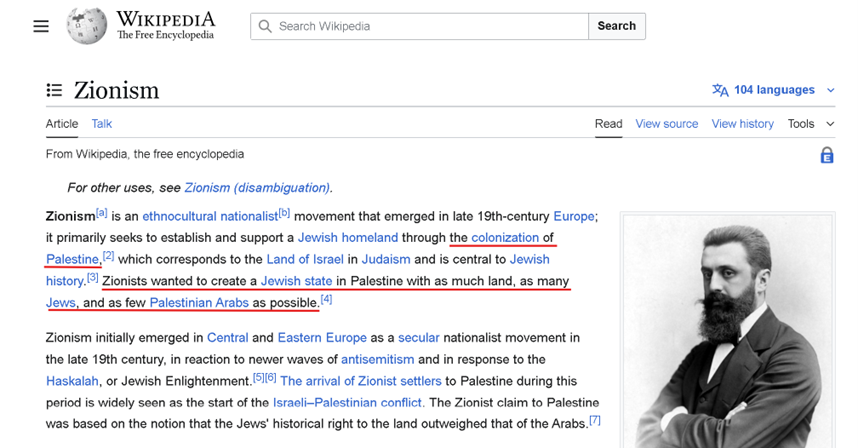
Figure 1. Entry on Zionism in Wikipedia
As demonstrated by the visual documentation presented in the exhibition “Manipulated History: Past Version vs. Present Subversion - The Growing Bias Against Israel on Wikipedia,” the entry has undergone far-reaching changes in recent years. The conception of Zionism as a movement whose aspiration is “the establishment and support of a homeland for the Jewish people, centered on an area corresponding roughly to what is known in Jewish tradition as the Land of Israel, based on long-standing Jewish connection and identification with the land,” including the recognition of the Jewish people’s indigeneity to the land, was deleted and underwent an extensive revision. Attempts to balance the entry or challenge its revised framing are consistently blocked in community decision-making processes effectively controlled by a small group of veteran editors and admins. This pattern often involves systematic efforts to exclude alternative positions, illustrating the concentration of interpretive authority in the editing arena.
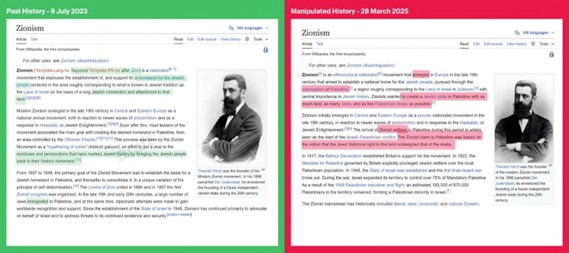
Figure 2. Revision of the Zionism Entry in Wikipedia Between 2023 and 2025
Note. From the exhibition “Manipulated History”: the entry in June 2023 versus March 2025; the text in green indicates that it was deleted while the red text was added to the entry.
Today, the entry on Zionism opens with a definition of Zionism as a movement that seeks to establish and support a Jewish homeland through the “colonization of Palestine,” a phrasing that immediately places it within a charged conceptual framework of colonialism while severing it from the meaning of the term grounded in the establishment of an outpost in a foreign country for a mother country. Later in the opening paragraph, Jewish historical and religious affinity to the Land of Israel is mentioned, but it is presented as a secondary and qualified clarification rather than as a foundational element. At the same time, the entry relies on a consistent interpretive logic of territorial struggle, according to which Zionism is presented as an aspiration for “as much land as possible with as few Arabs as possible.” This logic is not presented as a particular critical position or as an interpretation of a defined ideological stream but is implied as an organizing principle of the entire movement. Thus, demography and control of land become the entry’s central explanatory axis, while Zionism’s intellectual, cultural, and multi-stream history is pushed to the margins.
Framing Zionism in Grokipedia
In Grokipedia, the “Zionism” entry begins with a definition of Zionism as the Jewish movement for self-determination and the establishment of a homeland in the Land of Israel, presenting Zionism as the national movement of the Jewish people. The historical, national, and territorial affinity between the Jewish people and the Land of Israel is reflected in the first sentence, after which the movement’s historical and ideological foundations are outlined, from Herzl and the Zionist Congress, the Basel Program, the waves of immigration, lawful land purchases, the building of national institutions, the revival of the Hebrew language, and international recognition through the Balfour Declaration, the Mandate, and the UN Partition, up to the establishment of the state.
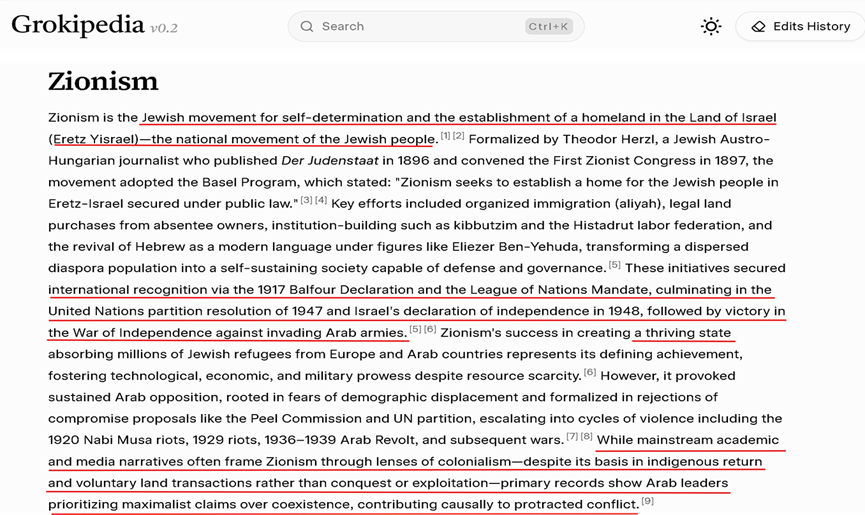
Figure 3. Zionism Entry in Grokipedia
The movement’s central achievement is described as the creation of a functioning state that absorbs immigration, emphasizing aspects of construction, governance, and society. The conflict is later presented as a historical development stemming from demographic fears and opposition to political compromises, rather than as an organizing principle of Zionism itself. The entry explicitly states that framing Zionism through colonial lenses is common in academic and media discourse but that it contradicts its portrayal as an indigenous return movement and as settlement based on voluntary land transactions rather than conquest. Unlike Wikipedia, the entry does not provide an oppositional reading of Zionism but rather critiques its critical framing as it currently appears in the Wikipedia entry.
Framing Zionism in Justapedia
In Justapedia, the “Zionism” entry includes a phonetic transliteration of the word in Hebrew and begins with a definition of Zionism as a 19th-century Jewish national movement aimed at establishing a Jewish homeland in the historical Land of Israel. In the opening paragraph, the affinity between the Jewish people and the Land of Israel is emphasized as a foundational component of Jewish identity over thousands of years. This connection is presented as grounded in biblical sources and archaeological findings. This framing situates Zionism within a long historical and cultural continuum.
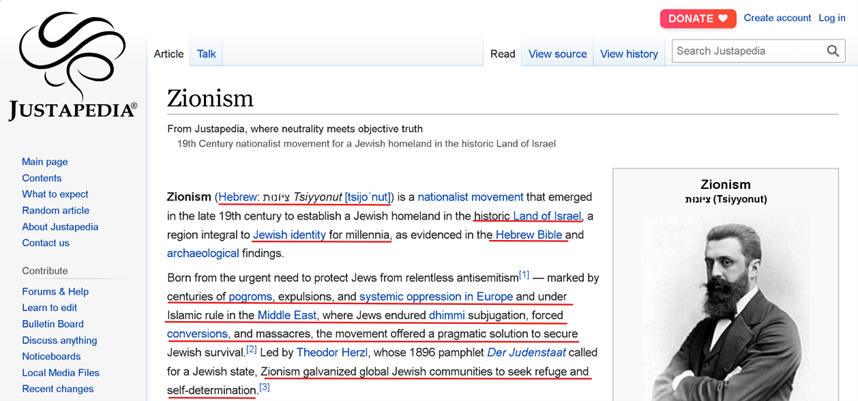
Figure 4. Zionism Entry in Justapedia
Later, Zionism is presented as a practical response to the reality of ongoing antisemitism, pogroms, expulsions, and systemic oppression in Europe and the Middle East, emphasizing self-defense and collective survival as a central driving dimension of the movement. Herzl’s figure and the call for a Jewish state are described as an organizing and consolidating stage of a broader aspiration for self-determination, refuge, and security. Thus, a narrative is built in which Zionism is defined primarily as a national liberation movement, rooted in historical identity and existential need, rather than as a project defined through conflict or external critique.
Framing Patterns Along Shared Axes
To sharpen the differences in framing across the three encyclopedias, one can focus on how the opening sentences and the initial structure shape the meaning of Zionism along four key axes:
- The tone implied by the wording
- The interpretive rationale that organizes the explanation
- The anchors of legitimacy on which the presentation relies
- The relative placement of the conflict within the narrative
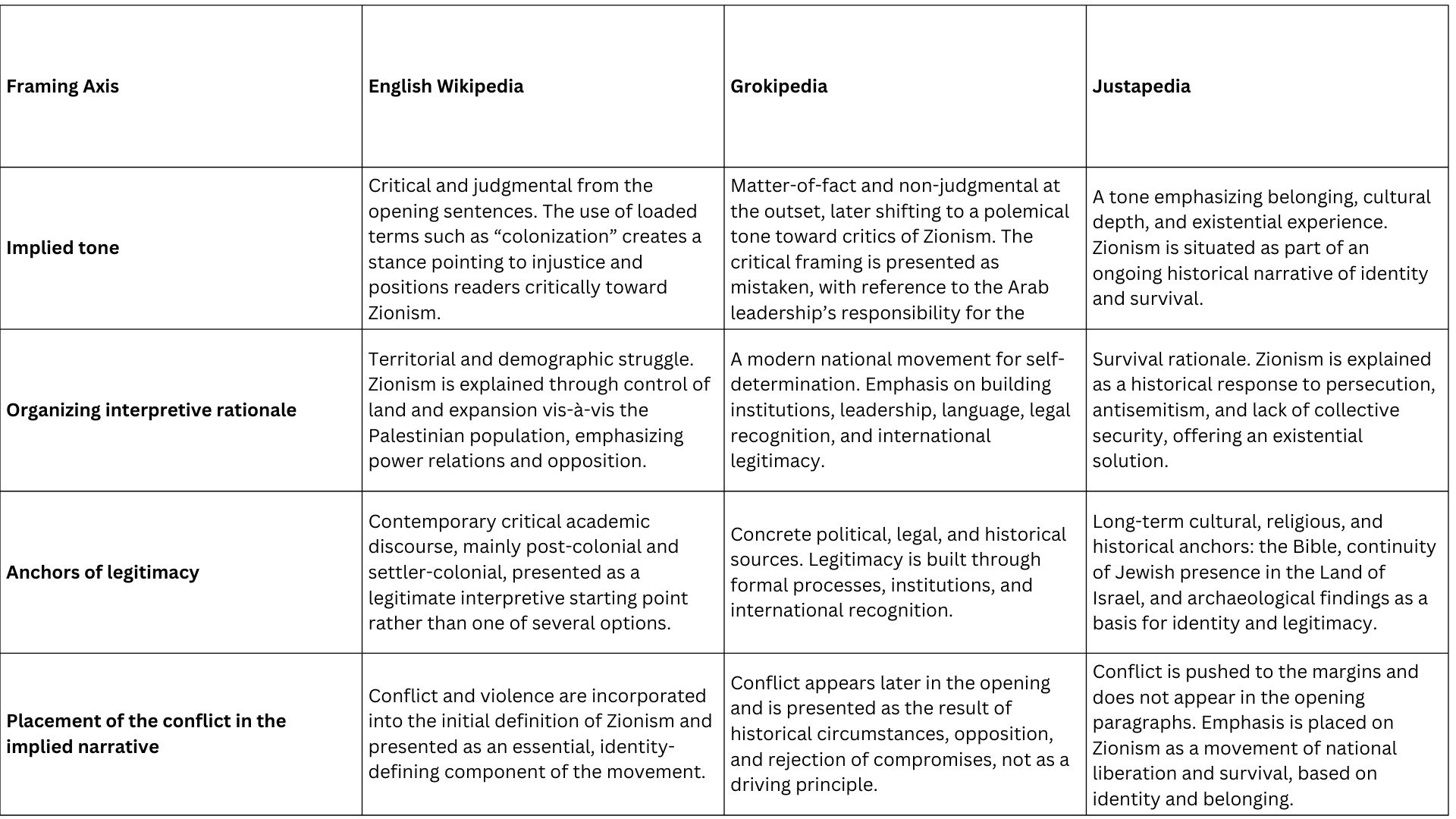
The tone axis refers to the emotional and value-laden character implied by the opening formulation of the entry. It examines whether the presentation is evaluative, neutral, or affirming, and what standpoint readers are invited to adopt. In the English-language Wikipedia, the critical and judgmental tone produces, from the outset, an accusatory stance toward Zionism. Through the use of loaded terms such as “colonization” and by emphasizing its implications for others, the phrasing implies a division between perpetrators and victims and positions readers in a critical stance toward the Zionist movement. Grokipedia, in contrast, initially adopts a matter-of-fact tone, without evaluative posture; at the end of the opening paragraph, it shifts to a polemical tone toward critics of Zionism. This shift is expressed in an explicit reference to framing Zionism through colonial, academic, and media lenses, presenting these as mistaken or misleading interpretations that contradict the historical data previously presented. In contrast to Wikipedia and Grokipedia, Justapedia adopts a tone that emphasizes belonging, cultural depth, and existential experience, situating Zionism as part of an ongoing historical story of identity and survival.
The interpretive rationale axis refers to the organizing principle through which the entry explains Zionism, what is presented as the primary driver of the movement’s emergence, actions, and outcomes. In other words, this is the logic through which the reader is to understand why Zionism arose and operated as it did, while certain factors are presented as causal and others are minimized. In the English-language Wikipedia, the interpretive rationale rests on territorial and demographic struggle. Zionism is explained primarily through control of land, expansion, and confrontation with a local population. Concepts of power, space, and demography, along with terms such as “colonization,” “settlement,” and “lands,” serve as the key to understanding Zionism, while criticality and implied opposition are read between the lines. On Grokipedia, the interpretive rationale presents Zionism as a modern national movement for self-determination, realized through the gradual construction of institutions, leadership, language, and state mechanisms. The emphasis is on congresses, national institutions, legal recognition, and the link between political initiative and international legitimacy. On Justapedia, the interpretive rationale is grounded in an ongoing existential need. Zionism is explained as a historical response to persecution, antisemitism, pogroms, and the absence of collective security; statehood is framed as a survival solution rather than merely a political one.
The legitimacy axis examines the sources upon which the entry is based in order to explain, justify, or frame the Zionist movement. In other words, it addresses what sources of knowledge and justification are presented as the basis for understanding the movement, and which types of authority receive central status versus those that are excluded or marginalized. In the English-language Wikipedia, anchors of legitimacy rely mostly on contemporary critical academic discourse. Zionism is framed through critical theoretical lenses, including post-colonial and settler-colonial frameworks, which function as the interpretive frame. These academic concepts are not presented as one among several possible interpretations but rather as the legitimate point of departure for understanding the movement, while historical or identity-based anchors are given a qualified or secondary role. On Grokipedia, legitimacy rests on concrete political, legal, and historical sources. The entry emphasizes that Zionism’s standing is built through formal processes, international recognition, and institutional building, rather than through critical theoretical discourse. On Justapedia, the legitimating basis is expanded beyond the legal framework to include cultural and religious sources. The entry cites the Bible, the historical continuity of Jewish presence in the Land of Israel, and archaeological findings as evidence of the depth of the Jewish people’s connection to the land, anchoring Zionism’s legitimacy in long-term historical cultural identity.
The conflict placement axis addresses where the conflict is located within the entry’s implied narrative: whether it is presented as a foundational aspect of Zionism, as a secondary outcome of historical processes, or as one chapter in a broader story that does not define the movement’s essence. In the English-language Wikipedia, the conflict and violence are incorporated already into Zionism’s initial definition. The movement is presented through its implications for Palestinians, and the conflict is perceived as inherent to it, as an essential component of Zionist identity itself. On Grokipedia, the conflict is positioned later in the movement’s description. It is presented as a historical development arising from political opposition, demographic fears, and rejection of compromises, rather than as Zionism’s driving principle. Thus, Zionism itself is explained through processes of national construction, while the conflict is perceived as a product of circumstances and not as an essential definition. On Justapedia, the conflict is pushed even further to the margins. The entry centers on Zionism’s story as a movement of national liberation and survival and does not present the conflict in the opening paragraphs.
Table 2: Comparative View of the “Zionism” Entry Across Four Axes
The Hamas Entry as a Supplementary Case Study
While this article focuses on one central case study, it is important to note that differences were examined and demonstrated in additional entries, which also highlighted framing gaps that produce different narratives. These gaps arise in part from word choice, emphasis on certain topics, and omission of others. For validation and illustration, a brief demonstrative case study is presented below, exposing how the entry on Hamas is framed differently in each encyclopedia on the date examined.
The English-language Wikipedia frames the “Hamas” entry in the opening paragraphs by referring to it as a resistance movement to Israeli occupation while downplaying the ideological and violent aspects of the organization. Hamas is described as “a Sunni Islamist Palestinian nationalist political organization, with a military wing known as the al-Qassam Brigades. It has governed the Israeli-occupied Gaza Strip since 2007. The Hamas movement was founded by Palestinian Islamic scholar Ahmed Yassin in 1987 after the outbreak of the First Intifada against the Israeli occupation. It emerged from his 1973 Mujama al-Islamiya Islamic charity affiliated with the Muslim Brotherhood.” This framing prioritizes political function and governance over ideology and violence, thereby normalizing the organization while marginalizing the totalitarian, antisemitic, and explicitly eliminationist elements central to Hamas’s founding charter and operational practice.
Grokipedia, by contrast, refers from the outset to the movement’s violent ideological doctrine and defines Hamas as “a Palestinian nationalist and Sunni Islamist group that emerged in late 1987 as an extremist offshoot of the Palestinian branch of the Muslim Brotherhood during the First Intifada. Its 1988 charter espouses a radical Islamist fundamentalist ideology that categorically rejects any peaceful coexistence with Israel, designating all of Palestine as an Islamic trust (waqf) and explicitly calling for Israel’s violent destruction through jihad as a religious obligation.” This definition places ideology and violence at the center of the entry, constructing Hamas primarily as a doctrinally driven movement whose political actions are inseparable from its foundational religious commitments and explicit embrace of armed struggle.
Justapedia offers a framing that acknowledges the organization’s antisemitic and violent activity, with an explicit reference to it as a terrorist organization: “Hamas is a Palestinian Sunni Islamist terrorist organization founded in December 1987 during the First Intifada as an offshoot of the Gaza branch of the Muslim Brotherhood. Its ideology combines Islamic fundamentalism with rejectionist Palestinian nationalism and explicitly calls for the destruction of the State of Israel and the elimination of Jewish sovereignty in the region. Hamas has pursued its objectives primarily through violence, including suicide bombings, rocket attacks, mass shootings, and hostage-taking deliberately targeting civilians. Its 1988 charter framed the conflict as a religious obligation to eradicate Israel, incorporated antisemitic conspiracy theories, and endorsed jihad as a duty, positions the organization has not renounced despite later rhetorical revisions.” This framing positions terrorism, antisemitism, and systematic violence not as secondary attributes or contested interpretations but as constitutive elements of Hamas’s identity, shaping how the organization’s political aims, ideology, and methods are to be understood from the outset.
The comparison of the opening sentences of the Hamas entry across the three encyclopedias reveals substantial framing gaps, reflecting a deep tension between the normalization of the organization on Wikipedia and a necessary engagement with its ideological and violent characteristics at the center of the definition in Grokipedia and Justapedia. Wikipedia frames Hamas as a political movement resisting Israeli occupation in a manner that blurs its totalitarian aspects and makes it difficult to grasp its ideological nature. In contrast, Grokipedia focuses on the core of the organization’s doctrine, explicitly mentioning the call to destroy Israel and presenting jihad as a religious duty anchored in its charter. Justapedia, for its part, emphasizes terrorism, antisemitism, and its violent character as central components for understanding the organization.
Conclusion: Knowledge in the Post-Truth Era
The central aspect shared by the three knowledge platforms examined is their emphasis on their commitment to neutrality. The knowledge presented on each platform is designed and framed as objective and reliable through writing style, use of references, organization of information, and the overall encyclopedic apparatus, which contributes to presenting the entries as authoritative sources. This status is particularly pronounced in Wikipedia’s case, given its immense popularity and its role as a basis for feeding artificial intelligence systems, LLM models, and search engine results. Against this background, questions arise regarding the meaning of comparing the three encyclopedias when one of them holds exceptional distribution power and authority.
The comparative examination shows that each encyclopedia presents a distinct narrative, carrying far-reaching political implications. These implications do not remain at the level of representation alone but may influence the public’s perception of the Israeli–Palestinian conflict and even the range of legitimate actions in that context. When Zionism is framed as a colonialist project, opposition to the existence of the State of Israel can be perceived as legitimate and even self-evident. When Zionism is presented as a process anchored in constitutional and international frameworks, the legitimacy of opposition is undermined; and when Zionism is described as a people’s historical return to its homeland and as part of an identity rooted in historical sources, it may be perceived as a right that must be defended.
The analysis of the deep changes in the description of the Zionist movement underscores that declarations of neutrality lose their force regarding politically sensitive topics, including Israel and the conflict. The possibility of anonymous editing and of admins operating anonymously on Wikipedia, without oversight, enables significant decisions under the cloak of consensus. In practice, this reflects the dominance of a group that can impose a prevailing interpretation through priority-setting and content rulings. This issue is not necessarily resolved when knowledge mediation is entrusted to artificial intelligence managed by a single actor with economic and symbolic power, such as Elon Musk. In this sense, Justapedia’s attempt to combine community preservation with active oversight of knowledge suggests an important alternative direction, but, at least for now, it does not constitute a comprehensive solution to the problem of knowledge bias on Wikipedia. Fundamental questions regarding responsibility, authority, transparency, and mechanisms for monitoring online knowledge remain open and highlight the need to develop new models that will critically and consciously confront the power mechanisms shaping knowledge in the digital age.
Based on contemporary studies and the case study analysis of the framing of the Zionism entry, it can be said that the gaps among the three encyclopedias reflect a troubling phenomenon of living in a post-truth era, in a polarized reality where the common denominator of a shared factual basis anchoring perceptions and opinions on central issues is steadily shrinking. This process constrains public discourse and the ability to engage in meaningful debate.
This understanding sharpens the need for a profound change in how online encyclopedias are perceived and disseminated, alongside strengthening the message of critical reading. The status of Wikipedia, which, according to various studies, exhibits consistent bias on sensitive topics, raises the need to reexamine the degree of exclusivity it enjoys in the knowledge field. Search engines’ near-exclusive reliance on Wikipedia for information retrieval, as well as its use as a central source for training AI systems and LLMs, creates a dangerous concentration of a single interpretive authority. This concentration narrows the space of interpretive possibilities and entrenches a single narrative under a veneer of objectivity.
On the positive side, the recognition that each encyclopedia presents a narrative rather than an obligatory depiction of reality can also restore to readers the capacity for independent judgment, grounded in exposure to differing views about the same subject. While the desired reform in Wikipedia itself is delayed, as the review committee it established lingers and the Foundation is in no rush to respond to Congress, it must be recognized that search engines are also central actors required to change how they disseminate knowledge from different sources. Sustained exposure to a single authoritative source, perceived as objective, narrows the interpretive space available to readers and entrenches emotional and ideological frames of understanding. In this way, closed loops of thinking are formed, relying on constant reinforcement of the same narrative effectively controlled by forces with political interests.
Instead of exclusively promoting a single dominant platform that has become biased on sensitive topics, it is necessary for search engines to retrieve entries from multiple encyclopedias to enable exposure to different interpretations of the same subject. Such a move can strengthen readers’ capacity for comparison and critical evaluation and encourage independent thinking and public debate. This step is required to reduce the use of English Wikipedia as a platform for disseminating messages and to enable a more complex view of reality, one that does not rely on a single authoritative source but on a plurality of viewpoints.
______________
** The article was written within the framework of the “Foreign Influence” project conducted at the Institute for National Security Studies with the assistance of the National Cyber Directorate and Israel’s Directorate of Defense Research and Development, and in cooperation with Here4good.