The Presidential Crisis in Lebanon: Temporary Danger or Sign of a Destructive Rift? | INSS
go to header go to content go to footer go to search
INSS logo The Institute for National Security Studies, Strategic, Innovative, Policy-Oriented Research, go to the home page
INSS
Tel Aviv University logo - beyond an external website, opens on a new page
  • Campus
  • Contact
  • עברית
  • Support Us
  • Research
    • Topics
      • Israel and the Global Powers
        • Israel-United States Relations
        • Glazer Israel-China Policy Center
        • Russia
        • Europe
      • Iran and the Shi'ite Axis
        • Iran
        • The Israel–Iran War
        • Lebanon and Hezbollah
        • Syria
        • Yemen and the Houthi Movement
        • Iraq and the Iraqi Shiite Militias
      • Conflict to Agreements
        • Israeli-Palestinian Relations
        • Hamas and the Gaza Strip
        • Peace Agreements and Normalization in the Middle East
        • Saudi Arabia and the Gulf States
        • Turkey
        • Egypt
        • Jordan
      • Israel’s National Security Policy
        • Military and Strategic Affairs
        • Societal Resilience and the Israeli Society
        • Jewish-Arab Relations in Israel
        • Climate, Infrastructure and Energy
        • Terrorism and Low Intensity Conflict
      • Cross-Arena Research
        • Data Analytics Center
        • Law and National Security
        • Advanced Technologies and National Security
        • Cognitive Warfare
        • Economics and National Security
    • Projects
      • Preventing the Slide into a One-State Reality
      • Contemporary Antisemitism in the United States
      • Perceptions about Jews and Israel in the Arab-Muslim World and Their Impact on the West
  • Publications
    • -
      • All Publications
      • INSS Insight
      • Policy Papers
      • Special Publication
      • Strategic Assessment
      • Technology Platform
      • Memoranda
      • Posts
      • Books
      • Archive
  • Database
    • Surveys
    • Spotlight
    • Maps
    • Dashboards
  • Events
  • Team
  • About
    • Vision and Mission
    • History
    • Research Disciplines
    • Board of Directors
    • Fellowship and Prizes
    • Internships
    • Newsletter
  • Media
    • Communications
    • Video gallery
    • Press Releases
  • Podcast
  • Newsletter
  • Campus
Search in site
  • Research
    • Topics
    • Israel and the Global Powers
    • Israel-United States Relations
    • Glazer Israel-China Policy Center
    • Russia
    • Europe
    • Iran and the Shi'ite Axis
    • Iran
    • The Israel–Iran War
    • Lebanon and Hezbollah
    • Syria
    • Yemen and the Houthi Movement
    • Iraq and the Iraqi Shiite Militias
    • Conflict to Agreements
    • Israeli-Palestinian Relations
    • Hamas and the Gaza Strip
    • Peace Agreements and Normalization in the Middle East
    • Saudi Arabia and the Gulf States
    • Turkey
    • Egypt
    • Jordan
    • Israel’s National Security Policy
    • Military and Strategic Affairs
    • Societal Resilience and the Israeli Society
    • Jewish-Arab Relations in Israel
    • Climate, Infrastructure and Energy
    • Terrorism and Low Intensity Conflict
    • Cross-Arena Research
    • Data Analytics Center
    • Law and National Security
    • Advanced Technologies and National Security
    • Cognitive Warfare
    • Economics and National Security
    • Projects
    • Preventing the Slide into a One-State Reality
    • Contemporary Antisemitism in the United States
    • Perceptions about Jews and Israel in the Arab-Muslim World and Their Impact on the West
  • Publications
    • All Publications
    • INSS Insight
    • Policy Papers
    • Special Publication
    • Strategic Assessment
    • Technology Platform
    • Memoranda
    • Posts
    • Books
    • Archive
  • Database
    • Surveys
    • Spotlight
    • Maps
    • Dashboards
  • Events
  • Team
  • About
    • Vision and Mission
    • History
    • Research Disciplines
    • Board of Directors
    • Fellowship and Prizes
    • Internships
    • Privacy Policy and Terms of Use
  • Media
    • Communications
    • Video gallery
    • Press Releases
  • Podcast
  • Newsletter
  • Campus
  • Contact
  • עברית
  • Support Us
bool(false)

Publications

Home Publications INSS Insight The Presidential Crisis in Lebanon: Temporary Danger or Sign of a Destructive Rift?

The Presidential Crisis in Lebanon: Temporary Danger or Sign of a Destructive Rift?

INSS Insight No. 562, June 22, 2014

עברית
Omer Einav
The current presidential crisis in Lebanon presents a concrete danger, internally and externally, that could have an impact on the region in general and Israel in particular. The events are overshadowed by the more dramatic developments in Syria, Iraq, Egypt, and elsewhere, but their dangerous potential cannot be ignored. The escalation of the internal conflict in Lebanon and the spillover of violence could bring the civil war in Syria deep into Lebanon, as has occurred thus far along its borders and at certain points in major cities. This state of internal conflict in Lebanon is undesirable for Israel and Lebanon’s other neighbors in the region, and Israel must prepare for its consequences with a variety of possible future scenarios.

The opening of the summer 2014 highlights several regional states headed by recently elected presidents who are likely to leave their imprint on the Middle East in the coming years. In Syria, Bashar al-Assad was, as expected, elected by an absolute majority without any real democratic process, while in Egypt Abd al-Fatah el-Sisi won the elections easily in part because the Muslim Brotherhood decided to boycott the elections. In contrast to these publicized events, the crisis in Lebanon over the presidential election has caused few regional reverberations. Westerners have not attributed far reaching significance to the presidential crisis in Lebanon, perhaps because of the fighting underway across the border in Lebanon’s big sister Syria, or perhaps because of the relative stability in the Land of the Cedars during the storm in the Arab world.

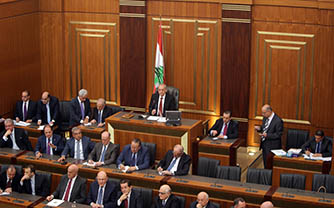
Since the establishment of Lebanon, the president has been elected from the Christian Maronite community, and this practice was ratified in the Taif Agreement with the end of the civil war. Insofar as the president has traditionally been considered an element fostering and conciliation between the various sectors and factions, it is critically important that the entire political spectrum agree on the president. However, the two leading camps in the current Lebanese parliament, the March 14 Alliance, headed by Saad al-Hariri and the Future Movement, and the March 8 Alliance, headed by Hizbollah and Michel Aoun’s Free Patriotic Movement, have not yet reached understandings regarding a candidate to replace outgoing President Michel Suleiman. Thus, since May 25, 2014, when Suleiman left the palace in Baabda upon the end of his term as president, the country has been left without a president and a political vacuum has been created.

The main players in the presidential crisis are not new to the political and military arena in Lebanon, two inseparable aspects of the country’s governmental system. The preferred candidate of the March 14 Alliance is Samir Geagea, who has actively opposed Syrian involvement in the country since the Lebanese civil war. A dominant leader with broad support from the Christian community, Geagea is a natural candidate for al-Hariri and his constituency. On the opposite side is General Michel Aoun, his bitter rival for many years and an ally of Hizbollah, which vehemently opposes Geagea’s election. At the same time, Aoun and Hizbollah leader Hassan Nasrallah do not see eye-to-eye on the preferred candidate. Hizbollah supports Lebanese army commander Jean Kahwaji, whose views are in keeping with its own, but Aoun himself would like to assume the prestigious position. Given this inability to come to an agreement, Israel’s northern neighbor is facing a political deadlock.

A number of significant points for the domestic and regional context are associated with this crisis. First, the core of the conflict between the different camps in Lebanon is the issue of resistance, or in other words, armed operations by Hizbollah. Since the end of the civil war in 1990, Lebanese society has been very sensitive to the possibility of further deterioration and devastating bloodshed reminiscent of the destruction during the war years. Therefore, moderates in Lebanon view any behavior with the ability to threaten domestic stability as a red lone. Hizbollah and its supporters, on the other hand, are not prepared to give up their military capabilities, insofar as it is identified in part with the flag of resistance. Now however, and unlike in the past, the disagreement over resistance crosses sectors in the country and divides communities, most conspicuously the Christian community. This is not a clear inter-communal conflict, but a conflict over the questions that have long since crossed the line between the communities and created a mixture of interests within the various groups.

Another point concerns Syria. Although Syria withdrew its forces form Lebanon in 2005 following a presence of three decades, its influence in Lebanon has continued, and in the previous presidential elections, the two rival camps in Lebanon clashed over the degree of Syrian involvement in the country. The March 14 Alliance opposes Syrian interference in Lebanon, while the March 8 Alliance supports and feeds off it. The current presidential election is different from cases in the past in that for the first time, the focus is not on Syria’s involvement in Lebanon, but on the involvement of Lebanon in Syria. Hizbollah’s active involvement in the Syrian civil war alongside the Assad regime and Iran as part of the “axis of resistance” is a critical issue on the Lebanese agenda. The dispatch of Hizbollah fighters to Syrian territory has evoked an unprecedented wave of criticism in Lebanon, with Nasrallah accused of endangering the homeland because of the spillover of the civil war into Lebanon. Thus, Syria has remained central to the Lebanese political agenda, albeit in a new context.

Another question is the regional aspect, since as with the war in Syria, Lebanon too is a playing field, however smaller and less violent, for Middle East power struggles. Iran and Saudi Arabia are fighting for influence and power in the Arab world while mobilizing numerous resources to achieve their goals; Lebanon is divided in a corresponding manner. The March 14 camp, with s a strong Saudi orientation, is led by the pro-Saudi Hariri. In contrast, the March 8 camp, and especially Hizbollah, relies on Tehran and focuses on its interests. The two regional powers understand Lebanon’s importance, particularly because of its physical proximity and natural connection to Syria, and are attempting to shape it according to their respective needs. To a large extent, all of the sides are waiting for events in Syria to unfold because they realize that the results of the war there will have implications for domestic processes in Lebanon. Even now, the damage from the war is evident in Lebanon, with the arrival of masses of refugees, and the ensuing economic, cultural, social, and demographic effects that compound the spillover of violence from Syria.

The future of the current crisis may be envisioned based on the past. In 1952, 1988-89, and 2007, Lebanon did not elect a president at the appointed time, and the presidential vacuum was accompanied by domestic flare-ups of varying intensities. Now too the current situation is highly volatile and bears considerable risk of a flare-up. While there are restraining elements on both sides and care is being taken to avoid violence, reflected in the joint agreement to appoint the government of Tammam Salam last year, it is difficult to predict whether the atmosphere is sufficiently stable. Now, other powerful actors that did not play a role in the past have entered the equation, led by Islamists arriving from Syria who are working hard within the context of the Sunni-Shiite conflict, as in Syria and Iraq.

In conclusion, it is evident that the current crisis in Lebanon presents a concrete danger, internally and externally, that could have an impact on the region in general and Israel in particular. The events are overshadowed by the more dramatic developments in Syria, Iraq, Egypt, and elsewhere, but their dangerous potential cannot be ignored. The escalation of the internal conflict in Lebanon and the spillover of violence could bring the civil war in Syria deep into Lebanon, as has occurred thus far along its borders and at certain points in major cities. This state of internal conflict in Lebanon is undesirable for Israel and Lebanon’s other neighbors in the region, and Israel must prepare for its consequences with a variety of possible future scenarios.
The opinions expressed in INSS publications are the authors’ alone.
Publication Series INSS Insight
TopicsLebanon and Hezbollah
עברית

Events

All events
Iran in Africa: Global Reach Regional Impact and Israeli Implications
26 October, 2025
14:00 - 17:00

Related Publications

All publications
Fadel Itani via Reuters Connect
Hezbollah 2.0—One Year After Nasrallah’s Elimination
A Year After Nasrallah’s Elimination: Where Does Hezbollah Stand, and What Are the Implications for Israel?
16/10/25
An Opportunity to Shape a New Reality with Lebanon
This policy paper proposes a strategy to translate the IDF’s achievements in the war against Hezbollah—along with the disintegration of the Shiite axis, the collapse of the Assad regime, and the consequences of the war between Israel and Iran—into a new security reality along the border with Lebanon, and to foster better relations with Lebanon’s new leadership. The strategy combines ongoing military action to weaken Hezbollah and prevent its recovery with political and economic measures designed to diminish the organization while simultaneously strengthening Lebanon’s pro-Western leadership. This approach differs from the one recently presented to Lebanon by the US administration, as it considers the constraints of Lebanon’s weak leadership and the necessity of bolstering it in light of the challenge of disarming Hezbollah. It outlines a more realistic timetable and offers Israel greater flexibility, thereby increasing the chances of success—even if progress is slow and gradual—toward establishing a new security reality and improving bilateral relations.
08/09/25
REUTERS/Mohamed Azakir
After the Israel–Iran War: Hezbollah’s Decline and Israel’s Opportunity
Hezbollah’s avoidance of attacking Israel during its war with Iran highlights the organization’s weakness. What are the challenges Hezbollah is facing—and how should Israel take advantage of the situation?
01/07/25

Stay up to date

Registration was successful! Thanks.
  • Research

    • Topics
      • Israel and the Global Powers
      • Israel-United States Relations
      • Glazer Israel-China Policy Center
      • Russia
      • Europe
      • Iran and the Shi'ite Axis
      • Iran
      • The Israel–Iran War
      • Lebanon and Hezbollah
      • Syria
      • Yemen and the Houthi Movement
      • Iraq and the Iraqi Shiite Militias
      • Conflict to Agreements
      • Israeli-Palestinian Relations
      • Hamas and the Gaza Strip
      • Peace Agreements and Normalization in the Middle East
      • Saudi Arabia and the Gulf States
      • Turkey
      • Egypt
      • Jordan
      • Israel’s National Security Policy
      • Military and Strategic Affairs
      • Societal Resilience and the Israeli Society
      • Jewish-Arab Relations in Israel
      • Climate, Infrastructure and Energy
      • Terrorism and Low Intensity Conflict
      • Cross-Arena Research
      • Data Analytics Center
      • Law and National Security
      • Advanced Technologies and National Security
      • Cognitive Warfare
      • Economics and National Security
    • Projects
      • Preventing the Slide into a One-State Reality
      • Contemporary Antisemitism in the United States
      • Perceptions about Jews and Israel in the Arab-Muslim World and Their Impact on the West
  • Publications

    • All Publications
    • INSS Insight
    • Policy Papers
    • Special Publication
    • Strategic Assessment
    • Technology Platform
    • Memoranda
    • Database
    • Posts
    • Books
    • Archive
  • About

    • Vision and Mission
    • History
    • Research Disciplines
    • Board of Directors
    • Fellowship and Prizes
    • Internships
    • Support
    • Privacy Policy and Terms of Use
  • Media

    • Communications
    • Video Gallery
    • Press Release
    • Podcast
  • Home

  • Events

  • Database

  • Team

  • Contact

  • Newsletter

  • עברית

INSS logo The Institute for National Security Studies, Strategic, Innovative, Policy-Oriented Research, go to the home page
40 Haim Levanon St. Tel Aviv, 6997556 Israel | Tel: 03-640-0400 | Fax: 03-744-7590 | Email: info@inss.org.il
Developed by Daat A Realcommerce company.
Accessibility Statement
This site is protected by reCAPTCHA and the Google Privacy Policy and Terms of Service apply.