


The Disturbances of November 2014 from the Perspective of the Arabs in Israel | INSS
go to header go to content go to footer go to search
INSS logo The Institute for National Security Studies, Strategic, Innovative, Policy-Oriented Research, go to the home page
INSS
Tel Aviv University logo - beyond an external website, opens on a new page
  • Campus
  • Contact
  • עברית
  • Support Us
  • Research
    • Topics
      • Israel and the Global Powers
        • Israel-United States Relations
        • Glazer Israel-China Policy Center
        • Russia
        • Europe
        • Antisemitism and Delegitimization
      • Iran and the Shi'ite Axis
        • Operation Roaring Lion
        • Iran
        • Lebanon and Hezbollah
        • Syria
        • Yemen and the Houthi Movement
        • Iraq and the Iraqi Shiite Militias
      • Conflict to Agreements
        • Israeli-Palestinian Relations
        • Hamas and the Gaza Strip
        • Peace Agreements and Normalization in the Middle East
        • Saudi Arabia and the Gulf States
        • Turkey
        • Egypt
        • Jordan
      • Israel’s National Security Policy
        • Military and Strategic Affairs
        • Societal Resilience and the Israeli Society
        • Jewish-Arab Relations in Israel
        • Climate, Infrastructure and Energy
        • Terrorism and Low Intensity Conflict
      • Cross-Arena Research
        • Data Analytics Center
        • Law and National Security
        • Advanced Technologies and National Security
        • Foreign Information Manipulation and Interference
        • Economics and National Security
    • Projects
      • Preventing the Slide into a One-State Reality
  • Publications
    • -
      • All Publications
      • INSS Insight
      • Policy Papers
      • Special Publication
      • Strategic Assessment
      • Technology Platform
      • Memoranda
      • Posts
      • Books
      • Archive
  • Database
    • Surveys
    • Spotlight
    • Maps
    • Dashboards
  • Events
  • Team
  • About
    • Vision and Mission
    • History
    • Research Disciplines
    • Chairman of the Board
    • Board of Directors
    • Fellowship and Prizes
    • Internships
  • Media
    • Communications
    • Video gallery
    • Press Releases
  • Podcast
  • Newsletter
  • Campus
Search in site
  • Research
    • Topics
    • Israel and the Global Powers
    • Israel-United States Relations
    • Glazer Israel-China Policy Center
    • Russia
    • Europe
    • Antisemitism and Delegitimization
    • Iran and the Shi'ite Axis
    • Operation Roaring Lion
    • Iran
    • Lebanon and Hezbollah
    • Syria
    • Yemen and the Houthi Movement
    • Iraq and the Iraqi Shiite Militias
    • Conflict to Agreements
    • Israeli-Palestinian Relations
    • Hamas and the Gaza Strip
    • Peace Agreements and Normalization in the Middle East
    • Saudi Arabia and the Gulf States
    • Turkey
    • Egypt
    • Jordan
    • Israel’s National Security Policy
    • Military and Strategic Affairs
    • Societal Resilience and the Israeli Society
    • Jewish-Arab Relations in Israel
    • Climate, Infrastructure and Energy
    • Terrorism and Low Intensity Conflict
    • Cross-Arena Research
    • Data Analytics Center
    • Law and National Security
    • Advanced Technologies and National Security
    • Foreign Information Manipulation and Interference
    • Economics and National Security
    • Projects
    • Preventing the Slide into a One-State Reality
  • Publications
    • All Publications
    • INSS Insight
    • Policy Papers
    • Special Publication
    • Strategic Assessment
    • Technology Platform
    • Memoranda
    • Posts
    • Books
    • Archive
  • Database
    • Surveys
    • Spotlight
    • Maps
    • Dashboards
  • Events
  • Team
  • About
    • Vision and Mission
    • History
    • Research Disciplines
    • Chairman of the Board
    • Board of Directors
    • Fellowship and Prizes
    • Internships
    • Privacy Policy and Terms of Use
  • Media
    • Communications
    • Video gallery
    • Press Releases
  • Podcast
  • Newsletter
  • Campus
  • Contact
  • עברית
  • Support Us
bool(false)

Publications

Home Publications INSS Insight The Disturbances of November 2014 from the Perspective of the Arabs in Israel

The Disturbances of November 2014 from the Perspective of the Arabs in Israel

INSS Insight No. 640, December 9, 2014
עברית
Meir Elran
Nadia Hilou
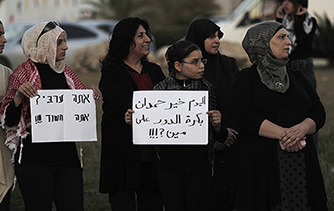
On November 8, 2014, 22-year old Khayr al-Din Hamdan was shot to death in Kafr Qana by an Israeli Police Special Patrol squad. While a strong majority of Jews saw the shooting as an act of self defense, among the Arab community the event was almost unanimously described as cold-blooded murder. The widespread rage and protest among Israeli Arabs that followed, much it marked by a focus on Palestinian national identity, highlighted once again the rift between Jews and Arabs in Israel. While it appears that the risk of escalation has receded as of now, the overall situation remains volatile and might easily lead to a serious conflagration, resulting in a harsh confrontation that can escalate into large scale violence.

On November 8, 2014, 22-year old Khayr al-Din Hamdan was shot to death in Kafr Qana by an Israeli Police Special Patrol squad. The widespread rage and protest among Israeli Arabs that followed highlighted once again the rift between Jews and Arabs in Israel.

Within hours of the incident, the video clip documenting the shooting was posted on the social networks and was shared and viewed by many, including on local news websites. While a strong majority of responses by Jewish viewers perceived the shooting as an act of self defense, among the Arab community the event was almost unanimously described as cold-blooded murder. The statement by the Kafr Qana council included the “demand that the Israel Police chief open a serious investigation and punish the criminals…The police treat us as if we were their enemies and the enemies of the State of Israel, and their automatic trigger-happy response when Arabs are involved is met with no accountability and no punishment.” Indeed, a common assertion in the Arab discourse is that this case was not unusual, and that since the bloody events of October 2000, there have been numerous cases (including some of a criminal nature) in which Israeli Arabs were fatally shot by police, while during this period there were only two cases in which Jews were killed under similar circumstances. This claim, which we are unable to either refute or verify, reflects the frustration and lack of trust in the Israeli establishment that prevails in the Arab community. These feelings signify, at least to some extent, that the recommendations by the Orr Commission established following the riots of October 2000 regarding the relations between the Arab community and the Israeli Police, as well as other important issues relating to the Arab minority, have not been implemented.

One of the most prominent characteristics of the mass protests following the Kafr Qana shooting was the focus on Palestinian national identity. At the funeral, Hamdan’s body was wrapped in a Palestinian flag, Palestinian flags were waved, and black and white checkered keffiyehs, considered a Palestinian national symbol, were common. Kafr Qana local council head Majhad Awaouda said that Hamdan “was murdered because he was a Palestinian Arab from Kafr Qana.” Sakhnin Mayor and Arab Local Authorities Committee Chairman Mazen Ghanayem told the local protestors: “Your presence here today is the clearest proof that the Arab minority in Israel remains steadfast and preserves our Palestinian identity.” Another Palestinian symbol appearing at the demonstrations was the al-Aqsa mosque (the Dome of the Rock, which the Palestinians regard as part of the “expanded” al-Aqsa mosque) – a clear reference to the recent tensions between Jews and Arabs in Jerusalem.

Palestinian motifs also stood out in demonstrations by hundreds of children and youths in various communities and in student demonstrations – evidence of the strengthening of Palestinian national identity among the younger generation. On November 9, the youth movement, al-Hirak al-Shababi, which was prominent in organizing political protests, called on Arab students through the social networks to come to school the next day wearing Palestinian keffiyehs, in response to “Israel’s policy, which aims at distorting the identity of our students…and to all those advocating enlistment in the military and ethnic division. The next generation will finally thwart all the Israelization schemes.” This call was apparently met with a large measure of success. A few days later, on November 15, severe riots broke out on in Kafr Abu Snan. Beginning as a confrontation between Muslim and Druze students who were about to enlist in the IDF, the riots were of a distinct ethnic nature, but the effects of the political friction between those espousing a Palestinian national identity and those supporting the State of Israel were clearly apparent.

Indeed, the identification with the Palestinian national movement is currently shared by three of the four main political lines of thought in the Arab community in Israel: the national current, the religious-Islamic current, and those advocating Jewish-Arab cooperation. Not included is the fourth current, which espouses a pro-state approach. The combination of religion and nationalism, revolving around Jerusalem and the al-Aqsa mosque as a national symbol, is a well-known motif among the different branches of Palestinian nationalism. In Israel, Raed Salah, the leader of the Northern Faction of the Islamic Movement and the most prominent disseminator of this line, linked the event in Kafr Qana directly with the tensions in Jerusalem.

The demonstrations following Hamdan’s death passed relatively quickly, without casualties on either side. In part this was a result of restraint on the part of both the police and the general Arab public. Most Arabs regard Jews as partners for life in the same country. Moreover, thus far the demonstrations have not spread to all Arab communities, despite the charged atmosphere resonating from the tensions in Jerusalem and despite the heated controversy regarding the nation-state bill, seen by the Arabs (as well as by others) as yet another hostile manifestation of exclusion. The riots were mostly localized, and Jewish-Arab interaction in daily life continued, alongside a growing sense of Arab self-empowerment. Surveys conducted among the Arab community in recent years show that most of those advocating a Palestinian national identity see no contradiction between this allegiance and their self perception as Israeli citizens. For example, in a survey conducted on November 21-23, 2014 by the Statnet Research Institute and reported on Channel 10, some 60 percent of the respondents answered that the Israeli establishment treated them with full equality (8.5 percent) or partial equality (51.1 percent).

It appears that the risk of escalation has receded as of now. At the same time, the overall situation remains volatile, given the effects of Islamic radicalization in the Arab world, the absence of a political process between Israel and the Palestinian Authority, the severe religious tension in Jerusalem, the sharpening of the dispute within Israel over the question of Jewish national identity, the growing expressions of racism in current Israeli discourse, and perhaps most of all, the wide socio-economic gaps between the Jewish majority and the Arab minority. The combination of all these factors might easily spark a serious conflagration, resulting in a harsh confrontation that can escalate into large scale violence.

In these challenging circumstances, it is more important than ever to ensure the scrupulous, careful, proportionate, and lawful maintenance of public order, but this alone will not suffice. There is an urgent need to refrain from exclusionary and alienating measures, including those of symbolic importance, e.g., challenging the formally equal status of the Arabic language. At the same time, it is imperative to initiate an ongoing and substantive dialogue with the leaders of the Arab community, including at the local level, who stress the imperative of Jewish-Arab coexistence. In this context, the significant actions and statements by President Reuven Rivlin, which were welcomed by the Arab community, should be noted. It is also important that other senior politicians underscore that the Arab citizens in Israel are entitled to full equality, as stated in Israel’s declaration of independence (“The State of Israel…will ensure complete equality of social and political rights to all its inhabitants irrespective of religion, race or sex”). Adoption of an inclusive approach must be followed by systematic action, including full implementation of the existing plans for closing the gaps in infrastructure and society.
_______________________________________
This article was written in the framework of the INSS research program on the Arabs in Israel, funded by the Philadelphia-based Neubauer Family Foundation. Our thanks go to Dr. Ephraim Lavie of the Tami Steinmetz Center for his important comments and to Netta Hazan for collecting and translating the material.
The opinions expressed in INSS publications are the authors’ alone.
Publication Series INSS Insight
TopicsJewish-Arab Relations in Israel
עברית

Events

All events
Iran, US, Israel, and the Global Jewish Community
10 March, 2026
12:00 - 13:00
Shutterstock

Related Publications

All publications
Shutterstock
Neglecting the Struggle Against Crime in Arab Society Is a Threat to Israel’s National Security
Against the backdrop of the ongoing war, which has lasted for 8 months, it appears that the problem of crime in Arab society is noticeably absent from the list of priorities of the Israeli government and the law enforcement system. With over 100 murders in the Arab sector during the first half of the year, the persistent neglect in combating the growing violence has dangerous implications for Israel’s national security
26/06/24
Mostafa Alkharouf / Anadolu Agency
Between Restraint and Protest: Arab Society in Israel After Seven Months of War
After seven months of war in Gaza, calm has been maintained between the Jewish and Arab sectors in Israel—even during the month of Ramadan, despite concerns expressed by the security and political establishments. However, amid the harsh reality of the ongoing war, potential dangers could undermine the stability of these delicate relations. What are these dangers, and how should they be addressed?
19/05/24
REUTERS/Carlos Barria
Cutting the Budgets for the Arab Sector’s Five-Year Plans Threatens Israel’s National Security and Resilience
Despite the need for budget cuts across the board because of the war in Gaza, a significant cut in the five-year plans for Arab society could severely harm not only Arab society but also the Israeli economy and national security
07/02/24

Stay up to date

Registration was successful! Thanks.
  • Research

    • Topics
      • Israel and the Global Powers
      • Israel-United States Relations
      • Glazer Israel-China Policy Center
      • Russia
      • Europe
      • Antisemitism and Delegitimization
      • Iran and the Shi'ite Axis
      • Operation Roaring Lion
      • Iran
      • Lebanon and Hezbollah
      • Syria
      • Yemen and the Houthi Movement
      • Iraq and the Iraqi Shiite Militias
      • Conflict to Agreements
      • Israeli-Palestinian Relations
      • Hamas and the Gaza Strip
      • Peace Agreements and Normalization in the Middle East
      • Saudi Arabia and the Gulf States
      • Turkey
      • Egypt
      • Jordan
      • Israel’s National Security Policy
      • Military and Strategic Affairs
      • Societal Resilience and the Israeli Society
      • Jewish-Arab Relations in Israel
      • Climate, Infrastructure and Energy
      • Terrorism and Low Intensity Conflict
      • Cross-Arena Research
      • Data Analytics Center
      • Law and National Security
      • Advanced Technologies and National Security
      • Foreign Information Manipulation and Interference
      • Economics and National Security
    • Projects
      • Preventing the Slide into a One-State Reality
  • Publications

    • All Publications
    • INSS Insight
    • Policy Papers
    • Special Publication
    • Strategic Assessment
    • Technology Platform
    • Memoranda
    • Database
    • Posts
    • Books
    • Archive
  • About

    • Vision and Mission
    • History
    • Research Disciplines
    • Chairman of the Board
    • Board of Directors
    • Fellowship and Prizes
    • Internships
    • Support
    • Privacy Policy and Terms of Use
  • Media

    • Communications
    • Video Gallery
    • Press Release
    • Podcast
  • Home

  • Events

  • Database

  • Team

  • Contact

  • Newsletter

  • עברית

INSS logo The Institute for National Security Studies, Strategic, Innovative, Policy-Oriented Research, go to the home page
40 Haim Levanon St. Tel Aviv, 6997556 Israel | Tel: 03-640-0400 | Fax: 03-744-7590 | Email: info@inss.org.il
Developed by Daat ,Yael Group.
Accessibility Statement
This site is protected by reCAPTCHA and the Google Privacy Policy and Terms of Service apply.