


Publications
INSS Insight No. 881, December 27, 2016
Follow us on Google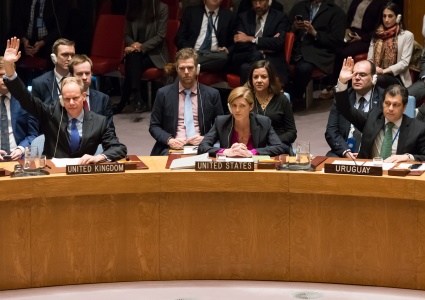
Security Council Resolution 2334 is a harsh finale to eight years of a frozen political process between Israel and the Palestinians. Extremely problematic for Israel and the peace process alike, the resolution is the outcome of a Palestinian strategy that prefers to contend with Israel in international institutions rather than through negotiations, and problematic policies and behavior by both the Obama administration and the Netanyahu government. The two leaders have awarded the Palestinians a diplomatic prize, and the Palestinians were thus relieved of any responsibility for the stalemate in the peace process while receiving a hefty political bonus from the international community. • With the new US administration, Israel would do well to prove its commitment to the future viability of two states, by implementing actions to generate changes to current trends. Israel can initiate actions that encourage the construction of functional Palestinian institutions and the expansion of Palestinian self-governance, toward the establishment of a stable Palestinian economic system and the construction of infrastructure enabling free movement – all these as a foundation for a Palestinian state, once the conditions for its establishment materialize.
Obama and Netanyahu Reward the PalestiniansSecurity Council Resolution 2334 is a harsh finale to eight years of a frozen political process between Israel and the Palestinians. It is the outcome of a Palestinian strategy that prefers to contend with Israel in international institutions rather than through negotiations, and problematic policies and behavior by both the Obama administration and the Netanyahu government. This Security Council resolution brings the peace process, which aspires to a two-state solution, to its lowest point since 2008. President Obama and Prime Minister Netanyahu have brought on a severe political avalanche and a resolution that is extremely problematic for Israel and the peace process alike. Obama, in a severe anti-Israeli move, harmed the United States’ staunchest ally in the Middle East, while Netanyahu clung to his shortsighted approach to the US administration. As a result, at the end of 2016, together they awarded the Palestinians a diplomatic prize, and the Palestinians were thus relieved of any responsibility for the stalemate in the peace process while receiving a hefty political bonus from the international community.
Israel is paying for Netanyahu’s problematic and erroneous reading of the American and global system in recent years. Netanyahu pinned his hopes on Congress – the same Congress that according to the American constitution could not prevent a nuclear agreement with Iran or impose a veto in the Security Council. The Prime Minister was reluctant to differentiate the isolated Jewish settlements in the West Bank from the settlement blocs and Jewish neighborhoods in East Jerusalem. However, a tacit understanding about a freeze on construction east of the security barrier would have made it difficult for Obama to abstain in face of a UN proposal that is detrimental for Israel. Instead, the conduct of the Israeli government regarding the settlement regulation bill; the delay in evacuating Amona; and assertions of a right to annex Area C were all key factors that pushed the Obama administration to abstain from imposing a veto on the problematic proposed resolution. The incongruence between Netanyahu’s speech before the General Assembly this past September about his vision of "an end to the automatic majority against Israel in the United Nations," and the sweeping vote against Israel on December 23, 2016 attests to the Prime Minister’s incorrect reading of the international reality. This faulty understanding is particularly noteworthy given that the resolution cannot be dismissed as a United Nations anti-Israel reflex, but is rather a sweeping vote by all of Israel’s closest friends – including its newest “ally,” Russia.
The mirror image of Netanyahu’s incorrect take on the situation is the Obama administration’s lapsed reading of Israeli public opinion and the Israeli political system, as well as the administration’s failure to examine the validity of its basic assumptions about promoting a solution to the dispute. The Obama administration’s inability to discern that there is a solid consensus in Israel in support of the settlement blocs and the Jewish neighborhoods in East Jerusalem, and that the Israeli public is not prepared to incur the same kinds of security risks that it had assumed in the past, lay at the heart of the attempt to undermine Netanyahu – which ultimately achieved the opposite result. Furthermore, the Obama’s disregard of Bush’s letter to Sharon of April 2004 and of the Clinton parameters, which recognized that the settlement blocs would be in Israeli territory, aroused much suspicion in Israel regarding the Obama administration and its intentions. Ascribing most of the blame for the lack of progress toward a two-state solution to Israel and dwelling on the issue of the settlements, while ignoring the major contribution of the Palestinians to the impasse in the political process (the Palestinians are the party that did not accept the principles of the framework agreement drafted by Secretary of State John Kerry) – all these severely impeded the ability of the administration to promote the peace process. With this action by the Security Council, the Obama administration “concluded” a problematic legacy of failures in the Middle East, including its standoff position to the destruction in Syria; the inability to defeat the Islamic State; the creation of a vacuum in the region that enabled Russia and Iran to fill the void; and a series of crises of trust between the administration and its allies in the region.
By not casing a veto, the Obama administration awarded a highly valuable prize to the Palestinians for their refusal to engage in direct negotiations with Israel and severely undermined the chances that the bilateral negotiations between the parties would resume any time in the foreseeable future. The Palestinians cannot allow themselves either to present a more moderate stance than that of the Security Council or to question that the response to their demands will come from the UN rather than through negotiations with Israel. For its part, Israel cannot sit down at the negotiating table under conditions of a predefined demarcation of the borders of the future Palestinian state. Instead of withdrawing from areas to “secure and recognized boundaries,” as per Resolution 242, Israel will have the 1967 boundaries, including in East Jerusalem, as its starting point. Reflecting the rift between the Israeli government and the White House, the Obama administration made no effort to coordinate its positions with Israel or try to soften Resolution 2334 and thereby neutralize the inherent obstacles in the resolution to renewed negotiations and achievement of a two-state solution.
Threats to Israel Posed by Resolution 23341. In terms of Israel, the approach underlying Resolution 2334, whereby “the Western Wall is tantamount to the Yitzhar settlement,” or “the Ramot neighborhood in Jerusalem is equivalent to the settlement of Elon Moreh,” eliminates any chances of negotiations toward a two-state arrangement.2. The resolution rewards Palestinian obduracy, the Palestinian strategy of avoiding negotiations with Israel, and the expectation that the international arena will dictate the parameters for the arrangement. Therefore, the resolution will encourage the Palestinians to adhere to their refusal to return to the negotiating table and exhibit the flexibility required in any genuine negotiation.3. The resolution increased the risk of Israelis at certain political and military echelons being brought to trial before the International Criminal Court in The Hague. It will be difficult to conduct peace negotiations in an atmosphere of “a legal witch hunt” of Israeli leaders and commanders.4. The delegitimization movement and the boycott of Israel will become stronger and receive moral and political encouragement, which can be translated into legal, political, public, and economic measures.5. The resolution places the Israeli issue as a bone of contention between American Democrats and Republicans and threatens America’s longstanding bipartisan support of Israel.6. The resolution damages Israeli deterrence, since a significant portion thereof is based on the strategic alliance with the United States and its support of Israel.7. The report on issues referred to in the resolution, which the UN Secretary-General is requested to release every three months, will guarantee constant preoccupation with these topics at the expense of more important issues and will nourish an ongoing anti-Israeli campaign.
At the same time, Resolution 2334 was not passed pursuant to Chapter 7 of the United Nations Charter, and, therefore does not allow the UN to impose sanctions and other practical measures against Israel without a further resolution. One can assess that the new administration in the United States, which is more sympathetic toward Israel than the Obama administration, will veto any attempt to pass resolutions pursuant to Chapter 7.
What Should Israel Do?In the final days of 2016, it is more important to look ahead than to engage in a retrospective analysis of the events that led to Resolution 2334. Preparations must be made with the aims of minimizing the negative impact of this resolution and formulating a more suitable policy for Israel, considering the difficult political situation that the resolution has created.
In the short term, feelings of anger, insult, betrayal, and rage, even if understandable, are not a proper foundation for a judicious, effective policy. Even if it is important to exact a price from the Palestinian Authority (which initiated the effort towards this resolution) the Israeli reaction should be put on hold until January 20, 2017, when President Donald Trump enters the White House. Broad annexation of Palestinian territories would not be wise in any case, and would be a mistake that would deepen Israel’s isolation, or lead to more severe measures against it. Similarly, political and diplomatic responses should be suspended until after the Trump inauguration. Extreme measures are detrimental and work solely to intensify Israel’s political isolation. Thus, the Prime Minister’s attack against the states that supported the resolution is a rash and unnecessary response. It is hardly in Israel’s interest to cultivate any “self-inflicted BDS,” which ironically would be far more effective than any activity undertaken to date by the BDS movement. On the other hand, strengthening the neighborhoods in Jerusalem and the settlement blocs, encouraging the relocation of the US embassy to Jerusalem, and gaining recognition of the current status of the Golan Heights may be courses of action that Israel could coordinate with the incoming Trump administration.
Three assumptions should underlie Israel’s long term strategy:1. The Trump administration will be far friendlier toward Israel, and it will be possible to reach understandings with it that were rejected consistently by the Obama administration.2. Any return to the negotiating table is impossible due to Palestinian obstinacy – particularly since the drafting of a comprehensive final agreement was not feasible until now (not with the Palestinian Authority and certainly not with Hamas) – and this will be even more difficult to achieve, now that Resolution 2334 has been passed. The resolution can be expected to radicalize the Palestinians’ positions further and bolster the Israeli public consensus about the need to strengthen the Jewish neighborhoods in Jerusalem and in the settlement blocs.3. However, the status quo is not good for Israel, and a change must be initiated that will preserve the feasibility of a two-state solution, but will lead to it in a manner that is viable under the current circumstances. Israel must proceed toward separation from the Palestinians in a controlled, cautious, and patient manner that will protect its interests as a democratic, safe, and just Jewish state and will restore its political and ethical standing in the world.
Building on these assumptions, it would be advisable for Israel to adopt a proactive strategy that is based on understandings with the United States. Israel could present a proposal to the Trump administration for a proactive Israeli initiative that involves practical actions to shape an improved reality. Israel must successfully resist the contentions that the settlements are the obstacle to peace, while differentiating between settlement blocs and isolated outposts; it is in the latter areas where construction should be frozen. Taking a broader perspective, it would be advisable for Israel to prove its commitment to the future viability of two states, by implementing actions to generate changes in the current trends. Within this scope, it would be correct for Israel to initiate actions that encourage the construction of functional Palestinian institutions and the expansion of Palestinian self-governance, toward the establishment of a stable Palestinian economic system and the construction of infrastructure enabling free movement – all these as a foundation for a Palestinian state, once the conditions for its establishment materialize. It is critical to gain the support of pragmatic Arab countries in order to realize this policy, backed and led by the Trump administration. Naturally, such a change in policy will also have repercussions in the political arena within Israel, and in this respect, it would be advisable for the Prime Minister to rein in the extremist tactics of those in the far right camp who have recently dictated the actions of his government through legislative and policy measures that are undermine Israel’s standing in the international arena.
The United States is Israel’s most important, and at times, only ally. It is critical that Israel not allow itself to be dragged into a Republican-Democratic dispute and that it once again achieve bipartisan support. It is also important to reestablish trust between the two countries, and mainly between their leaders – trust that was violated by both sides during the Obama and Netanyahu tenures. It is necessary to resume building foundations for special, strong relations between Israel and the United States, which will guarantee the vital interests of both countries.