Israel in the Red Sea Arena: An Updated Maritime Strategy | INSS
go to header go to content go to footer go to search
INSS logo The Institute for National Security Studies, Strategic, Innovative, Policy-Oriented Research, go to the home page
INSS
Tel Aviv University logo - beyond an external website, opens on a new page
  • Campus
  • Contact
  • עברית
  • Support Us
  • Research
    • Topics
      • Israel and the Global Powers
        • Israel-United States Relations
        • Glazer Israel-China Policy Center
        • Russia
        • Europe
      • Iran and the Shi'ite Axis
        • Iran
        • The Israel–Iran War
        • Lebanon and Hezbollah
        • Syria
        • Yemen and the Houthi Movement
        • Iraq and the Iraqi Shiite Militias
      • Conflict to Agreements
        • Israeli-Palestinian Relations
        • Hamas and the Gaza Strip
        • Peace Agreements and Normalization in the Middle East
        • Saudi Arabia and the Gulf States
        • Turkey
        • Egypt
        • Jordan
      • Israel’s National Security Policy
        • Military and Strategic Affairs
        • Societal Resilience and the Israeli Society
        • Jewish-Arab Relations in Israel
        • Climate, Infrastructure and Energy
        • Terrorism and Low Intensity Conflict
      • Cross-Arena Research
        • Data Analytics Center
        • Law and National Security
        • Advanced Technologies and National Security
        • Cognitive Warfare
        • Economics and National Security
    • Projects
      • Preventing the Slide into a One-State Reality
      • Contemporary Antisemitism in the United States
      • Perceptions about Jews and Israel in the Arab-Muslim World and Their Impact on the West
  • Publications
    • -
      • All Publications
      • INSS Insight
      • Policy Papers
      • Special Publication
      • Strategic Assessment
      • Technology Platform
      • Memoranda
      • Posts
      • Books
      • Archive
  • Database
    • Surveys
    • Spotlight
    • Maps
    • Dashboards
  • Events
  • Team
  • About
    • Vision and Mission
    • History
    • Research Disciplines
    • Board of Directors
    • Fellowship and Prizes
    • Internships
  • Media
    • Communications
    • Video gallery
    • Press Releases
  • Podcast
  • Newsletter
  • campus
Search in site
  • Research
    • Topics
    • Israel and the Global Powers
    • Israel-United States Relations
    • Glazer Israel-China Policy Center
    • Russia
    • Europe
    • Iran and the Shi'ite Axis
    • Iran
    • The Israel–Iran War
    • Lebanon and Hezbollah
    • Syria
    • Yemen and the Houthi Movement
    • Iraq and the Iraqi Shiite Militias
    • Conflict to Agreements
    • Israeli-Palestinian Relations
    • Hamas and the Gaza Strip
    • Peace Agreements and Normalization in the Middle East
    • Saudi Arabia and the Gulf States
    • Turkey
    • Egypt
    • Jordan
    • Israel’s National Security Policy
    • Military and Strategic Affairs
    • Societal Resilience and the Israeli Society
    • Jewish-Arab Relations in Israel
    • Climate, Infrastructure and Energy
    • Terrorism and Low Intensity Conflict
    • Cross-Arena Research
    • Data Analytics Center
    • Law and National Security
    • Advanced Technologies and National Security
    • Cognitive Warfare
    • Economics and National Security
    • Projects
    • Preventing the Slide into a One-State Reality
    • Contemporary Antisemitism in the United States
    • Perceptions about Jews and Israel in the Arab-Muslim World and Their Impact on the West
  • Publications
    • All Publications
    • INSS Insight
    • Policy Papers
    • Special Publication
    • Strategic Assessment
    • Technology Platform
    • Memoranda
    • Posts
    • Books
    • Archive
  • Database
    • Surveys
    • Spotlight
    • Maps
    • Dashboards
  • Events
  • Team
  • About
    • Vision and Mission
    • History
    • Research Disciplines
    • Board of Directors
    • Fellowship and Prizes
    • Internships
    • Privacy Policy and Terms of Use
  • Media
    • Communications
    • Video gallery
    • Press Releases
  • Podcast
  • Newsletter
  • Campus
  • Contact
  • עברית
  • Support Us
bool(false)

Publications

Home Publications Memoranda Israel in the Red Sea Arena: An Updated Maritime Strategy

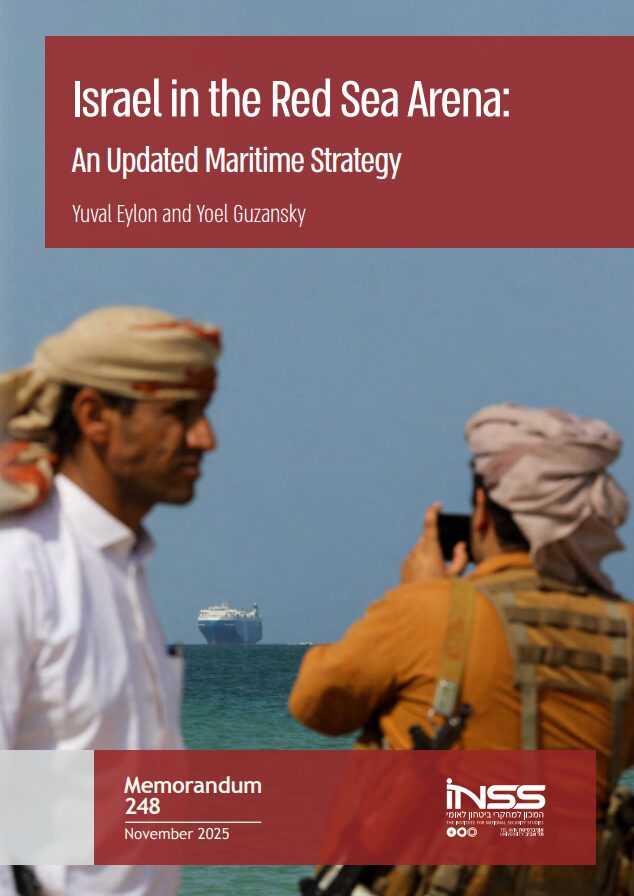
Israel in the Red Sea Arena: An Updated Maritime Strategy

Memorandum 248, December 2025

Yuval Eylon
Yoel Guzansky

In the Red Sea region, significant geo-strategic processes have unfolded over the past decade, manifested in political, security, economic, and technological shifts. This area—stretching between the Middle East in the north, the Arabian Peninsula to the east, the Horn of Africa to the south, and East Africa to the west—has become a focal point of both global and regional power struggles. At the same time, it has also generated opportunities for complex civilian and security cooperation. These developments present Israel with a significant opportunity to leverage its geo-strategic assets in order to strengthen its status and expand its influence on its surroundings.


In recent years, there has been a global resurgence of attention to maritime domains, which have once again taken center stage due to their centrality in major conflicts now unfolding around the world. This renewed focus highlights the vital importance of the maritime sphere to the global economy and its role as an arena where the ability to operate effectively is essential to the great powers, nations, and organizations.


Israel is currently facing the need to formulate a security concept that takes into account the transformations and shifts shaping the entire region in the wake of the Hamas’s attack on October 7, 2023, and the ongoing multi-arena campaign. As part of this effort, Israel should also address the maritime domain. This memorandum offers insights and ideas aimed at broadening the understanding of the opportunities and challenges of the Red Sea region and assisting in incorporating this arena into Israel’s updated national security concept.


Click here to download the full Memorandum

Table of Contents:

The Red Sea as a Multi-Dimensional Strategic Arena. The Red Sea is a vital lifeline and a key link in global supply chains, being a shipping artery that accounts for approximately 17% of global maritime trade traffic. This is one of the main reasons for its status as an arena of inter-power competition, involving China, the United States, Russia, as well as regional players, and this arena is gaining strategic importance in fields such as communication, environmental protection, food security, and energy...
Read more

In the Red Sea region, significant geo-strategic processes have been unfolding over the past decade, manifesting in political, security, economic, and technological changes. This region, stretching between the Middle East to the north, the Arabian Peninsula to the east, the Horn of Africa to the south, and East Africa to the west, has transformed from primarily a maritime trade corridor into a focal point for inter-power and regional struggles, while simultaneously creating opportunities for complex civil and security collaborations. These processes present Israel with a significant opportunity to leverage its geostrategic assets to strengthen its position and exert broader and deeper influence on its surroundings...
Read more

The Red Sea is an intercontinental body of water that separates the continents of Asia and Africa and serves as an elongated extension of the Indian Ocean. It is artificially connected to the Mediterranean Sea through the Suez Canal—one of the most important transportation infrastructures in the world. Its shores are populated by numerous countries of strategic importance—Djibouti, Eritrea, Sudan, Egypt, Israel, Jordan, Saudi Arabia, and Yemen—some of which are considered conflict zones or, at the very least, face internal governance challenges...
Read more

The maritime domain effectively facilitates activities and the integration of interests in various spheres, both civilian and security-related. Israel should build partnerships and capabilities, or strengthen existing capabilities, in order to integrate or collaborate with other entities in the region to establish as much control as it can in order to minimize threats against it and successfully address them. In recent years, the Red Sea has become one of the most important and complex arenas in the international sphere...
Read more

In the 21st century, the functioning of a war fleet is not limited to combat alone but includes a wide range of missions, primarily sea control, preventing maritime access, and projecting power toward the shore—as defined by theorists Ken Booth and Geoffrey Till.6 Sea control is considered the primary objective of modern navies, and it is contingent on the ability to effectively execute a range of military operations under threat, with reasonable risk. The projection of sea power is an important component in creating deterrence and the ability to respond quickly to threats in the coastal domain, particularly in areas characterized by conflicts and strategic choke points—such as the Red Sea...
Read more

The Red Sea has long since become a geo-strategic arena of increasing importance in the international system. Throughout the memorandum, the changes that have occurred in the region in recent years—political, securityrelated, economic, and infrastructural—were examined, and a map of the interests of global and regional actors in this arena was outlined. This analysis positions the Red Sea as a vital maritime transportation axis for global trade, with growing importance for Israeli national security...
Read more

The opinions expressed in INSS publications are the authors’ alone.
Publication Series Memoranda
TopicsSaudi Arabia and the Gulf States

Events

All events
Iran in Africa: Global Reach Regional Impact and Israeli Implications
26 October, 2025
14:00 - 17:00

Related Publications

All publications
REUTERS/Evelyn Hockstein/File Photo
The Washington–Riyadh Axis: The Alliance Shaping the Middle East and the Challenge for Israel
What are the implications of the Saudi crown prince’s historic visit to Washington, both for Saudi Arabia and for the United States, and what risks and opportunities does it create for Israel?
27/11/25
Shutterstock
Gulf Involvement in Africa: Motives and Implications
The growing involvement of the Gulf states in Africa: interests, opportunities, and implications for the region and for Israel
11/11/25
Regional Involvement in the Gaza Strip: Scenarios and Implications
The differing positions and interests of Saudi Arabia, the United Arab Emirates, Qatar, and Turkey regarding the shaping of the Gaza Strip—and their implications
04/11/25

Stay up to date

Registration was successful! Thanks.
  • Research

    • Topics
      • Israel and the Global Powers
      • Israel-United States Relations
      • Glazer Israel-China Policy Center
      • Russia
      • Europe
      • Iran and the Shi'ite Axis
      • Iran
      • The Israel–Iran War
      • Lebanon and Hezbollah
      • Syria
      • Yemen and the Houthi Movement
      • Iraq and the Iraqi Shiite Militias
      • Conflict to Agreements
      • Israeli-Palestinian Relations
      • Hamas and the Gaza Strip
      • Peace Agreements and Normalization in the Middle East
      • Saudi Arabia and the Gulf States
      • Turkey
      • Egypt
      • Jordan
      • Israel’s National Security Policy
      • Military and Strategic Affairs
      • Societal Resilience and the Israeli Society
      • Jewish-Arab Relations in Israel
      • Climate, Infrastructure and Energy
      • Terrorism and Low Intensity Conflict
      • Cross-Arena Research
      • Data Analytics Center
      • Law and National Security
      • Advanced Technologies and National Security
      • Cognitive Warfare
      • Economics and National Security
    • Projects
      • Preventing the Slide into a One-State Reality
      • Contemporary Antisemitism in the United States
      • Perceptions about Jews and Israel in the Arab-Muslim World and Their Impact on the West
  • Publications

    • All Publications
    • INSS Insight
    • Policy Papers
    • Special Publication
    • Strategic Assessment
    • Technology Platform
    • Memoranda
    • Database
    • Posts
    • Books
    • Archive
  • About

    • Vision and Mission
    • History
    • Research Disciplines
    • Board of Directors
    • Fellowship and Prizes
    • Internships
    • Support
    • Privacy Policy and Terms of Use
  • Media

    • Communications
    • Video Gallery
    • Press Release
    • Podcast
  • Home

  • Events

  • Database

  • Team

  • Contact

  • Newsletter

  • עברית

INSS logo The Institute for National Security Studies, Strategic, Innovative, Policy-Oriented Research, go to the home page
40 Haim Levanon St. Tel Aviv, 6997556 Israel | Tel: 03-640-0400 | Fax: 03-744-7590 | Email: info@inss.org.il
Developed by Daat A Realcommerce company.
Accessibility Statement
This site is protected by reCAPTCHA and the Google Privacy Policy and Terms of Service apply.
No audio version available for this podcast