


Publications
The launch of a drone into Israeli territory this past February was yet another offensive cognitive activity by Hezbollah, intended to mask its deteriorating situation – in the domestic arena, stemming from the growing criticism of the organization in advance of the coming elections, scheduled for May, and vis-à-vis Israel, given its difficulty to maintain the “deterrence equation” that it defined. Jerusalem should expect additional acts of this sort, while preparing for a future situation in which the attacks become a security threat
INSS Insight No. 1565, March 3, 2022
Follow us on GoogleIt has become increasingly apparent that the domestic difficulties faced by Hezbollah exert growing influence on its behavior toward Israel. Along with restraining its military activity along the border in order to avoid military friction with Israel, the organization is waging a vigorous cognitive campaign to maintain the deterrence equation and to improve its public image as “the defender of Lebanon.” Hezbollah is constrained by rising domestic criticism of its role in Lebanon’s economic and political collapse, particularly in advance of the elections scheduled for May 15. The latest incident in the cognitive campaign included kinetic activity in the form of launching a drone that while unable to cause significant damage, was intended to validate the organization’s (empty) claims about its success in introducing a new deterrence equation against Israel in the aerial realm.
The 40-minute flight of a drone launched by Hezbollah on February 18, 2022 through Israeli airspace and its successful return to Lebanese territory was clearly a kinetic cognitive activity. The incident received extensive coverage in Hezbollah's media outlets and was specifically presented as a major success that ostensibly demonstrates the end of Israel's aerial superiority in Lebanese airspace and creates an additional component in the deterrence equation with Israel. However, the picture that Hezbollah tried to paint is far from reality. While the IDF must indeed hone and improve its capabilities against this kind of challenge, the clear superiority of the Israeli Air Force, which operates in Lebanese airspace, remains intact. In response to the launch of the drone into its territory, Israel underscored this gap – that same day it sent a deterrent message to Nasrallah by means of an Israeli flyover at low altitude over the Dahiyah quarter in Beirut.
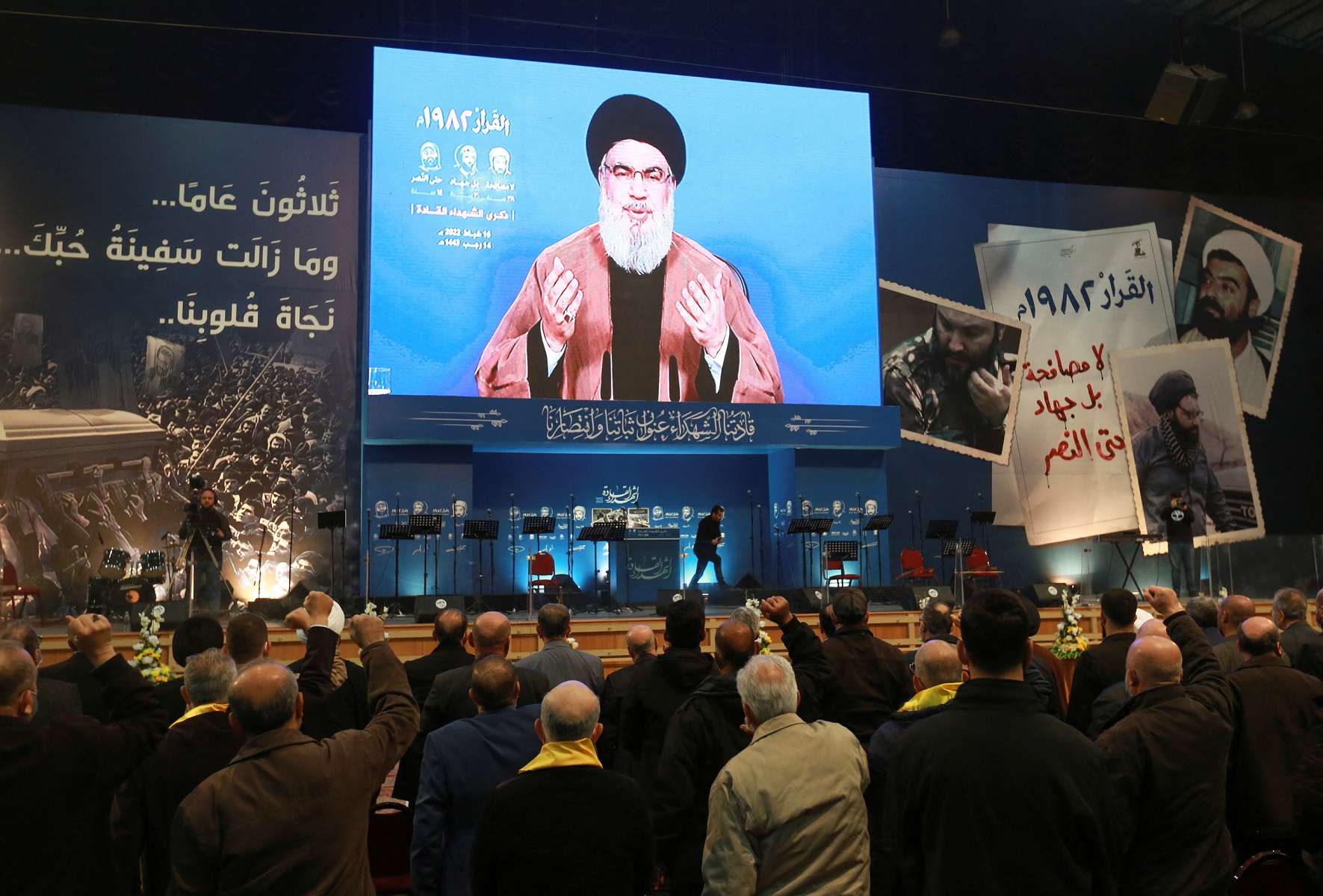
The drone incident figured in Nasrallah's arrogant, condescending, and threatening rhetoric toward Israel in his speeches of February 8 and 16, in which he claimed that the organization possesses advanced weapons that can defeat Israel – matching its previous victories, i.e., following Israel's withdrawal to the security zone (1985), the complete withdrawal from Lebanon (2000), and the Second Lebanon War (2006) – and inflict extensive damage on it. Nasrallah emphasized the allegedly large number of precision missiles at the organization's disposal, its improved air defense capabilities, and especially the unmanned aerial vehicles (UAVs) that it acquired following the IDF drone attack on the Dahiyah quarter in Beirut in August 2019. Israel, he charged, is threatened by the organization's unprecedented capabilities and is therefore deterred from any action against Lebanon, and as proof, he claimed that there has been a decline in the number of Israeli UAVs operating in Lebanon. In the spirit of his famous "spider web" speech in May 2000, Nasrallah now declared that the Zionist entity is a fake, has lost its willingness to fight while maintaining a temporary existence only, and threatened that if it sends soldiers to strike Hezbollah's precision missiles, it can expect "a second Ansariya ambush" [in which twelve Israeli elite combat soldiers were killed]. In addition, he again emphasized the importance of Hezbollah to the defense of Lebanon, and tried to demoralize the Israeli side with references to Israeli media items, while mocking the internal disintegration of Israeli society and its economic difficulties.
It is true that Hezbollah's military buildup continues, but it seems that the acceleration of these cognitive efforts actually stems from the organization's distress, mainly due to the increasing criticism it faces domestically, in advance of the parliamentary elections currently scheduled for May 15. In addition to the publicity-oriented activity with the drone, this effort involves the organization's publications and its activity on social media, including videos presenting its special capabilities (recently, for example, a video about the organization's "alpine" unit was released). The aim of this effort is twofold: to deter Israel from military measures against it while Lebanon and the organization are at their weakest point and the international system is preoccupied with the war in Ukraine, and simultaneously to restore its image and its standing vis-à-vis the Lebanese public, as the only force that can serve as "the defender of Lebanon" against Israel, the United States, and Israel's new partners following the Abraham Accords.
The domestic criticism of Hezbollah relates to the organization's role in Lebanon’s economic collapse, in part because its integration within the government prevents the receipt of external aid from the West; its conduct, along with its political partners, which has paralyzed the Lebanese political system; its responsibility for the August 2020 Beirut port explosion disaster and its efforts to disrupt the attempts to investigate the incident – in spite of the general public's demands to prosecute those responsible and to compensate the victims; its actions against Israel, which could drag Lebanon into unnecessary military conflicts; its ties with Iran and its contribution to Tehran’s expanded influence in Lebanon; and its involvement in conflicts outside of Lebanon in the service of Iranian interests.
There is concern in the organization that this criticism will harm its political standing in the elections, and in advance of the elections it has adopted the slogan "we will remain, defend and build" (that is, we are here to stay, defending Lebanon while working to reconstruct it and build it). At the same time, it is clear that the organization is interested in postponing the elections and will probably work toward pushing them off in any way possible, as long as it is not perceived as being at fault for this. If the elections are held as planned, it is expected that in advance the organization will try to influence their results, despite the public denials by Hezbollah figures of this intention, who claim that the organization wants the elections to be held on time and blame its opponents for attempts to cancel them.
Alongside the cognitive campaign against Israel, it is clear that the imbroglio of internal constraints on Hezbollah has prompted the organization's restraint toward Israel in the military sphere. In the past year the organization has refrained from initiating actions that could bring it into conflict with the IDF. Thus, during Operation Guardian of the Walls (May 2021), Hezbollah refrained from any direct involvement in the sporadic rocket fire into Israeli territory carried out by the Palestinian factions. In addition, in practice Hezbollah is having difficulty maintaining the deterrence equations with Israel that Nasrallah tends to glorify in his speeches:
- The first deterrence equation that Nasrallah champions relates to the fact that for years, Israel – which carries out extensive attacks in Syria as part of the "campaign between wars" – has refrained from carrying out direct attacks within Lebanon. This is due to the concern of a deterioration into a violent conflict with Hezbollah, which has promised that it will respond to any such measure with a violent incident along the border. The organization's very restrained response following IDF air strikes in Lebanon in August 2021, following shooting attributed to Palestinian elements, exposed the difficulty of maintaining this equation.
- Hezbollah has failed in its attempts in recent years to establish a new equation, which Nasrallah boasted about in his speeches, whereby an Israeli soldier will be harmed if any Hezbollah operative is harmed in Israeli strikes in Syria. Thus far, the organization has refrained from taking action again, and has not avenged the deaths of two of its operatives: one killed following an air strike attributed to the IDF (July 2019), and the other during demonstrations organized by Hezbollah along the Lebanese border fence during Operation Guardian of the Walls.
- Recently, Nasrallah has apparently tried to compose a new deterrence equation vis-à-vis Israel in the aerial realm by launching drones that are not able to cause substantive damage, as well as boasting about the UAVs and air defense systems in Hezbollah's possession. These efforts are destined to fail due to the Israeli Air Force's superiority in Israeli airspace as well as in Lebanese airspace, and its ability to use it when needed.
To be sure, Hezbollah’s UAVs creates new challenges for Israel, and thus the real challenge is not posed by the small drones, such as the one that penetrated into Israel recently, but rather the attack UAVs. Hezbollah has been trying to launch small drones for almost two decades, with greater intensity in recent years. It is difficult to intercept them due to their low signature, but their ability to cause significant physical damage is also very limited (according to a statement by the IDF Spokesperson, the recent launch was identified and its flight was tracked, but the IDF did not succeed in intercepting it before it returned to Lebanon) and the purpose of launching them is mainly to gather intelligence and demonstrate capabilities. On the other hand, Israel must prepare for the more serious threat of attack UAVs, which are possessed by Hezbollah and other Shiite axis forces, in Syria, Iraq, and Yemen as well as in the Gaza Strip. Iran helps equip these forces and train them in using the UAVs, for example, those used by the Houthis in attacking the Aramco oil facilities in Saudi Arabia in September 2019.
The excessive demonstration of confidence in the public sphere, which was highly apparent in Nasrallah's recent speeches; the emphasis on Israel's failure to prevent the provision of high quality weapons from Iran; his praise for Hezbollah's ability to produce precision weapons independently; and the underestimation of Israel's capabilities and its determination to damage Hezbollah's precision warfare arsenal – be it authentic or intended for the purposes of deterrence – could prompt a miscalculation on his part and exact a heavy toll from Hezbollah and from Lebanon. This could occur if Israel were to conclude that the organization's capabilities and its intentions constitute a significant strategic threat to its security, and choose to take decisive action to remove the threat by critically harming the organization and its infrastructure; this in turn would incur the risk of the expected cost both to the Israeli home front and to civilians in Lebanon, which serve as a human shield for Hezbollah. In such a case, Nasrallah would have to cope with severe results that are the opposite of what he intended.