


Publications
INSS Insight No. 824, May 29, 2016
Follow us on Google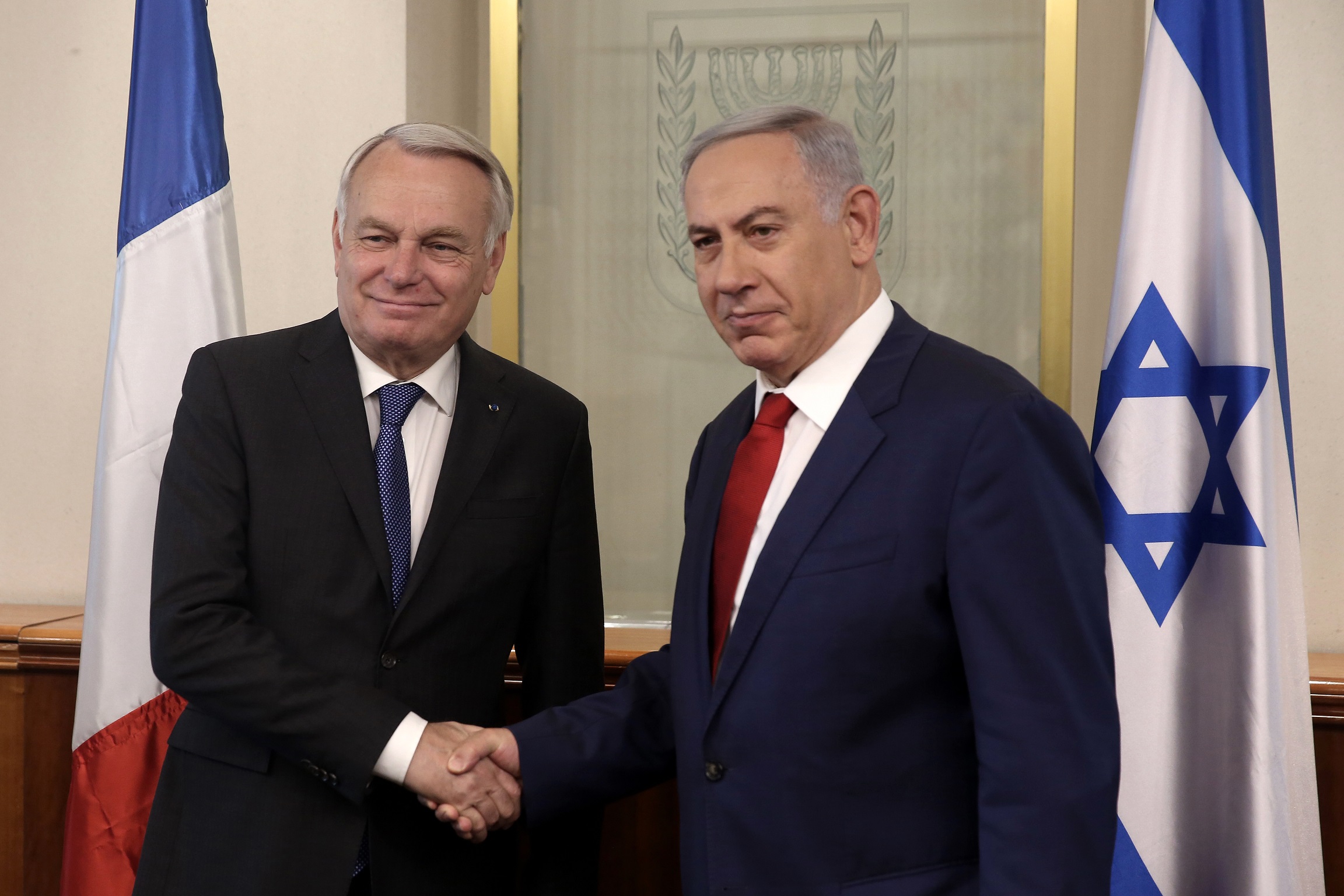
There is an ostensible contradiction between the feverish diplomatic activity in the regional and international arenas to revive the Israeli-Palestinian political process and the internal political developments in Israel. French Foreign Minister Jean-Marc Ayrault visited the Middle East earlier this month to promote the French initiative, which seeks to convene an international conference to jumpstart the political process between Israel and the Palestinians; Egyptian President Abdel Fattah el-Sisi floated his own initiative to renew negotiations between Israel and the Palestinians, and it was reported that he intends to host a three-way meeting in Cairo, joined by Israeli Prime Minister Benjamin Netanyahu and Palestinian Authority President Mahmoud Abbas. In response, Netanyahu declared that he is willing to restart direct negotiations with the Palestinians, while Abbas declared his support for the French and Egyptian initiatives. Former UK Prime Minister Tony Blair, who served as the Quartet’s special envoy to the Middle East, is also trying to promote a regional political initiative that dovetails with el-Sisi’s plan. On May 24, 2016, Blair announced that if the Netanyahu government agrees to restart talks with the Palestinians on the basis of the Arab Peace Initiative, Arab nations are prepared to take steps to normalize relations with Israel. Meanwhile, in Israel, the attempt to have the Zionist Camp join the government failed, and instead Yisrael Beitenu – a political party that since the last parliamentary election has competed with the Prime Minister over who represents the more extreme right wing positions – has joined the coalition.
The key question now is: will Israel and the Palestinians be willing to launch a political process in a format that regional and international players are trying to establish? In particular, is the new constellation of the Israeli government, with its more pronounced right wing flavor, capable of doing so?
The major new development is the international, and in particular, the regional involvement of the pragmatic Sunni states in the attempt to revive the political process. From the perspective of Israel and the Palestinians, the dynamic is a mixed blessing.
From Israel’s point of view, entering the process will allow it to try to improve relations and work with the pragmatic Sunni states on the basis of shared interests forged by the regional upheavals. Although the Israeli right does not believe it possible to end the conflict, and feels that the concrete need to steer Israel through the regional tumult is the most urgent objective, normalization of relations with the Arab world has been one of Israel’s traditional goals and seen as a key to Arab recognition of Israel and an end to the conflict. At present, Israel and the pragmatic Arab states alike believe that Iran’s regional policy is the most potent threat and are wary of the growing strength of Iran’s regional allies; furthermore, they are aligned in their resistance to Salafi jihadist groups operating in the region and in their concern about the weakening of US power in the Middle East. Regional and international participation in the political process also promises to enhance the prospect that regional and international actors will help implement agreements formulated between Israel and the Palestinians in critical areas, such as the refugee problem, the holy sites, and security – and helping finance these measures. To a certain extent, Israel can maneuver between the French initiative and the joint el-Sisi-Blair initiative: accepting the el-Sisi-Blair initiative may make it possible to refuse the French initiative without paying a significant political diplomatic price or to change its nature and make the proposed international conference into a forum of support for the el-Sisi plan. But there’s the rub: from the point of view of the Israeli government, the main drawback lies in the fact that the regional actors might affect the parameters of the agreement with the Palestinians, and that these would set the tone of the negotiations. The main demand of the regional elements is that talks be conducted on the basis of the Arab Peace Initiative, which speaks of borders on the basis of the 1967 armistice lines (allowing for the possibility of consensual land swaps) and a just, consensual solution to the refugee problem on the basis of General Assembly Resolution 194. Another critical disadvantage lies in the French initiative’s attempt to establish parameters and a timetable for the talks, although presumably the Palestinian side would also have to accept parameters to which it is currently opposed, such as recognition of Israel as the nation state of the Jewish people.
From the Palestinian perspective, the renewed international and regional interest in the political process has many advantages. One, to a certain extent, international and regional involvement meets the traditional Palestinian demand to balance the asymmetry in the power relations between Israel and the Palestinians. Two, predetermining parameters for the negotiations that are central to their interests – such as borders on the basis of the 1967 lines and resolving the refugee problem – is a major achievement. Three, regional support can help Abbas overcome his internal political weakness and confront the Hamas opposition to his policies, because it would constitute a response to the criticism liable to be leveled against him for making agreements that will be presented as concessions to Israel. On the other hand, the international and regional initiatives also bear some disadvantages for the Palestinian side. One is the Arab states’ agreement to take some steps to normalize relations with Israel even before the Palestinians have made any gains through negotiations, as Abbas does not believe Netanyahu is sincere in his stated commitment to the two-state solution; he suspects that the Israeli Prime Minister’s objective is to conduct sham talks in order to ease the international pressure on Israel. Two, Abbas would also have to agree to the parameters of the talks, which are problematic for him, including recognition of Israel as a Jewish state, and conduct yet another round of talks with Israel whose endpoint and outcomes are far from defined, and to do so from a place of political weakness within the Palestinian arena and with great doubt as to the Arab states’ ability to provide him with decisive backing.
Despite the concerns, the balance of considerations is reflected in the way Palestinian spokespeople talk about the various initiatives, indicating that Abbas sees the proposed political process positively and is willing to participate in it. By contract, the situation on the Israeli side is much more complicated. Israel is vehemently opposed to international involvement as per the French initiative, and to date, the Israeli government has never agreed to hold talks on the basis of the Arab Peace Initiative and has even avoided lukewarm expressions of support for it. Consequently, it is hard to believe that the Israeli government in its new constellation will be any more flexible than previous governments on the critical issues related to revival of the political process. However, as there has been increased cooperation between Israel and Egypt under el-Sisi’s leadership, it will be difficult for Israel to refuse an Egyptian invitation to participate in the three-way meeting in Cairo. Would a meeting result in Israel’s joining the proposed process? It may also be that el-Sisi will make the agreement of all three parties a precondition for holding the meeting, in which case the meeting will in all likelihood not take place, especially if Israel will not a priori agree to hold talks on the basis of the Arab Peace Initiative.
In recent years, much has been said about the need for Israel to identify opportunities that can be leveraged toward improvement of its strategic position in the midst of the regional turmoil. It seems that the renewed international and especially the regional interest in reviving the political process is just such an opportunity that, if exploited, can be a way for Israel to promote its relations with the pragmatic Arab states and serve as a channel to make progress toward resolving the conflict with the Palestinians. However, this opportunity will in all probability be squandered because of the political situation in Israel and Abbas’s weakness, factors that can be expected to discourage the steps Israel will have to take in exchange for realizing the potential inherent in this opportunity and any willingness to put them into practice. Therefore, it seems that Egypt and the Arab Gulf states will continue to cooperate with Israel against their shared enemies in a limited fashion and only behind the scenes, but in all probability, under current circumstances, the positive potential inherent in these relations will not be realized.