Escalation in Jerusalem: Beyond Stabilization Efforts | INSS
go to header go to content go to footer go to search
INSS logo The Institute for National Security Studies, Strategic, Innovative, Policy-Oriented Research, go to the home page
INSS
Tel Aviv University logo - beyond an external website, opens on a new page
  • Campus
  • Contact
  • עברית
  • Support Us
  • Research
    • Topics
      • Israel and the Global Powers
        • Israel-United States Relations
        • Glazer Israel-China Policy Center
        • Russia
        • Europe
        • Antisemitism and Delegitimization
      • Iran and the Shi'ite Axis
        • Operation Roaring Lion
        • Iran
        • Lebanon and Hezbollah
        • Syria
        • Yemen and the Houthi Movement
        • Iraq and the Iraqi Shiite Militias
      • Conflict to Agreements
        • Israeli-Palestinian Relations
        • Hamas and the Gaza Strip
        • Peace Agreements and Normalization in the Middle East
        • Saudi Arabia and the Gulf States
        • Turkey
        • Egypt
        • Jordan
      • Israel’s National Security Policy
        • Military and Strategic Affairs
        • Societal Resilience and the Israeli Society
        • Jewish-Arab Relations in Israel
        • Climate, Infrastructure and Energy
        • Terrorism and Low Intensity Conflict
      • Cross-Arena Research
        • Data Analytics Center
        • Law and National Security
        • Advanced Technologies and National Security
        • Foreign Information Manipulation and Interference
        • Economics and National Security
    • Projects
      • Preventing the Slide into a One-State Reality
  • Publications
    • -
      • All Publications
      • INSS Insight
      • Policy Papers
      • Special Publication
      • Strategic Assessment
      • Technology Platform
      • Memoranda
      • Posts
      • Books
      • Archive
  • Database
    • Surveys
    • Spotlight
    • Maps
    • Dashboards
  • Events
  • Team
  • About
    • Vision and Mission
    • History
    • Research Disciplines
    • Chairman of the Board
    • Board of Directors
    • Fellowship and Prizes
    • Internships
  • Media
    • Communications
    • Video gallery
    • Press Releases
  • Podcast
  • Newsletter
  • Campus
Search in site
  • Research
    • Topics
    • Israel and the Global Powers
    • Israel-United States Relations
    • Glazer Israel-China Policy Center
    • Russia
    • Europe
    • Antisemitism and Delegitimization
    • Iran and the Shi'ite Axis
    • Operation Roaring Lion
    • Iran
    • Lebanon and Hezbollah
    • Syria
    • Yemen and the Houthi Movement
    • Iraq and the Iraqi Shiite Militias
    • Conflict to Agreements
    • Israeli-Palestinian Relations
    • Hamas and the Gaza Strip
    • Peace Agreements and Normalization in the Middle East
    • Saudi Arabia and the Gulf States
    • Turkey
    • Egypt
    • Jordan
    • Israel’s National Security Policy
    • Military and Strategic Affairs
    • Societal Resilience and the Israeli Society
    • Jewish-Arab Relations in Israel
    • Climate, Infrastructure and Energy
    • Terrorism and Low Intensity Conflict
    • Cross-Arena Research
    • Data Analytics Center
    • Law and National Security
    • Advanced Technologies and National Security
    • Foreign Information Manipulation and Interference
    • Economics and National Security
    • Projects
    • Preventing the Slide into a One-State Reality
  • Publications
    • All Publications
    • INSS Insight
    • Policy Papers
    • Special Publication
    • Strategic Assessment
    • Technology Platform
    • Memoranda
    • Posts
    • Books
    • Archive
  • Database
    • Surveys
    • Spotlight
    • Maps
    • Dashboards
  • Events
  • Team
  • About
    • Vision and Mission
    • History
    • Research Disciplines
    • Chairman of the Board
    • Board of Directors
    • Fellowship and Prizes
    • Internships
    • Privacy Policy and Terms of Use
  • Media
    • Communications
    • Video gallery
    • Press Releases
  • Podcast
  • Newsletter
  • Campus
  • Contact
  • עברית
  • Support Us
bool(false)

Publications

Home Publications INSS Insight Escalation in Jerusalem: Beyond Stabilization Efforts

Escalation in Jerusalem: Beyond Stabilization Efforts

INSS Insight No. 749, September 20, 2015

עברית
Kobi Michael
Oded Eran
The current escalation in Jerusalem, particularly on the Temple Mount, requires the design of an overall strategy, not a tactic of merely putting out fires as they occur. The general strategy should facilitate a complex balance between efforts to stabilize the situation and efforts to fashion creative solutions. The stabilization efforts should include stepped up police presence and law enforcement, along with legislative changes to enact more severe punishment. These should be combined with efforts to temper the behavior of Jewish provocateurs, and diplomatic and public relations efforts to expose the true nature of the events on the Temple Mount to the international community, with an emphasis on the riots and violent confrontations aroused by Palestinian groups. Concurrently, Israel should try to refashion the existing situation on the Temple Mount, with a focus on excluding inciters, headed by Hamas and the northern faction of the Islamic Movement, while reinforcing the presence and influence of the Jordanian Waqf on the site.

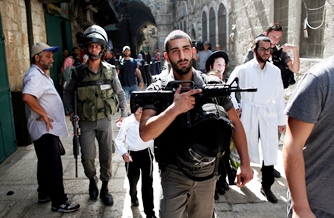
Recent weeks have seen escalation in the security situation in Jerusalem, with an emphasis on the Arab neighborhoods near the Temple Mount. Cases of stone throwing have become a matter of daily routine in some Jerusalem neighborhoods, particularly Armon Hanatziv, which borders Sur Baher. On Rosh Hashanah, an Israeli citizen was killed after his car was hit by stones reportedly thrown by residents of Sur Baher. In addition to the deteriorating security situation and the increased friction between the Israeli police and Palestinian rioters in the bordering neighborhoods and along several main arteries in Jerusalem and the roads leading to the capital, the Temple Mount is marked by escalating violent confrontation. Pictures broadcast on television of riots over Rosh Hashanah at the Temple Mount led Arab leaders to express concern and protest; King Abdullah of Jordan referred to potential consequences for bilateral Jordan-Israel relations.

More than any other single issue, the Temple Mount embodies the dispute at the core of the Israeli-Palestinian conflict and the contradictory interests of the many actors involved. Escalation on the Temple Mount harms Israel, which seeks to be regarded as the sovereign authority responsible for freedom of worship there and access to all. Israel faces a dilemma, however, between its desire to maintain order on the site and prevent violent Palestinian groups from gaining control over it, and concern over the recourse to increased force and the subsequent effect on international relations. The escalation also affects Jordan, which is unable to exert influence on the Palestinian groups inciting the population, even as the kingdom seeks to portray itself as the custodian of the Muslim interest in the Muslim sites in Jerusalem. The escalation also damages the formal Palestinian leadership, i.e., Fatah and Palestinian Authority Chairman Mahmoud Abbas, and plays into the hands of Hamas, parts of the Islamic movement in Israel (especially the northern faction), and external parties, including Qatar and Turkey, which seek to exploit the events in order to reinforce their standing in the bloc of Islamic countries.

Although their respective essential interests are being damaged, the parties involved find themselves in a trap from which it is difficult to escape. The government of Israel is reluctant to forbid right wing politicians to visit the Temple Mount at sensitive times, because each such measure is interpreted as Israeli weakness and an achievement for the inciters on the Temple Mount, and makes the government a ready target for those who accuse it of not insisting on Israeli sovereignty in Jerusalem and conceding Judaism’s connection to its holiest site. For its part, the PA is unable to exert any measurable influence on the developments, except by creating a more inciting or calming atmosphere (it usually chooses incitement). Any effort by the PA to lower tensions on the Temple Mount is severely criticized by its bitter rival, Hamas, which wishes to exacerbate tension in order to subvert the PA’s legitimacy as the leader of the Palestinian struggle, and in order to undermine its existence.

Like Israel and the Palestinians, Jordan is fettered by entangled interests. King Abdullah expressed his dismay at the events in Jerusalem at his meeting with Prime Minister Cameron of Britain, and also reported on his conversation on the subject with United States Vice President Biden. In addition, he submitted a Jordanian resolution, in the name of the Arab League, to the UN Security Council condemning Israel for its actions on the Temple Mount, which were portrayed as an attempt to change the status quo on the site; instead of a resolution, the Security Council issued a “declaration” expressing its “grave concern” over the violence. These moves have raised expectation among the Jordanian population for concrete responses by the palace, and as such, the king is liable to dig himself into a trap and find himself obligated to take a more extreme and harsher position than he intended. On the one hand, a Jordanian attempt to urge the two sides to calm the situation will be perceived as cooperation with Israel – recognition of sorts of Israeli sovereignty on the Temple Mount that harms the Arab, Palestinian, and Muslim interest, and is therefore liable to encourage incitement in Jordan. At the same time, the Jordanian king is no doubt aware of the possible negative consequences of tension with Israel for critical Jordanian interests.

In this state of affairs, Israel would do well to pursue the golden mean between enforcing its sovereignty and guaranteeing orderly freedom of worship for all, and maintaining interests relating to its image and relations with neighboring and other countries. In other words, Israel should maneuver in the space between the need to show assertiveness and exercise control of the security situation and the need to allow freedom of access and worship, as required by its declarations and intentions. Together with consideration for the links between Israel and Jordan and the kingdom’s special role on the Temple Mount, decision makers in Israel must be sensitive to Israeli public opinion and allow Jews free access to the Temple Mount.

The decision by the Minister of Defense to classify the Murabitun and Murabitat (groups of men and women organized by the northern faction of the Islamic movement in Israel sparking violent clashes on the Temple Mount) as illegal organizations, and to expel them from the Temple Mount, combined with the increase in the number of Jewish visitors to the Temple Mount and the mounting attempts to bypass the ban on prayer by Jews are regarded by the inciters of escalation as proof that Israel intends to change the status quo on the Temple Mount. Under these conditions, more moderate parties in the PA and the Jordanian kingdom are finding it difficult to gain a hearing for other opinions, and are forced to join the chorus of denunciations, even when they are not convinced that they are justified. Their enlistment in this chorus, however, helps create an atmosphere of hysteria and escalation. This elicits harsh responses from the Israeli side in an attempt to contain the events and prevent a more severe deterioration.

The crisis, ongoing for several months already and recently aggravated (although it has not necessarily peaked), due to the season’s Jewish and Muslim holidays and the forthcoming UN General Assembly, requires the design of an initiative and overall strategy, not merely putting out fires as they occur. The general strategy should facilitate a complex balance between efforts to stabilize the situation and efforts to fashion creative solutions. The stabilization efforts should include stepped up police presence and law enforcement, and legislative changes to enact more severe punishment. These should be combined with efforts to temper the behavior of Jewish provocateurs, and diplomatic and public relations efforts to expose the true nature of the events on the Temple Mount to the international community, with an emphasis on the riots and violent confrontations aroused by Palestinian groups. Concurrently, Israel should try to refashion the existing situation on the Temple Mount, with a focus on excluding inciters, headed by Hamas and the northern faction of the Islamic Movement, while reinforcing the presence and influence of the Jordanian Waqf on the site. This would help preempt a possible maneuver in Abbas’s expected appearance before the UN General Assembly in late September that harps on the issue of Jerusalem as a convenient tool for the purpose of increasing the delegitimization of Israel in the international community.

In his speech to the General Assembly, Prime Minister Netanyahu should underscore the importance of the Temple Mount in the Jewish ethos. At the same time, however, he should express willingness to conduct a dialogue with key responsible players in the Muslim world, headed by King Abdullah, who have no interest in the escalation that Islamic groups are trying to effect. The Prime Minister would do well  to convene a meeting with the king of Jordan, the president of Egypt, and the king of Morocco, who chairs the Jerusalem committee in the Organization of Islamic Cooperation, as well as with Mahmoud Abbas, despite his threats “to set off a bomb” in his speech – or perhaps for this very reason. The purpose of the meeting will be to coordinate means of preserving tranquility on the Temple Mount, a holy site for all the major religions, and invite the leaders to ascend the Temple Mount with him as a symbolic step showing joint determination to prevent extremist groups from dictating the atmosphere on the site. The firm hand required to obstruct extremist groups seeking to impose their will on the Temple Mount should be wrapped in a glove of diplomacy and resourcefulness.

The opinions expressed in INSS publications are the authors’ alone.
Publication Series INSS Insight
TopicsIsraeli-Palestinian Relations
עברית

Events

All events
Iran, US, Israel, and the Global Jewish Community
10 March, 2026
12:00 - 13:00
Shutterstock

Related Publications

All publications
Habbou Ramez/ABACA via Reuters Connect and REUTERS (modified by INSS)
De-Hamasification of the Gaza Strip: Learning from Western and Arab Models of Deradicalization
The radicalization of Palestinian society in the Gaza Strip is not a new phenomenon, but the process has accelerated and deepened dramatically since Hamas’ takeover of the territory in 2007. Under its rule, an extremist religious-nationalist ideology has been systematically embedded across all spheres of Gaza life—from education and religious institutions to welfare and the media—producing a profound “Hamasification” of public consciousness. The war that erupted on October 7 brought unprecedented ruin to the Gaza Strip, both physically and institutionally, posing a monumental reconstruction challenge, but also a rare historic opportunity. This memorandum argues that military disarmament and physical rehabilitation alone will not ensure long-term security and stability, and that a far deeper process of “de-Hamasifcation” is required: dismantling Hamas’ ideological and institutional hegemony and replacing it with a more moderate civic and normative infrastructure. The study presents a comparative analysis of Western and Arab deradicalization models and finds that Western approaches—such as those implemented in Germany and Japan—struggle to provide an adequate response to Gaza’s cultural and political context. Instead, we propose adopting operational principles drawn from contemporary Arab models, particularly the “civic-transformative” model applied in the Gulf states, which combines a firm crackdown on extremist actors with re-education toward religious tolerance and broad-based economic rehabilitation. The paper outlines an integrative strategy encompassing sustained security demilitarization, the mobilization of an Arab coalition to provide religious and political legitimacy, and the establishment of a credible political horizon as a counterweight to the ethos of “resistance.” Only the combination of these elements can generate a viable governing and ideological alternative to Hamas and lead to a more stable long-term security environment for the State of Israel.
05/02/26
REUTERS / Jonathan Ernst
Trump’s Board of Peace: An Initiative for the Gaza Strip or an Alternative to the UN?
What is the mission of the international board established by the US president as part of his plan to end the war in the Gaza Strip—and what are the implications of Trump’s move?
04/02/26
Harun Ozalp / Anadolu via REUTERS
The Transition to Phase II in the Gaza Strip—An Unprecedented Challenge for Israel
What challenges and concerns have arisen—both in Jerusalem and in Ramallah—following the announcement of the transition to the second phase of the Trump plan for stabilizing the Gaza Strip, and how should Israel act?
27/01/26

Stay up to date

Registration was successful! Thanks.
  • Research

    • Topics
      • Israel and the Global Powers
      • Israel-United States Relations
      • Glazer Israel-China Policy Center
      • Russia
      • Europe
      • Antisemitism and Delegitimization
      • Iran and the Shi'ite Axis
      • Operation Roaring Lion
      • Iran
      • Lebanon and Hezbollah
      • Syria
      • Yemen and the Houthi Movement
      • Iraq and the Iraqi Shiite Militias
      • Conflict to Agreements
      • Israeli-Palestinian Relations
      • Hamas and the Gaza Strip
      • Peace Agreements and Normalization in the Middle East
      • Saudi Arabia and the Gulf States
      • Turkey
      • Egypt
      • Jordan
      • Israel’s National Security Policy
      • Military and Strategic Affairs
      • Societal Resilience and the Israeli Society
      • Jewish-Arab Relations in Israel
      • Climate, Infrastructure and Energy
      • Terrorism and Low Intensity Conflict
      • Cross-Arena Research
      • Data Analytics Center
      • Law and National Security
      • Advanced Technologies and National Security
      • Foreign Information Manipulation and Interference
      • Economics and National Security
    • Projects
      • Preventing the Slide into a One-State Reality
  • Publications

    • All Publications
    • INSS Insight
    • Policy Papers
    • Special Publication
    • Strategic Assessment
    • Technology Platform
    • Memoranda
    • Database
    • Posts
    • Books
    • Archive
  • About

    • Vision and Mission
    • History
    • Research Disciplines
    • Chairman of the Board
    • Board of Directors
    • Fellowship and Prizes
    • Internships
    • Support
    • Privacy Policy and Terms of Use
  • Media

    • Communications
    • Video Gallery
    • Press Release
    • Podcast
  • Home

  • Events

  • Database

  • Team

  • Contact

  • Newsletter

  • עברית

INSS logo The Institute for National Security Studies, Strategic, Innovative, Policy-Oriented Research, go to the home page
40 Haim Levanon St. Tel Aviv, 6997556 Israel | Tel: 03-640-0400 | Fax: 03-744-7590 | Email: info@inss.org.il
Developed by Daat ,Yael Group.
Accessibility Statement
This site is protected by reCAPTCHA and the Google Privacy Policy and Terms of Service apply.