After the Turkish Parliamentary Elections: Big Hopes, with Remaining Worries | INSS
go to header go to content go to footer go to search
INSS logo The Institute for National Security Studies, Strategic, Innovative, Policy-Oriented Research, go to the home page
INSS
Tel Aviv University logo - beyond an external website, opens on a new page
  • Campus
  • Contact
  • עברית
  • Support Us
  • Research
    • Topics
      • Israel and the Global Powers
        • Israel-United States Relations
        • Glazer Israel-China Policy Center
        • Russia
        • Europe
        • Antisemitism and Delegitimization
      • Iran and the Shi'ite Axis
        • Operation Roaring Lion
        • Iran
        • Lebanon and Hezbollah
        • Syria
        • Yemen and the Houthi Movement
        • Iraq and the Iraqi Shiite Militias
      • Conflict to Agreements
        • Israeli-Palestinian Relations
        • Hamas and the Gaza Strip
        • Peace Agreements and Normalization in the Middle East
        • Saudi Arabia and the Gulf States
        • Turkey
        • Egypt
        • Jordan
      • Israel’s National Security Policy
        • Military and Strategic Affairs
        • Societal Resilience and the Israeli Society
        • Jewish-Arab Relations in Israel
        • Climate, Infrastructure and Energy
        • Terrorism and Low Intensity Conflict
      • Cross-Arena Research
        • Data Analytics Center
        • Law and National Security
        • Advanced Technologies and National Security
        • Foreign Information Manipulation and Interference
        • Economics and National Security
    • Projects
      • Preventing the Slide into a One-State Reality
  • Publications
    • -
      • All Publications
      • INSS Insight
      • Policy Papers
      • Special Publication
      • Strategic Assessment
      • Technology Platform
      • Memoranda
      • Posts
      • Books
      • Archive
  • Database
    • Surveys
    • Spotlight
    • Maps
    • Dashboards
  • Events
  • Team
  • About
    • Vision and Mission
    • History
    • Research Disciplines
    • Chairman of the Board
    • Board of Directors
    • Fellowship and Prizes
    • Internships
  • Media
    • Communications
    • Video gallery
    • Press Releases
  • Podcast
  • Newsletter
  • Campus
Search in site
  • Research
    • Topics
    • Israel and the Global Powers
    • Israel-United States Relations
    • Glazer Israel-China Policy Center
    • Russia
    • Europe
    • Antisemitism and Delegitimization
    • Iran and the Shi'ite Axis
    • Operation Roaring Lion
    • Iran
    • Lebanon and Hezbollah
    • Syria
    • Yemen and the Houthi Movement
    • Iraq and the Iraqi Shiite Militias
    • Conflict to Agreements
    • Israeli-Palestinian Relations
    • Hamas and the Gaza Strip
    • Peace Agreements and Normalization in the Middle East
    • Saudi Arabia and the Gulf States
    • Turkey
    • Egypt
    • Jordan
    • Israel’s National Security Policy
    • Military and Strategic Affairs
    • Societal Resilience and the Israeli Society
    • Jewish-Arab Relations in Israel
    • Climate, Infrastructure and Energy
    • Terrorism and Low Intensity Conflict
    • Cross-Arena Research
    • Data Analytics Center
    • Law and National Security
    • Advanced Technologies and National Security
    • Foreign Information Manipulation and Interference
    • Economics and National Security
    • Projects
    • Preventing the Slide into a One-State Reality
  • Publications
    • All Publications
    • INSS Insight
    • Policy Papers
    • Special Publication
    • Strategic Assessment
    • Technology Platform
    • Memoranda
    • Posts
    • Books
    • Archive
  • Database
    • Surveys
    • Spotlight
    • Maps
    • Dashboards
  • Events
  • Team
  • About
    • Vision and Mission
    • History
    • Research Disciplines
    • Chairman of the Board
    • Board of Directors
    • Fellowship and Prizes
    • Internships
    • Privacy Policy and Terms of Use
  • Media
    • Communications
    • Video gallery
    • Press Releases
  • Podcast
  • Newsletter
  • Campus
  • Contact
  • עברית
  • Support Us
bool(false)

Publications

Home Publications INSS Insight After the Turkish Parliamentary Elections: Big Hopes, with Remaining Worries

After the Turkish Parliamentary Elections: Big Hopes, with Remaining Worries

INSS Insight No. 709, June 14, 2015

עברית
Gallia Lindenstrauss
Ceyhun Çiçekçi
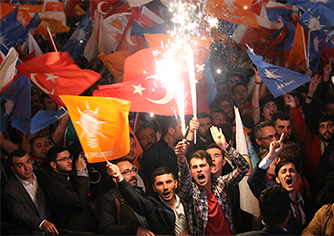
Many in Turkey and abroad were surprised (and some also quite pleased) to see the setback suffered by the ruling Justice and Development Party (AKP) in Turkey’s June 7, 2015 parliamentary elections. Relative to other electoral campaigns in Turkey, Israel as an issue did not feature much. This should not be interpreted as a relaxation of tensions between the countries; rather, the added value of emphasizing this issue was seen at this time as limited. While the possibility of the return of the ambassadors to Ankara and Tel Aviv at some point in the reign of the new government in Turkey cannot be overruled, no one should expect a genuine improvement in the relations between Turkey and Israel in the foreseeable future. Whereas the tensions in relations were exacerbated by the long dominance of the AKP and Erdoğan’s rhetoric, there are also some root problems, foremost the impact of negative developments between Israel and the Palestinians on Turkish-Israeli bilateral relations.

Many in Turkey and abroad were surprised (and some also quite pleased) to see the setback suffered by the ruling Justice and Development Party (AKP) in Turkey’s June 7, 2015 parliamentary elections. While several opinion polls conducted prior to the elections predicted the final results relatively accurately, the concern was that these polls could not reliably assess whether the predominantly Kurdish party, the People’s Democratic Party (HDP), would reach the 10 percent election threshold, as the prediction was within the margin of error in these polls. There were also concerns of possible major fraud in the elections, which we now know did not occur.

Last week’s elections were the first parliamentary elections since the AKP’s rise to power in 2002 in which there was a decline in support for the AKP (from 50 percent and 327 parliamentary seats in the 2011 elections to 41 percent and 259 seats in 2015). The support for the second largest party, the Kemalist Republican People’s Party (CHP), decreased slightly (from 26 percent and 135 seats in 2011 to 25 percent and 131 seats in 2015). The support for the Nationalist Movement Party (MHP) increased from 13 percent in 2011 to 16 percent (with an increase from 53 seats to 79). The HDP received 13 percent of the votes (compared to 6 percent in 2011, when its representatives ran as independents), and rose from 35 seats to 81.

It is clear that a main cause for the reduced support for the AKP was the slowdown of the Turkish economy. In addition, the perception within segments of the Turkish society regarding growing authoritarian tendencies of Turkish President Recep Tayyip Erdoğan and the unpopularity of the AKP’s push for a presidential system hurt the party’s final showing. Also noteworthy were the opposing views on the direction the Kurdish peace process should take (reflected in both the increases of support for the Kurdish HDP and for the nationalist MHP). Moreover, the charisma and inclusive rhetoric of Selahattin Demirtaş, the HDP co-chair, as well as the spirit of the Gezi Park protests had an important effect on the results.

In the aftermath of the elections, no party has enough seats in parliament to form the next government on its own (276 seats are required), and therefore the scenarios for a new government generally outline a coalition between the AKP and one of the other parties or a possible minority government. The coalition that can do the most to push Turkey forward would be an AKP-HDP coalition. Such a coalition would enable Turkey to move ahead in solving its longstanding Kurdish question. Indeed, to some degree there has been already cooperation between these parties throughout the peace process with the Kurds that was re-ignited in 2013. However, AKP is more likely to form a government with MHP, as both parties are based on the right side of the political spectrum, with the AKP being center-right and MHP being far right. Still the fault line between them is their diametrical stance on the Kurdish issue. Nor can an AKP-CHP coalition be ruled out, although the parties are ideologically opposed, with AKP in many respects post-Kemalist and CHP as still staunchly Kemalist. The opposition parties will have difficulties in forming a coalition between them, as until now both MHP and HDP have constructed their party identities against the backdrop of the other. If no coalition government is formed within 45 days, Turkey will hold new elections. Note, however, that even if a coalition government is formed, previous coalition governments in Turkey have not succeeded in surviving their full term.

The Israel Angle

Relative to other electoral campaigns in Turkey, Israel as an issue did not feature much. This should not be interpreted as a relaxation of tensions between the countries, rather that the added value of emphasizing this issue was seen at this time as limited. Overall, support for the Palestinian cause is an issue embraced across the political spectrum. During Operation Protective Edge, all parties in parliament issued a joint statement condemning attacks on civilians and called for an immediate halt in the operation, and  Demirtaş , co-chair of the HDP, while criticizing Erdoğan, said, “Forget the shouting…If you want to provide help to the Palestinian people, stop fooling the people. With a serious boycott, let’s all together stop the Israeli state’s policies of massacres.” The MHP chair, Devlet Bahçeli, has said that Israel’s apology to Turkey over the Mavi Marmara affair should be interpreted as part of Israeli attempts to promote the establishment of a Kurdish state, to which he sharply objects, and these attempts are meant in his view for ensuring Israel’s security interests. Conversely, In October 2014, MHP deputy chair Tuğrul Türkes voiced his opinion that Turkey should return its ambassadors to Tel Aviv and Cairo.

When the subject of Israel did come up in the run-up period to the elections it was through the issue of Jerusalem, with AKP party leaders vowing to conquer it one day. Emphasizing the religious element was one more way to show the religious credentials of the Justice and Development Party and try to preserve, among others, the support of the pious Kurdish voters (an attempt that proved largely unsuccessful). This was seen as important in trying to keep the HDP below the election threshold. From Israel’s perspective, the rhetoric on Jerusalem is worrisome because it transcends the bilateral tensions and even the Israeli-Palestinian issue, and can be an additional incendiary point for those trying to widen the gap between Israel and the Muslim world.

In the divisive campaign the Justice and Development Party conducted in the “us, or against us” rhetoric, Israel was clearly marked as supporting those who are against the party. Specifically, the discourse of the "Parallel State," implying that the religious Gülen movement (previously an ally to AKP, but for some time now a foe) and its followers in bureaucracy are trying to topple the rule of the Justice and Development Party, and that outside actors envious of Turkey’s growing international posture are joining hands with it, labeled Israel (and the Jews) as collaborators with the movement. Erdoğan was blunt when in his criticism before the elections of the New York Times said “Jewish capital” was behind it.

While the possibility of the return of the ambassadors to Ankara and Tel Aviv at some point in the reign of the new government in Turkey cannot be overruled, no one should expect a genuine improvement in the relations between Turkey and Israel in the foreseeable future. Whereas the tensions in relations were exacerbated by the long dominance of the AKP and the rhetoric of Erdoğan, there are also some root problems, foremost the impact of negative developments between Israel and the Palestinians on Turkish-Israeli bilateral relations. Specifically, Hamas’s rule over Gaza has been a major point of contention between the two states. Perhaps, however, Israel’s growing understanding of the urgent need to accelerate the reconstruction efforts in Gaza can also ease some of the tensions between Turkey and Israel, at least regarding this issue.
______________________________________________
Dr. Gallia Lindenstrauss is a research fellow at INSS. Ceyhun Çiçekçi is a research assistant and a Ph.D. candidate at the Department of International Relations, Canakkale 18 Mart University.

The opinions expressed in INSS publications are the authors’ alone.
Publication Series INSS Insight
TopicsTurkey
עברית

Events

All events
Iran, US, Israel, and the Global Jewish Community
10 March, 2026
12:00 - 13:00
Shutterstock

Related Publications

All publications
Mehmet Ali Ozcan / Anadolu via REUTERS connect
The War Turkey Did Not Want
Missiles, refugees, Kurds, and eroding regional standing: The challenges Ankara faces during the war in Iran, its actions, and the opportunities it may seek to exploit
12/03/26
Anadolu via Reuters Connect and Shutterstock (modified by INSS)
The Turkish Legal Campaign Against Israel
Far beyond straining relations: How Ankara’s legal actions contribute to the deterioration of Israel’s international standing
17/02/26
Protests in support of the Iranian people in western Turkey. Photo: REUTERS/Dilara Senkaya
Iran’s Stability as a Turkish National Security Interest
Anxiety, Apprehension, or Inspiration: How the Upheaval in Iran is Viewed Through Turkish Eyes?
04/02/26

Stay up to date

Registration was successful! Thanks.
  • Research

    • Topics
      • Israel and the Global Powers
      • Israel-United States Relations
      • Glazer Israel-China Policy Center
      • Russia
      • Europe
      • Antisemitism and Delegitimization
      • Iran and the Shi'ite Axis
      • Operation Roaring Lion
      • Iran
      • Lebanon and Hezbollah
      • Syria
      • Yemen and the Houthi Movement
      • Iraq and the Iraqi Shiite Militias
      • Conflict to Agreements
      • Israeli-Palestinian Relations
      • Hamas and the Gaza Strip
      • Peace Agreements and Normalization in the Middle East
      • Saudi Arabia and the Gulf States
      • Turkey
      • Egypt
      • Jordan
      • Israel’s National Security Policy
      • Military and Strategic Affairs
      • Societal Resilience and the Israeli Society
      • Jewish-Arab Relations in Israel
      • Climate, Infrastructure and Energy
      • Terrorism and Low Intensity Conflict
      • Cross-Arena Research
      • Data Analytics Center
      • Law and National Security
      • Advanced Technologies and National Security
      • Foreign Information Manipulation and Interference
      • Economics and National Security
    • Projects
      • Preventing the Slide into a One-State Reality
  • Publications

    • All Publications
    • INSS Insight
    • Policy Papers
    • Special Publication
    • Strategic Assessment
    • Technology Platform
    • Memoranda
    • Database
    • Posts
    • Books
    • Archive
  • About

    • Vision and Mission
    • History
    • Research Disciplines
    • Chairman of the Board
    • Board of Directors
    • Fellowship and Prizes
    • Internships
    • Support
    • Privacy Policy and Terms of Use
  • Media

    • Communications
    • Video Gallery
    • Press Release
    • Podcast
  • Home

  • Events

  • Database

  • Team

  • Contact

  • Newsletter

  • עברית

INSS logo The Institute for National Security Studies, Strategic, Innovative, Policy-Oriented Research, go to the home page
40 Haim Levanon St. Tel Aviv, 6997556 Israel | Tel: 03-640-0400 | Fax: 03-744-7590 | Email: info@inss.org.il
Developed by Daat ,Yael Group.
Accessibility Statement
This site is protected by reCAPTCHA and the Google Privacy Policy and Terms of Service apply.