


Publications
How can Hezbollah’s financial resilience—based on a complex and sprawling global system that enables it to withstand IDF infrastructure strikes in Lebanon—be undermined?
INSS Insight No. 2131, May 3, 2026
Follow us on GoogleA significant part of Hezbollah’s resilience rests on a global money-transfer network embedded within the Lebanese diaspora and in informal remittance systems, as well as on a wide range of illicit revenue streams developed over decades. Therefore, military strikes alone—without an international financial strategy focused on the organization’s financial network—are unlikely to significantly undermine its long-term financing capabilities or its capacity for recovery derived from them. To impair Hezbollah’s financing system, a broader strategy is required, beyond the military activity conducted thus far in the current war—one that integrates military action with measures targeting the organization’s funding sources.
Israel’s military campaign against Hezbollah with Operation Roaring Lion is aimed at damaging physical infrastructure, including the organization’s financial arm, al-Qard al-Hassan. However, beyond the financial support the organization receives from Iran, a substantial portion of Hezbollah’s financial resilience relies on a global money-transfer network embedded within the Lebanese diaspora and in informal remittance systems, as well as on a wide array of illicit income sources developed over decades. According to the latest sanctions data from the US Treasury Department (OFAC), Hezbollah’s financial system is not merely local but operates through a global network of shell companies, family members, and business intermediaries spread across several continents. Consequently, without an international financial strategy focused on this network, military strikes alone are unlikely to significantly impair Hezbollah’s long-term financing capabilities. Parallel “shadow economy” mechanisms continue to generate substantial income even when formal financial institutions are targeted.
Since the renewal of hostilities between Israel and Hezbollah, Israel has struck bank branches and financial assets linked to the organization, including facilities associated with al-Qard al-Hassan. This institution, established in the 1980s as part of Hezbollah’s social services network, initially operated as a charitable body providing interest-free loans to the Shiite population in Lebanon. Over time, it evolved into Hezbollah’s primary financial institution, particularly following the collapse of Lebanon’s banking system after 2019. The institution expanded its operations despite international sanctions imposed by the United States since 2007, targeting entities and individuals connected to Hezbollah and its illicit business network. Today, al-Qard al-Hassan operates an extensive financial network that includes ATMs and gold-trading mechanisms and effectively serves as Hezbollah’s banking system.
A major data leak in 2020 exposed al-Qard al-Hassan’s internal databases, revealing nearly 400,000 accounts and highlighting the scale of Hezbollah’s financial system, including its ties to donors and supporters across multiple continents. Given the size of the leaked database and the adult Shiite population in Lebanon—which stood at approximately 1.1 million in the 2022 elections—it can be estimated that a significant share of Lebanon’s Shiite population is involved in this sanctioned financial body. This indicates that Hezbollah’s financial system is deeply embedded in civilian economic life, making it difficult to isolate through military means alone. Moreover, additional information accumulated over the years has revealed that Hezbollah’s financial activity extends far beyond Lebanon’s borders. Accounts linked to individuals in Europe, Africa, North America, and South America have been identified. For example, prominent members of Lebanese Shiite communities abroad, including religious leaders and businesspeople, appeared in the database as major donors.
This global financial footprint aligns with the broader nature of Lebanon’s economy, which relies heavily on remittances from abroad. Even prior to the collapse of Lebanon’s financial system in 2019, these transfers played a central role in sustaining the local economy. By 2023, their volume reached roughly one-third of Lebanon’s GDP, which was among the highest ratios in the world.
Figure 1. Remittances to Lebanon and Other Countries in the Region as a Percentage of GDP, 2004–2023
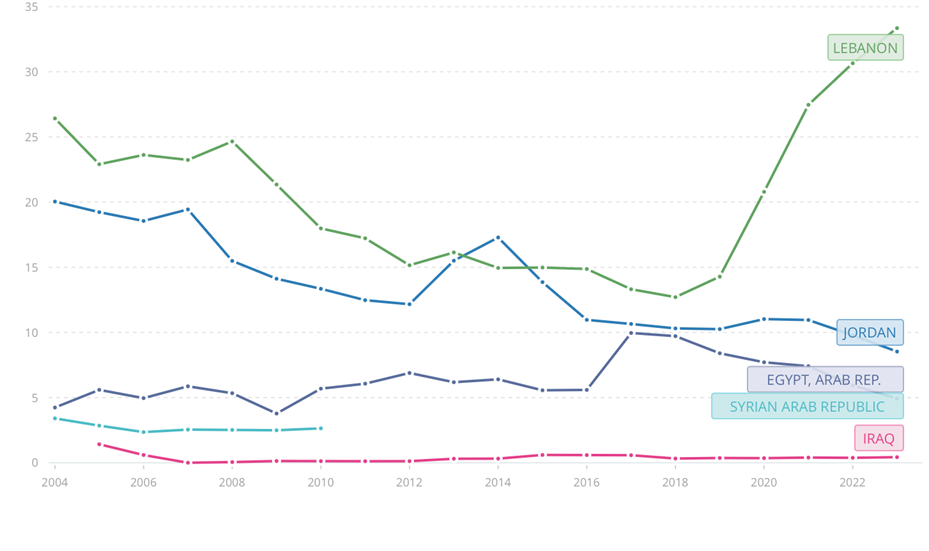
Source: World Bank
It should be emphasized that most of these funds do not pass through the formal banking system. Instead, approximately 95% of transfers flow through Lebanon’s cash economy, which itself constitutes nearly half of the country’s economic activity. This environment creates ideal conditions for Hezbollah to integrate its financial operations within legitimate economic activity.
Data on the Lebanese diaspora abroad further reveals Hezbollah’s ability to leverage Shiite communities overseas. Among tens of thousands of Lebanese voters registered outside the country—distributed across Europe (over 51,000 voters), North America (over 34,000), Africa (over 9,500), and the Gulf states (over 12,500)—analysis by 240 Analytics cross-referenced diaspora data with information on al-Qard al-Hassan accounts. The findings indicate that hundreds of individuals in these countries hold accounts linked to Hezbollah’s financial system, while thousands more maintain familial or business ties with account holders. Some accounts are even marked as “belonging to Hezbollah members.” Although most diaspora financial activity is legitimate, this network of connections provides Hezbollah with broad channels of potential funding channels.
Informal Financial Systems and Hezbollah’s Resilience
Hezbollah’s economic capabilities—which, alongside investment in its military buildup, have also supported the provision of social services (healthcare, education, employment) to its Shiite support base—rely on illicit sources and informal transfer systems such as hawala. Hawala networks enable cross-border fund transfers without direct financial transactions, relying on intermediaries operating on trust and settling accounts through offsets or trade arrangements. Hezbollah’s financial structure is not centralized in a single institution or geographic location but resembles a decentralized network embedded within diaspora communities, informal financial systems, and legitimate economic activity.
In practice, Hezbollah integrates these systems into a broader illicit financial architecture: Revenues from criminal activity (including drug trafficking in Latin America and globally) are first laundered through trade-based mechanisms, such as the purchase and resale of legitimate goods, and then transferred across countries via informal mechanisms like hawala. These systems are particularly difficult to track, as they leave minimal financial records and often operate outside formal regulatory frameworks due to their reliance on cash.
Lebanon’s current status on the gray list of the Financial Action Task Force (FATF) does not significantly hinder the organization. Hezbollah can exploit diaspora networks and informal financing channels to route funds through jurisdictions with stronger financial reputations, thereby avoiding scrutiny. At the same time, the organization has demonstrated the ability to leverage access to state-linked economic mechanisms in Lebanon, diverting funds from formal agreements and development projects into its financial system. This blurring between state resources, private companies, and illicit financing further strengthens the organization’s financial resilience.
Implications for Israel’s Current Campaign Against Hezbollah
Hezbollah’s financing model is decentralized and socially embedded. This characteristic complicates financial targeting of the organization, both politically and operationally. Consequently, Israeli strikes against Hezbollah’s financial infrastructure may produce tactical effects—particularly disruption of activity, uncertainty among account holders, or temporary liquidity pressure—while the organization’s global financial network limits the strategic impact of military strikes. Moreover, Hezbollah’s international funding channels enable it to restore damaged financial nodes relatively quickly by shifting activity to alternative intermediaries or jurisdictions.
Additionally, recent US sanctions highlight that Hezbollah’s financial activity does not depend on a single institution, al-Qard al-Hassan, but rather on a network of interchangeable financial nodes—companies, money changers, and intermediaries—that can be rapidly reconstituted. This significantly reduces the long-term effectiveness of military action alone.
Recommendations
To significantly impair Hezbollah’s financing capabilities, a broader strategy is required beyond the current military campaign—one that integrates military action with measures targeting the organization’s funding sources. Five key policy directions are proposed:
- Expand international financial cooperation: Israel should work with the United States, European countries, and key African states where Lebanese diaspora communities are present to deepen intelligence sharing and enforcement against financial actors linked to Hezbollah.
- Focus on financial intermediaries: Sanctions and enforcement efforts should target not only al-Qard al-Hassan but also money changers, hawala brokers, and trade-based money laundering networks that facilitate Hezbollah’s international transfers.
- Address diaspora financial exposure: Increasing oversight of financial flows associated with the Lebanese diaspora, especially in countries with large Shiite populations, may reduce Hezbollah’s ability to exploit global transfer channels.
- Establish a dedicated interagency financial task force: Israel should create a permanent body to coordinate and implement efforts against Hezbollah’s financial networks. Such a framework (similar to past initiatives such as the Mossad’s “Tzelzel” unit, which has since been closed) should integrate intelligence agencies, financial experts, legal professionals, and law enforcement authorities to ensure a comprehensive and sustained approach.
- Leverage economic diplomacy vis-à-vis Lebanon: As part of broader international efforts to stabilize Lebanon’s economy and banking system, Israel and its partners should pressure the Lebanese government to take more meaningful action against Hezbollah’s financial infrastructure. Conditioning international economic assistance on concrete steps to curb the organization’s financial activity could increase pressure on Beirut—beyond the limited measures taken to date.
Conclusion
Hezbollah’s financial resilience does not rely solely on local infrastructure but on a decentralized global system that integrates a large Lebanese diaspora, informal transfer mechanisms, and illicit revenue streams. This structure provides the organization with high adaptability and reduces the effectiveness of targeted military action. Therefore, achieving a significant and sustained impact on Hezbollah’s financing capabilities requires a multidimensional approach that combines military activity with financial, regulatory, and diplomatic measures on the international stage. Only a comprehensive and coordinated strategy that is focused on the core of the organization’s global financial network can, over time, constrain its ability to maintain and rebuild its military and organizational power.