


Publications
The Israeli government’s policy in Judea and Samaria is in the middle of a broad political-ideological transformation. How is this reflected in practice, and why does it pose a significant security and diplomatic risk for Israel?
INSS Insight No. 2129, April 23, 2026
Follow us on GoogleThe West Bank arena is in the middle of a conceptual and practical transformation. Under the cover of the essential requirement of “absolute security,” the government is advancing a policy of applying Israeli sovereignty, blocking pathways to a future political settlement, weakening the Palestinian Authority to the point of collapse, and pushing Palestinians out of their places of residence. This policy effectively adopts the principles of the “Decisive Plan” promoted by the government’s ideological right and rooted in the doctrine of Minister Bezalel Smotrich. The consequences are destabilization and damage to security in the West Bank, leading toward a one-state reality and fundamentally altering Israel’s character. As a result, Israel may face serious risks, including an outbreak of terrorism, internal moral erosion, intensified international criticism that could lead to the formal designation as an apartheid state, deepening diplomatic isolation, and a freeze in longstanding peace relations, including the Abraham Accords.
The Israeli government’s policy in the West Bank is undergoing a broad political-ideological transformation. Since its establishment, and especially after October 7, the current government has been promoting a fundamental restructuring of the legal, property, and administrative regime in the West Bank. These are not isolated measures but rather a systematic program led by key government officials aimed at expanding Israeli settlements; entrenching control and land ownership; increasing Israeli governance in the area; blocking any possibility of a future arrangement based on separation into two states, while weakening the Palestinian Authority; and, in practice, preparing the ground for applying Israeli sovereignty in the area. This process marks a deep shift in government policy from a concept of “Conflict Management” with the Palestinians to adopting the “Decisive Plan” advanced by the ideological right. This plan, presented by Minister Smotrich as early as 2017, aims to defeat Palestinian national aspirations and realize the vision of "Greater Israel" through annexation and the application of sovereignty over all of the West Bank. Within this framework, Palestinians are offered alternatives of residency without political rights or emigration, alongside the use of force to suppress any resistance from those unwilling to relinquish their national aspirations. The plan is further reinforced by the concept of “absolute security” that took shape after October 7, according to which every threat requires an immediate military response, while maintaining operational freedom for the IDF and full security control over the Palestinian territory, whereas restraint or a political arrangement is perceived as a strategic risk.
Formally, there has been no change in the legal status of the territory. Israel has not officially declared annexation, and the legal framework ostensibly remains that of belligerent occupation. In practice, however, the government is gradually applying de facto sovereignty in the West Bank through several lines of action that fundamentally alter the structure and character of control in the territory.
Framing Settlements as a Security Need
The government primarily justifies its policy on security grounds in order to secure broad domestic legitimacy, while avoiding presenting it as an ideological decision to assert the right of Jews to settle throughout the West Bank and to block any future political settlement.
Thus, while managing the campaign against Iran, Defense Minister Israel Katz visited the Samaria Regional Council and declared that strengthening settlement, particularly in northern Samaria, “is a clear security interest of the State of Israel” and emphasized a commitment to deepening “our hold on the ground and ensuring the security of all Israeli citizens.” He and Samaria Regional Council head Yossi Dagan stressed that settlement in northern Samaria constitutes “Israel’s protective belt.”
In practice, this policy ignores warnings from the security establishment regarding the operational burden created by the numerous settlement points scattered throughout the West Bank, effectively doubling the area the IDF is required to defend. Against this backdrop, IDF Chief of General Staff Lt. Gen. Eyal Zamir warned that he is “raising ten red flags” and cautioned that “the IDF may collapse into itself.” Due to a shortage of battalions for routine security, reliance is increasing on territorial defense units and local first response teams in settlements, a trend that blurs the line between regular military forces and local reservists and armed civilians.
The extensive spread of settlements, outposts, and agricultural farms greatly lengthens defensive lines and stretches force deployment, resulting in more territory, more remote points, more access routes, more checkpoints, more points of friction, and more forces and resources required. Significant combat forces are diverted to protecting outposts and farms instead of engaging in counterterrorism and defending the seam zone—the gateway to Israel’s interior. In addition, security tasks harm the IDF’s readiness for emergencies, lead to reduced training, and necessitate extensive reserve mobilization. In this reality, military activity in civilian spaces deepens further.
The Settlement Axis: Entrenching Ownership and Accelerating Expansion
At the core of the process lies a fundamental change in the land regime designed to entrench Israeli ownership of land. This shift is being advanced through decisions of the political-security cabinet in February 2026 to open the land market to enable direct purchase by Israelis (repealing Jordanian law), restore the state as an active purchasing actor, and reduce barriers and oversight mechanisms for real estate transactions (eliminating the requirement for “transaction permits” and opening the land registry to public inspection). At the same time, the government decided to renew land registration in Area C for the first time since 1967—a move of a sovereign nature that creates final land ownership registration.
In parallel, the government is accelerating settlement expansion by approving construction plans and advancing measures to legalize communities and connect them to infrastructure even before full authorization, legalizing illegal outposts, and expanding agricultural use. This trend is supported by complementary steps of land seizures and the establishment of over 100 agricultural farms, extensive investment in infrastructure and roads, and increased allocation of security components to settlements—anchored in a government plan of approximately NIS 2.7 billion over five years to strengthen infrastructure beyond the Green Line.
This trend was clearly reflected in a cabinet decision at the end of March 2026 to establish 34 new settlements in Area C by legalizing 10 illegal outposts and building 24 new settlements (see Figure 1). This is an unprecedented number approved in a single decision, which, together with the 68 communities approved since January 2023, totals approximately 102 settlements. Their locations, adjacent to Palestinian population centers between Areas A and B and widely dispersed (in the Jenin, Ramallah, and Hebron regions, and the Jordan Valley), have a direct spatial impact of undermining Palestinian territorial continuity, increasing dependence on Israeli-controlled routes, and intensifying daily friction between Jewish and Palestinian populations.
Figure 1. Expansion of settlements in the West Bank. Source: T-Politography.
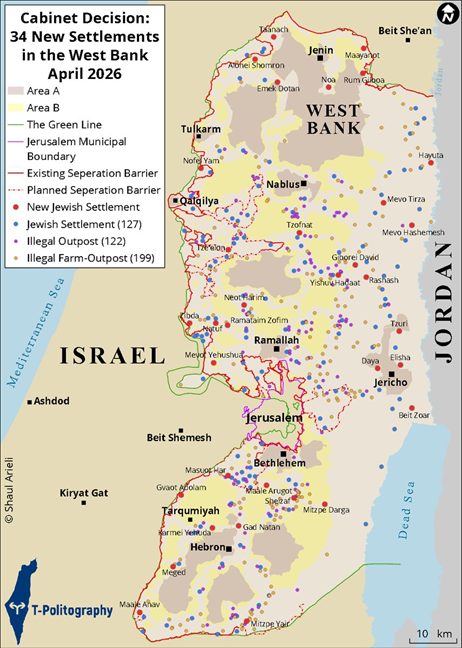
Note. The locations of the new 34 settlements are approximate; no official map has yet been published.
The fact that most of the settlements are planned outside the route of the security barrier and the settlement blocs, which are perceived as a central defensive line, sharpens the gap between the security justification presented by the government and its actual policy. If the barrier is intended to ensure security, then expanding settlements beyond it does not align with security logic. This gap is further highlighted by the cabinet’s disregard for warnings from the security establishment that expanding and dispersing centers of settlement increases the burden on the IDF and erodes routine security, especially amid rising settler violence that requires resource allocation to reduce friction.
Moreover, the decision, made during the war with Iran, was kept confidential to reduce American pressure following criticism by the Trump administration over rising settler violence and concerns about changing the status quo.
Taken together, the dispersal of settlements beyond settlement blocs and defensive lines, disregard for security warnings, and the manner in which the decision was advanced indicate that ideological considerations, and not purely security ones, primarily drive government policy, demonstrating its willingness to expand settlements even at the cost of an increased security burden and deepening diplomatic tensions with close allies.
The Enforcement Axis: Expanding Authority into Areas under Palestinian Authority Control
At the same time, the government has decided to expand Israeli enforcement powers beyond Area C into Areas A and B in matters of water, environment, heritage, and archaeology. This expansion will allow Israel to issue orders, delay or halt work, and directly influence planning, infrastructure, and development in areas administered by the Palestinian Authority. It marks a shift from limited security enforcement in Areas A and B to ongoing administrative intervention, reducing the Palestinian Authority’s administrative autonomy, governance capacity, and planning authority while deepening Israel’s involvement in daily management.
The Governance Axis: Transition to Institutionalized Civilian Control in Sensitive Sites
In the governance axis, authority over planning and construction in the settlement area in Hebron and the Tomb of the Patriarchs compound has been transferred to the Civil Administration, bypassing the Hebron municipality. Additionally, an Israeli administrative body for Rachel’s Tomb has been established with permanent authority and funding.
These moves signify a shift from agreed frameworks to direct Israeli management and establish a permanent governing infrastructure. They strengthen Israeli civilian presence at highly sensitive sites of religious and historical significance and create institutionalized civilian management frameworks no longer dependent on military governance.
The Authority Axis: Weakening the Palestinian Authority
At the same time, the government is taking direct steps to weaken the Palestinian Authority. Viewing it as a competing actor for control, economic, administrative, and political pressure measures are being applied, including delaying and reducing clearance revenue transfers, preventing Palestinian workers from returning to jobs in Israel, and imposing sanctions on PA officials. These measures are intended to erode its functioning and undermine its standing among the Palestinian population. The World Bank described the PA’s situation at the end of 2025 as a deep fiscal crisis: Clearance revenues, its main income source, were significantly deducted by Israel in 2025, and since May 2025, their transfer has been completely halted. As a result, the PA can pay only 50%–70% of monthly salaries, while essential social expenditures have been cut. This further deepens the Palestinian public’s crisis of trust in the PA. In addition to accusations of corruption, a picture is emerging of eroding capacity for Palestinian self-governance.
These moves are also being advanced contrary to the position of the security establishment. They aim to damage the governance of the PA, the only Palestinian actor capable of maintaining public order, addressing civilian needs, curbing Hamas in the West Bank, and cooperating with the IDF on security, precisely because it is a potential partner for political dialogue and a foundation for a Palestinian state. Israel is disregarding the implications of weakening governance, including the risk of a governance vacuum and loss of control over Palestinian security apparatuses. Such a situation would require Israel to assume the PA’s roles of maintaining order and providing for the Palestinian population, thus bearing a heavy security-civil burden.
As the PA’s governance erodes, the risk of renewed activity by paramilitary groups that do not obey it grows, as does the potential for a “turning of the guns,” in which security forces direct their weapons against IDF troops and settlers instead of acting against Hamas and Islamic Jihad. For ideological right-wing actors in Israel seeking to advance the “Decisive Plan,” such a development could serve as an opportunity for the final collapse of the PA.
Settler Violence and Selective Enforcement as a Complementary Axis
Alongside institutional tools, settler violence and Jewish terrorism against Palestinians function as a complementary mechanism. This is not a marginal phenomenon but a systematic pattern that includes threats, bodily harm, property damage, arson, stone-throwing at Palestinian vehicles, forceful seizure of grazing land, and displacement of Palestinians from water sources, farmland, and living areas, up to actual expulsion.
According to IDF data, in 2025 there were about 870 “Jewish nationalist crime” incidents (an increase of about 27% compared to the previous year), while the UN reports 1,732 “settler violence incidents.” Despite differences stemming from classification methods, both sources indicate the same trend: a consistent increase in both the number and severity of incidents. This violence is not limited to a handful of extremists; it also involves armed settlers, territorial defense soldiers (settlers serving in reserve units operating in their residential areas), and members of local first response teams. Rather than strengthening security, these forces intensify friction and increase violence, blurring the civilian-military boundary.
In the absence of consistent and deterrent enforcement by security forces and police, alongside deliberate steps such as canceling administrative detentions of Jews and weakening the Jewish division of the Israel Security Agency (Shin Bet), and amid lenient messaging and governmental backing, this violence creates sustained pressure on Palestinian communities and contributes to a de facto change in patterns of control on the ground. This lack of enforcement allows negative dynamics to advance unchecked, effectively turning them into a policy tool.
Implications
Taken together, the government’s lines of action fundamentally alter the structure and character of Israel’s control in the West Bank. They reflect a transition from temporary military control over disputed territory awaiting future political settlement to an institutionalized civilian control model with expanded powers, shifting the center of gravity from the security system to the political-civilian echelon. At the same time, the distinction between Area C and Areas A and B is blurred, rapidly eroding the framework of the interim agreement between Israel and the Palestinian Authority and blocking all avenues for a future agreed-upon political arrangement based on the two-state reality.
Contrary to declarations about the need for absolute security and the framing of settlement as a means to achieve it, government policy in the West Bank is not aimed at creating long-term security stability but at shaping a new reality: the West Bank as a space permanently controlled by Israel. In all likelihood, sustained pressure on the Palestinian population will not lead to political submission or emigration, as some in the government hope. These actors are clinging to a “deceptive calm,” which, in the short term, has reduced terrorism due to IDF and Shin Bet counterterrorism efforts, coordination with PA security forces, and Palestinian fears of the “Gaza-ization” of the West Bank. However, in a reality where Palestinians are left without rights, with a restricted political space and under constant pressure, alongside the erosion of the PA and security coordination, the path will be paved for strengthening terrorism and increasing motivation for widespread, high-intensity violence, as well as the risk of a major eruption in the West Bank.
In conclusion, the West Bank arena is undergoing a profound conceptual and political transformation with significant strategic implications for Israel. It is being advanced mostly through cabinet and government decisions, amid the limited attention of an Israeli public exhausted by two and a half years of trauma and war. Under the cover of security framing and the concept of “absolute security,” the government is reshaping the structure and character of Israel’s control in the territory. In practice, its policy and actions point to a clear objective: the application of Israeli sovereignty and the blocking of pathways to a future political settlement, alongside the collapse of the Palestinian Authority and the displacement of Palestinians. As a result, Israel may face growing risks of high-intensity terrorism, internal moral erosion, being labeled an apartheid state, deepening international isolation, and the freezing of longstanding peace relations and the Abraham Accords.