


Publications
Amid a severe crisis in Israel–Jordan relations, the war against Iran broke out, and its repercussions could alter the nature of relations between Amman and Jerusalem
INSS Insight No. 2114, March 18, 2026
Follow us on GoogleOperation Roaring Lion—the war with Iran—is being waged during a low point in Israel–Jordan relations and sharpens the importance of peace as a strategic asset for both countries. Despite the rupture between the leaders of the two countries and the tension in the Palestinian arena, military coordination between the IDF and the Jordanian Armed Forces has continued. The war has led Jordan to adopt a declared policy of “positive neutrality,” namely, intercepting Iranian missiles in its sovereign airspace on their way to Israel and actively defending its territory against direct attacks, while also declaring that it is not a party to the conflict and calling for de-escalation and a diplomatic settlement. This position reflects the kingdom’s maneuvering between two poles: on the one hand, its alliance with the United States, its security ties with Israel, which are vital to its stability, and its perception of Iran as a regional threat; on the other hand, the need to respond to domestic public pressure hostile to Israel and to express the palace’s concerns about the war’s economic consequences, the spread of regional chaos, and the imposition of Israeli hegemony in the region. The changes in the region due to the war, together with the fruitful security cooperation during it, create a window of opportunity to strengthen relations between Jerusalem and Amman—a goal that should be placed at the center of the diplomatic effort expected after the war. Realizing this potential depends on restoring Israeli–Jordanian dialogue at the highest levels, increasing Israeli attentiveness to Jordanian concerns in the Palestinian context, and leveraging the American–Gulf umbrella to expand security and economic cooperation between the two states.
Israel and Jordan entered the current war with Iran in the midst of a severe crisis in their relations. Since October 7, 2023, the leaders of the two countries have neither met nor spoken publicly; the countries’ ambassadors returned to their respective capitals, and the level of relations was downgraded; joint infrastructure projects discussed before the war were frozen. This state of affairs reflects the anti-Israeli sentiment prevalent among parts of the Jordanian public, which has intensified over the past two and a half years against the background of the war in the Gaza Strip, as well as the deep concern of the royal house itself in light of Israel’s policy in the Palestinian arena and its conduct in the bilateral sphere vis-à-vis Jordan.
Repeated statements by Israel’s prime minister, ministers, and public figures expressing support for encouraging the voluntary emigration of Palestinians from the Gaza Strip and the West Bank, and rejecting the establishment of a Palestinian state have raised grave concerns in Jordan that Israel’s right-wing government sees Jordan as the Palestinians’ “alternative homeland”—a scenario that, in Jordan’s eyes, threatens its national identity and even its very existence. Steps approved by the Israeli government in February 2026, with the aim of making it easier for Israelis to purchase Arab land in the West Bank—mainly the repeal of a land law originating from the period of Jordanian rule—are interpreted in Amman as the de facto application of Israeli sovereignty in the West Bank and as the death knell for the two-state solution. To this must be added the kingdom’s anger over the continued erosion of the status quo on the al-Aqsa compound and its closure to worshippers during Ramadan.
Tensions in the Palestinian arena have been compounded by direct friction between the two countries over one of the most important pillars of their relations: water cooperation. In November 2023, shortly after the outbreak of the war in Gaza, Jordan froze the signing of the “Prosperity” agreement—a deal under Emirati auspices in which Israel was to sell desalinated water to Jordan, and Jordan was to supply solar electricity to Israel. In November 2025, Israel decided not to renew a 2021 agreement to supply Jordan with an additional 50 million cubic meters of water per year, reallocating the amount to domestic agricultural needs. This decision reduced the supply of water available to Jordan by about 4%, further straining its already depleted water sector.
Despite the negative developments in relations between the two countries, military coordination has continued around repelling common threats and maintaining calm along the borders. The kingdom remains committed to peace with Israel and recognizes its contribution to Jordan’s security, economy, and relations with the United States, which grants it annual aid totaling $1.45 billion. At the same time, question marks are multiplying in Jordanian public discourse regarding the value of the peace treaty. As Marwan al-Muasher, Jordan’s first ambassador to Israel and later foreign minister and deputy prime minister, said last November: “Jordan used to think that there was a ‘deep state’ in Israel that would protect the Jordanian interest. Jordan believed that despite the political upheavals in Israel, Israel’s security establishment fully understood the need to preserve Jordan’s stability. I say this with complete honesty—if that was true in the past, it is certainly not true today.”
The Jordanian Dilemma in the War: Between Hostility to Iran and Fear of What Comes Next
The troubled relationship between Jordan and Iran has historical roots stretching back decades and is unrelated to Israel. In the 1980s, King Hussein supported Iraq in its war against Iran. In 2004, King Abdullah coined the term “Shiite Crescent” to warn of expanding Iranian influence in the Middle East. Iran’s involvement in Syria and Iraq, both of which border Jordan, has confronted the kingdom with direct threats, including border infiltration, terrorism, and the smuggling of weapons and drugs. In addition, King Abdullah has for years urged the United States to adopt a hard line toward Iran. In 2015, he expressed reservations about the nuclear agreement advanced by President Obama, although he refrained from criticizing it publicly.
As in previous rounds of conflict between Israel and Iran, Jordan has once again found itself caught in the crossfire with the outbreak of the current war. Thus far, the kingdom has reported the fall of hundreds of interception fragments, along with injuries and property damage. During Operation Rising Lion in June 2025, Iranian missiles and UAVs on their way to Israel were intercepted over Jordanian territory. This time, however, about half of the attacks were directed at Jordan itself and were carried out with the involvement of pro-Iranian militias in Iraq. The targets included the al-Ruwaished (H4) and Muwaffaq al-Salti (Azraq) air bases, where American military forces are stationed under the 2021 Jordan–US security partnership agreement for counterterrorism cooperation. One of the attacks reportedly hit the radar of an American THAAD missile interception system. Meanwhile, it was reported that an Iranian cyberattack aimed at damaging the kingdom’s strategic wheat silos by disrupting storage temperatures had been thwarted—an incident Jordanian media described as “an attempt to undermine its food security and social stability.”
Despite Iran’s hostile activity, Jordan’s public position has remained measured and ambivalent: on the one hand, it condemned the Iranian attacks against it and against the Arab Gulf states and made clear to the chargé d’affaires at the Iranian embassy in Amman that harm to the security of the kingdom and its citizens constitutes a “red line.” On the other hand, it declared that it is not a party to the conflict and would not permit any actor to use its sovereign territory offensively; it was careful not to express support for overthrowing the Iranian regime and refrained from severing diplomatic ties with Tehran. In conversations King Abdullah held with dozens of world leaders, foremost among them President Trump, he repeatedly emphasized the need for dialogue and diplomacy in order to halt the escalation, resolve the crisis, and achieve comprehensive calm.
This policy, referred to in Jordan as “positive neutrality,” stems from four main considerations:
First, domestic public opinion. Since the beginning of the war, the Jordanian regime has faced a campaign accusing it of cooperating with the “Israeli–American enemy,” hinting that American attacks on Iran are being launched from Jordanian territory. In response, Amman has been careful to stress that the interception of Iranian missiles is intended to protect the kingdom’s sovereignty and the security of its citizens and does not serve foreign interests. It has also not confirmed that it allowed any party to use its airspace or bases in its territory as a launching point for attacks on Iran. At the same time, unlike during Operation Rising Lion, Jordan has refrained from condemning the Israeli–American attack on Iran despite pressure to do so from the Islamic Action Front, the Muslim Brotherhood’s political arm in the Jordanian parliament.
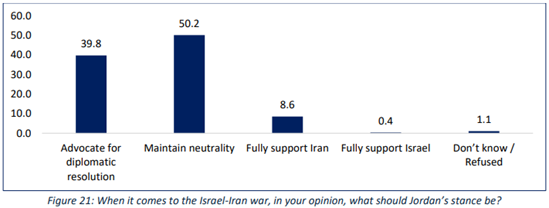
This public stance helps the Jordanian regime remain aligned with its population, which is both heavily Palestinian and influenced by Islamist perceptions. Furthermore, although many Jordanians view Iran as a negative factor undermining the region’s stability, they are even more antagonistic toward Israel and tend to side with its adversaries. A public opinion poll conducted in September 2025, before Iran directly attacked Jordan, found that 76.2% of Jordanians viewed Israel as Jordan’s primary threat, while only 9% named Iran. At the same time, 90% supported Jordan taking a neutral stance or supporting a diplomatic settlement between Israel and Iran, whereas 8.6% and 0.4%, respectively, favored openly aligning with Iran or Israel. These figures suggest a gap between the palace’s threat perceptions and those of the street, and highlight the need to bridge them in order to preserve domestic cohesion.
Second, security and economic risks due to the war. Jordan fears not only direct Iranian attacks on targets within its territory, but also a war of attrition that could destabilize the region and the entire world. The longer the campaign continues, the greater the risk of significant damage to the Jordanian economy. The suspension of the supply of natural gas from Israel—which normally accounts for most of Jordan’s electricity generation—has already forced the kingdom to import more expensive alternatives such as liquefied gas and diesel, resulting in losses estimated at $170 million per month. At the same time, rising prices for imported oil are increasing the cost of fuel, transport, and goods, thereby intensifying inflationary pressures and burdening the Jordanian treasury. The tourism sector, which had only recently begun to recover from the damage caused by the war in Gaza, is now facing a high rate of booking cancellations, harming a major source of employment and foreign-currency income.
Third, skepticism regarding the war’s likely outcome. Many in Jordan doubt that the war can achieve one of its principal objectives of creating conditions for regime change in Iran. Jordanian commentators believe that Iran’s political establishment is determined to fight for its survival, backed by a cohesive and loyal ideological-religious base rooted in Iranian society. In contrast, the American-Israeli plan to overthrow the regime is unclear and rests on wishful thinking. Under these uncertain conditions, an explicit Jordanian alignment against Iran could prove a dangerous gamble. Moreover, even in a scenario of regime collapse, many in Jordan do not necessarily see the emergence of a new, peaceful, and stable order in Iran, but rather the possibility of a descent into anarchy, civil war, struggles for influence, and state disintegration—scenarios that would heighten regional instability.
Finally, concern over Israel’s growing strength and perceived hegemonic ambitions. Despite its fundamental unease with Iran and its commitment to maintaining ties with the United States and Israel, Jordan also looks westward with apprehension. In the view of Jordanian commentators close to the establishment, an Israel emboldened by its power—arrogant and unrestrained—could seek to shape a new regional order without regard for its eastern neighbor. They believe that the unilateral moves advanced by the Israeli government in the West Bank and Jerusalem before—and during—the war may continue with even greater intensity afterward. Accordingly, from Jordan’s perspective, an Israeli victory over Iran would amount to the replacement of one threat with another and would not necessarily herald a better future.
Conclusion and Recommendations
The current war with Iran is a reminder of the importance of Israeli–Jordanian peace and of the kingdom’s unique contribution to Israel’s security as a geographic buffer separating it from Iran and the Shiite militias in Iraq. Even during periods of tension between the two leaderships, security coordination between the militaries continued. Jordan did not allow its airspace to be used against Israel, helped keep threats away from the countries’ long-shared border, and enabled travelers from Israel to use Jordanian airports. This conduct should also be seen in the context of the kingdom’s struggle since October 7 against Islamist elements seeking to draw Jordan into the “ring of fire” of the Iranian-led Axis of Resistance. In this regard, a historic decision was made in April 2025 to outlaw the Muslim Brotherhood because of its involvement in terrorism and its challenge to the state’s monopoly on the use of force.
Israel–Jordan relations now stand at a crossroads. The continuation of Israel’s current policy in both the Palestinian and bilateral arenas could lead to further friction and deepen the erosion of the peaceful relationship between the two countries. Conversely, an alternative Israeli policy could capitalize on the new strategic window of opportunity created by the war to improve ties. Growing American involvement in shaping the regional architecture, the weakening of Iran, the “head of the snake” of the Axis of Resistance, and Jordan’s contribution to the regional missile defense array and to the struggle against the radical camp could all serve as leverage for renewed rapprochement between Jerusalem and Amman under Washington’s auspices.
The American–Israeli effort expected at the end of the war to revive normalization processes should focus not only on bringing new states into the circle of peace but also—as a high priority—on strengthening relations between Israel and Jordan, which constitute a strategic asset for regional security and stability. Four steps could help advance this goal:
- Renew high-level political dialogue: Israel should work to restore political channels of communication with the palace and not rely only on the existing security channels. It should recognize that the current public climate in Jordan initially requires quiet diplomacy to prepare the ground for more visible moves. Direct dialogue between the leaderships could help convey messages, reduce misunderstandings, restore trust, and create permanent frameworks for consultation on regional and bilateral issues.
- Leverage the American umbrella: The United States, as the sponsor of the peace treaty and a strategic partner of both countries, has a central role to play in rebuilding trust between Jerusalem and Amman. Washington can encourage regional cooperation between the countries, help Jordan cope with the economic consequences of the war, and consider further strengthening the kingdom’s security capabilities in light of internal and external threats. Regional frameworks led by US Central Command (CENTCOM) could provide a platform for multilateral security cooperation involving Israel and Jordan.
- Israeli consideration for Jordanian concerns and interests in the Palestinian arena: Improving relations with Jordan requires Israel to avoid unilateral steps in the West Bank, such as annexation and weakening the Palestinian Authority, which are perceived in Jordan as undermining the prospects for a future two-state solution and paving the way for transforming Jordan into the Palestinians’ “alternative homeland.” Such steps endanger the kingdom’s stability, fuel anti-Israel public sentiment in Jordan, and strengthen radical political actors—chief among them the Muslim Brotherhood—precisely at a time when the authorities are working to weaken them. In addition, Israel should respect the status quo on the al-Aqsa compound and work with Jordan to maintain calm and security in Jerusalem’s Holy Basin, in accordance with the special status accorded to the kingdom in the peace treaty.
- Deepen the economic partnership: Israel should position itself vis-à-vis Jordan as a beneficial economic neighbor, initially through renewing and expanding cooperation in the fields of gas and water—which constitute pillars of the relationship between the two countries and contribute to the kingdom’s stability and resilience. At the same time, Israel, the United States, and the Gulf states should integrate Jordan into multilateral regional initiatives in transport, trade, energy, and tourism that would strengthen its regional standing, benefit its economy, and provide it with an incentive to enhance the peace ties. A concrete example is the IMEC corridor, as Jordan’s strategic geographic location enables it to serve as a central link in trade between India and Europe via the Gulf states and Israel.