


Publications
Anxiety, Apprehension, or Inspiration: How the Upheaval in Iran is Viewed Through Turkish Eyes?
INSS Insight No. 2097, February 4, 2026
Follow us on GoogleFor Turkey, Iran’s stability is not merely a foreign policy issue but a core component of national security with direct implications for the Turkish economy. Sharing a long border with the Islamic Republic, Ankara views any significant upheaval in Tehran as a potential multidimensional threat. These threats range from waves of migration and disruptions in the energy and trade markets to the central concern of a governing vacuum that could strengthen Kurdish separatist actors (the PKK and its affiliates) along the shared border. Despite the geopolitical rivalry and the Sunni–Shiite divide, preserving the status quo in Tehran constitutes a key interest for the Erdoğan government, which fears that a collapse of governance in its eastern neighbor would generate a “domino effect” destabilizing the entire region—a scenario reminiscent of the geopolitical and humanitarian chaos that followed the wars in Iraq and Syria.
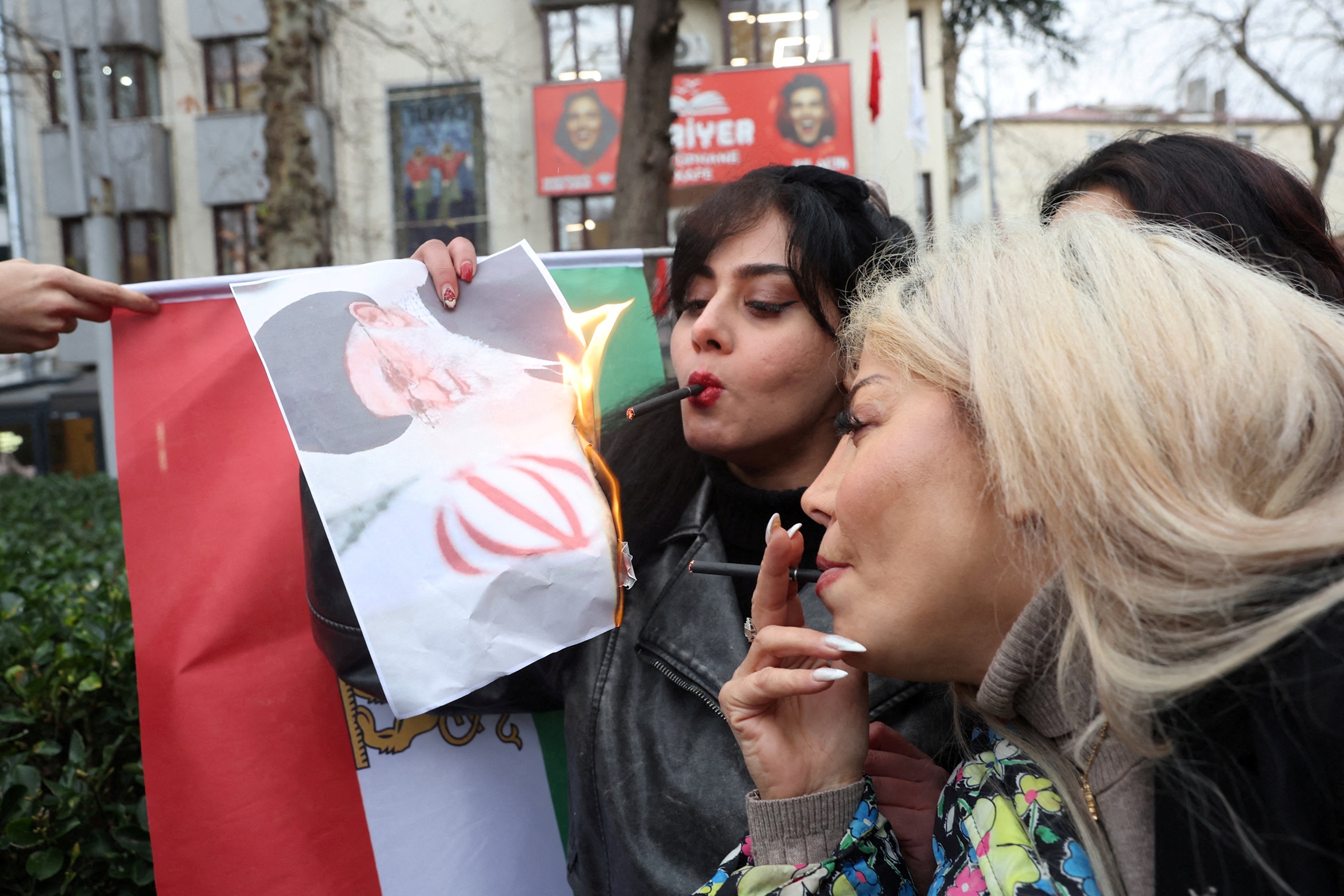
The protests that erupted in Tehran on December 28, 2025, triggered an unusually high level of alert in Ankara. The initial participation of the bazaari (merchant) class in the cycle of protests was perceived as indicative of a significant crack in the pillars of the Iranian regime, confronting Turkish decision-makers and the public with a dilemma: whether to support the Iranian public’s demands for economic improvement and even fundamental political change, or to prioritize the institutional stability of the existing regime. This article analyzes the Turkish public’s perceptions of these events, examining certain gaps between the official government position and prevailing sentiments in the media and civil society.
The Position of the Turkish Political Establishment: Convergence around Regime Stability in Iran and Opposition to Foreign Intervention
An analysis of statements by senior Turkish officials and their coalition partners reveals a strategic outlook that places Iran’s stability as a matter of essential importance for Turkey. At the core of this position is a perception that popular protests in Iran are a tool used by foreign powers to undermine order rather than being an authentic internal process. In effect, senior figures in Ankara have adopted the Iranian regime’s own narrative, which portrays the protests as a plot by Iran’s enemies—led primarily by the United States and Israel—to topple the regime. These claims revolve around several central themes:
Preventing chaos and supporting dialogue—In remarks delivered after a cabinet meeting on January 19, 2026, President Recep Tayyip Erdoğan drew a link between global instability and developments in Iran. He described the protests as a “test that targets its social peace and stability” and emphasized that Turkey would oppose any initiative that drags the region into “uncertainty.” The president’s expression of confidence in Iran’s ability to weather this “trap-filled period” reflects a clear preference for existing institutions over violent regime change, which could lead to spillover terrorism and migration flows into Turkey.
The “Gezi model” and the threat of imperialism—Devlet Bahçeli, chairman of the Nationalist Movement Party (MHP), in a parliamentary speech on January 13, 2026, drew a direct parallel between the anti-government demonstrations in Turkey, known as the Gezi Park protests, in 2013 and the current wave of protests in Iran, identifying both as “provocations by (foreign) intelligence and imperialists.” For Turkey’s nationalist right—from the coalition partner MHP to nationalist opposition parties such as Zafer and the İYİ Party—undermining Iranian sovereignty is perceived as a direct threat to Turkey’s own territorial integrity. Bahçeli emphasized the restraint shown by Iran’s Turkic (Azeri) minority, interpreting it as a refusal to serve as “subcontractors of imperialism.”
Warning against regional escalation—Foreign Minister Hakan Fidan reinforced this line in statements emphasizing fears of broad military escalation. According to reports in BBC Türkçe, Fidan warned that Iran’s internal tensions, alongside the collapse of the local currency (the rial) to a historic low, constitute “fertile ground” for exploitation by external actors. He explicitly noted that Israel is “looking for an opportunity” to attack Iran, and that such intervention would plunge the entire Middle East into irreversible chaos. In this framing, Ankara presents the protests in Iran not as a human rights concern but as a geopolitical event threatening the regional balance of power.
The Turkish Media Arena: Between Government Mouthpieces and Opposition Voices
Turkish media coverage of the protests in Iran reflects the deep polarization within Turkey and the near-total control exercised by the Justice and Development Party (AKP) over information flows. A study examining coverage of the protests that began in Iran at the end of 2017 (Karabiyik, 2022) pointed to a stark ideological divide: While opposition-aligned outlets explained the protests as the result of internal and economic factors, the establishment media overwhelmingly adopted the “foreign forces” narrative, mirroring the government’s rhetoric. This trend has intensified significantly in the current period, as most major media outlets in Turkey are owned by business conglomerates that have close ties to the government.
Mainstream media as a governmental instrument: Institutional control of the media is not merely ideological but also structural. Data from the Media Ownership Monitor (MOM) project show that Turkish media ownership is concentrated in the hands of a few business groups whose broad commercial interests depend on government tenders. As a result, outlets such as TRT and A Haber operate as extensions of Turkey’s Foreign Ministry, framing the unrest in Tehran not as a civic struggle for justice but as an “imperialist plot” aimed at weakening Turkey by destabilizing its neighbors. This coverage is designed not only to protect the Iranian regime but primarily to prevent “inspiration” for similar protests within Turkey itself.
Opposition outlets as a space for alternative interpretation: In contrast, media outlets such as Sözcü and Halk TV present a fundamentally different picture. For them, the 2025–2026 events in Iran reflect hardships familiar to the Turkish citizen: runaway inflation, erosion of the educated urban middle class, suppression of civil liberties, and the collapse of purchasing power—even among the merchant class. On these channels, the emphasis is on solidarity with the protesters and on the failure of centralized governance models. However, due to the economic structure of Turkey’s media market, these voices are marginalized or subjected to heavy regulatory and legal pressure, ensuring that the government’s “external threat” narrative dominates the broader public discourse.
Social Segmentation and Strategic Interests: Iran as a Mirror of Turkish Polarization
Public reactions in Turkey to the protests in Iran are far from monolithic; they reflect the deep ideological fault lines within Turkish society itself. An analysis of a unique sample of 80–120 Turkish language-posts (including main posts, high-engagement replies, quotes, and threads) on the social media platform X, collected through targeted advanced searches between December 2025 and January 2026, provides empirical confirmation of this polarization. The conversation is divided into two distinct camps that mirror domestic politics:
The solidarity and change camp (approximately 25%–30% of the discourse): Those identified with the secular-liberal camp—associated with the largest opposition party, the Republican People’s Party (CHP)—view the Iranian struggle, previously articulated with the slogan “Women, Life, Freedom,” as a source of inspiration. In their view, the uprising against religious coercion serves as a mirror reflecting the dangers inherent in Turkey’s own “democratic backsliding.”
The sovereignty and anti-intervention camp (approximately 10%–15% of the discourse): The conservative camp, identified with the AKP and ideologically close to the Muslim Brotherhood, faces a complex strategic dilemma. At a deeper level, mutual suspicion is entrenched between Ankara and Tehran, with each viewing the other as a rival for regional hegemony and leadership of the Muslim world.
Against this backdrop, some within this camp view the protests in Iran as a potential opportunity to weaken the “Shiite crescent” and disrupt Iran’s strategic continuity stretching to Lebanon, similar to Turkey’s approach during the Syrian civil war. However, this aspiration for Sunni hegemony is constrained by political realism and by fears of Western-backed “color revolutions.” Ultimately, voices aligned with Foreign Minister Hakan Fidan’s stance prevail: Concern that instability would benefit Kurdish terrorist actors (PKK/PJAK) or seriously harm Turkey’s energy market outweighs the temptation to weaken its Shiite rival.
Beyond ideological divisions, there is a broad public consensus—reflected in roughly 45% of the online discourse—around three central areas of concern. This consensus cuts across political lines and unites the MHP with nationalist opposition parties such as the İYİ Party and Zafer Party, all of which define developments in Iran as a direct threat to national security:
The Kurdish “domino effect” and threats to territorial integrity: This is the dominant concern among nationalist circles (approximately 20%–25% of the discourse on X). The central fear is that a collapse of the Iranian regime would create a governing vacuum in northern Iran, enabling groups such as PJAK (affiliated with the PKK) to establish autonomy. For Turkish nationalists, such a vacuum is perceived as an existential threat to Turkey’s territorial integrity, as it could serve as a logistical rear base for terrorism and fuel domestic separatist aspirations.
The refugee nightmare: Any shock in Iran immediately translates into fears of an uncontrolled wave of migration into Turkey. Turkey already hosts the world’s largest refugee population—approximately 2.3 million Syrians and about 170,000 other asylum seekers (as of early 2026).
Concerns stemming from the recent protests in Iran revolve around two main migration threats. First, Iranian refugees are viewed as the primary perceived threat. A collapse of Iran’s economy or violent repression of the protests could push hundreds of thousands of Iranian citizens—primarily from the eroding middle class—to flee toward the Turkish border. Turkish media has even reported preparations for establishing a buffer zone between the two countries to stem this phenomenon. Unlike refugees from active war zones, these migrants would be an urban population gravitating toward Turkey’s metropolitan centers—a scenario perceived as a direct threat to the country’s social cohesion and the already fragile economic stability.
Furthermore, there are concerns about spillover migration of non-Iranian labor migrants. For Turks, a stable Iran is the sole buffer preventing the westward movement of additional labor migrants and asylum seekers, especially Afghans remaining in Iran, currently estimated at around 3.8 million. In 2024 alone, approximately 225,000 illegal migrants were detained in Turkey, a figure that underscores Turkish sensitivity to any deterioration in control over the Iranian border.
Energy security and the economy: a lifeline amid economic fragility: For a public grappling with inflation of approximately 31% in early 2026, Iran is a critical factor affecting Turkey’s cost of living:
- Energy dependence: Iran supplies roughly one-tenth of Turkey’s natural gas consumption. Any disruption during the winter months would result in an immediate spike in electricity and heating prices.
- Trade and transit relations: With bilateral trade totaling $5.7 billion and strategic projects—including the plan to build the Marand–Cheshmeh Soraya railway ($1.6 billion)—Iran serves as a vital land bridge for Turkey to reach Central Asian markets.
Preference for the status quo: From a systemic perspective, the Turkish public tends to favor the “known devil” in Tehran over the uncertainty associated with violent regime change, given deep concerns about the direct economic and security consequences for Turkey. At the same time, analysis of the discourse reveals a significant shift in the media arena: unlike Karabiyik’s findings regarding the 2017 protests, by 2026, social media had become the central—and almost exclusive—battleground for the Turkish opposition.
Conclusion: Iran as a Lesson in Regime Legitimacy and National Security From a Turkish Perspective
An analysis of Turkish public perceptions of the 2026 events in Iran indicates that Turkey’s eastern neighbor serves as a mirror through which Ankara defines its own threats and strategic identity. While large segments of the Turkish public—led by the political establishment under Erdoğan and Bahçeli—frame the protests as an “external conspiracy” and focus on containing immediate threats such as migration waves, a potential Kurdish governing vacuum, and disruptions to energy supplies, voices from the conservative-liberal opposition reveal a deeper layer of analysis.
Remarks by opposition parliamentarian Cemalettin Kani Torun on January 13, 2026, represent a high point in the internal Turkish debate on the relationship between governance and stability. Torun inverts the conventional equation, asserting that “democracy is not a luxury—it is a matter of national security.” In his view, Iran’s vulnerability to external intervention and collapse stems not from the strength of its adversaries but from the erosion of its internal political legitimacy caused by prolonged disregard for citizens’ demands. This perspective—treating a fortified domestic front, the rule of law, and freedom of expression as the state’s “strongest shield”—resonates with broad segments of the Turkish public who identify a direct link between political stability and social resilience.
For Turkey, therefore, what is unfolding on the streets of Tehran is far more than a crisis in a neighboring state. It is an issue that sharpens Turkey’s strategic priorities. While a significant segment of the opposition views the Iranian case as evidence that sustainable stability requires strengthening democratic institutions and internal legitimacy, fear of instability in Iran cuts across political camps. An overwhelming majority of the Turkish public, regardless of political affiliation, shares concern over a potential “domino effect” involving mass migration, economic disruption, and the empowerment of terrorist actors along Turkey’s eastern border. For decision-makers in Jerusalem and in the West, understanding that Iranian stability is perceived in Turkey as a security asset is essential for assessing Ankara’s responses to future developments along the Shiite axis and throughout the Middle East as a whole.