


The Cold War Returns Warmer: US Withdrawal and China’s Arctic Ambitions | INSS
go to header go to content go to footer go to search
INSS logo The Institute for National Security Studies, Strategic, Innovative, Policy-Oriented Research, go to the home page
INSS
Tel Aviv University logo - beyond an external website, opens on a new page
  • Campus
  • Contact
  • עברית
  • Support Us
  • Research
    • Topics
      • Israel and the Global Powers
        • Israel-United States Relations
        • Glazer Israel-China Policy Center
        • Russia
        • Europe
      • Iran and the Shi'ite Axis
        • Iran
        • The Israel–Iran War
        • Lebanon and Hezbollah
        • Syria
        • Yemen and the Houthi Movement
        • Iraq and the Iraqi Shiite Militias
      • Conflict to Agreements
        • Israeli-Palestinian Relations
        • Hamas and the Gaza Strip
        • Peace Agreements and Normalization in the Middle East
        • Saudi Arabia and the Gulf States
        • Turkey
        • Egypt
        • Jordan
      • Israel’s National Security Policy
        • Military and Strategic Affairs
        • Societal Resilience and the Israeli Society
        • Jewish-Arab Relations in Israel
        • Climate, Infrastructure and Energy
        • Terrorism and Low Intensity Conflict
      • Cross-Arena Research
        • Data Analytics Center
        • Law and National Security
        • Advanced Technologies and National Security
        • Cognitive Warfare
        • Economics and National Security
    • Projects
      • Preventing the Slide into a One-State Reality
      • Contemporary Antisemitism in the United States
      • Perceptions about Jews and Israel in the Arab-Muslim World and Their Impact on the West
  • Publications
    • -
      • All Publications
      • INSS Insight
      • Policy Papers
      • Special Publication
      • Strategic Assessment
      • Technology Platform
      • Memoranda
      • Posts
      • Books
      • Archive
  • Database
    • Surveys
    • Spotlight
    • Maps
    • Dashboards
  • Events
  • Team
  • About
    • Vision and Mission
    • History
    • Research Disciplines
    • Board of Directors
    • Fellowship and Prizes
    • Internships
  • Media
    • Communications
    • Video gallery
    • Press Releases
  • Podcast
  • Newsletter
  • Campus
Search in site
  • Research
    • Topics
    • Israel and the Global Powers
    • Israel-United States Relations
    • Glazer Israel-China Policy Center
    • Russia
    • Europe
    • Iran and the Shi'ite Axis
    • Iran
    • The Israel–Iran War
    • Lebanon and Hezbollah
    • Syria
    • Yemen and the Houthi Movement
    • Iraq and the Iraqi Shiite Militias
    • Conflict to Agreements
    • Israeli-Palestinian Relations
    • Hamas and the Gaza Strip
    • Peace Agreements and Normalization in the Middle East
    • Saudi Arabia and the Gulf States
    • Turkey
    • Egypt
    • Jordan
    • Israel’s National Security Policy
    • Military and Strategic Affairs
    • Societal Resilience and the Israeli Society
    • Jewish-Arab Relations in Israel
    • Climate, Infrastructure and Energy
    • Terrorism and Low Intensity Conflict
    • Cross-Arena Research
    • Data Analytics Center
    • Law and National Security
    • Advanced Technologies and National Security
    • Cognitive Warfare
    • Economics and National Security
    • Projects
    • Preventing the Slide into a One-State Reality
    • Contemporary Antisemitism in the United States
    • Perceptions about Jews and Israel in the Arab-Muslim World and Their Impact on the West
  • Publications
    • All Publications
    • INSS Insight
    • Policy Papers
    • Special Publication
    • Strategic Assessment
    • Technology Platform
    • Memoranda
    • Posts
    • Books
    • Archive
  • Database
    • Surveys
    • Spotlight
    • Maps
    • Dashboards
  • Events
  • Team
  • About
    • Vision and Mission
    • History
    • Research Disciplines
    • Board of Directors
    • Fellowship and Prizes
    • Internships
    • Privacy Policy and Terms of Use
  • Media
    • Communications
    • Video gallery
    • Press Releases
  • Podcast
  • Newsletter
  • Campus
  • Contact
  • עברית
  • Support Us
bool(false)

Publications

Home Publications INSS Insight The Cold War Returns Warmer: US Withdrawal and China’s Arctic Ambitions

The Cold War Returns Warmer: US Withdrawal and China’s Arctic Ambitions

Will Beijing dominate the key sector the Trump administration is abandoning?

INSS Insight No. 2075, December 24, 2025

עברית
Paul Weisko

The withdrawal of climate science funding by the American government leaves a serious data gap that must be filled quickly. China is the country that, despite lacking territorial presence in the Arctic, is most able to fill this gap in Arctic research, particularly with regard to the region’s accelerated warming. This ability is not because China is the next most capable country, but rather because it is the only nation with the sheer resources to replace the American commitment.


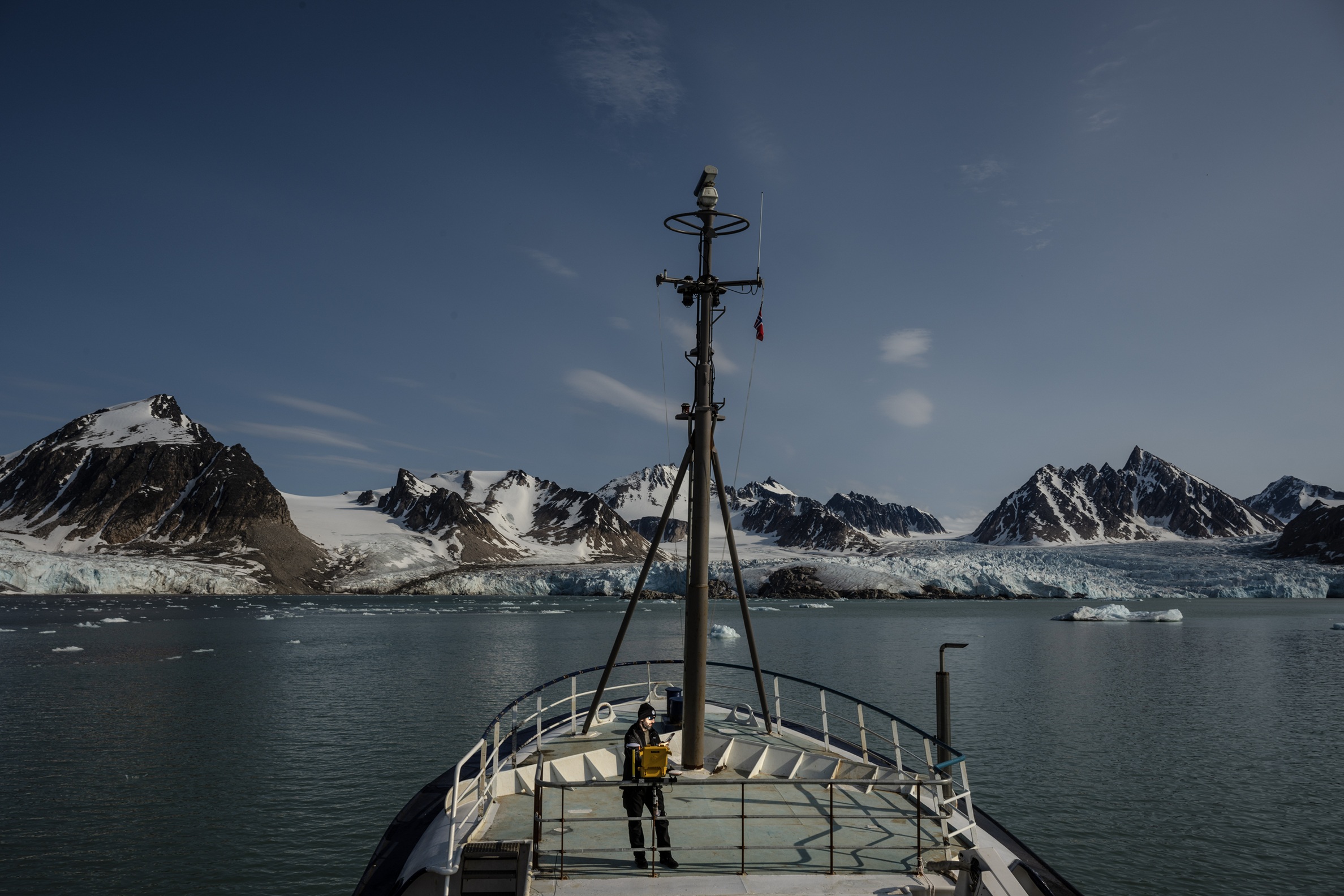
The Arctic is undergoing rapid and unprecedented transformations due to global warming. It is warming three to four times faster than the global average, a phenomenon known as “Arctic amplification.” This acceleration stems largely from ice–albedo feedback: as reflective ice and snow melt, darker ocean and land surfaces absorb more solar radiation, intensifying the warming cycle. The Arctic’s stability is vital not only for regional ecosystems but also for the planet’s climate regulation. Yet as the region warms, feedback loops among melting ice, rising temperatures, and greenhouse-gas release threaten to destabilize global climate systems.

At the same time, melting ice is opening new economic and geopolitical frontiers. Once-inaccessible natural resources and maritime routes—such as the Northern Sea Route, Northwest Passage, and Transpolar Sea Route—are increasingly viable. This accessibility has turned the Arctic into both an environmental flashpoint and a geopolitical arena. Russia, Canada, and, increasingly, China have sought to capitalize on these openings. Yet every form of exploitation—whether shipping, oil drilling, or mineral mining—further accelerates warming. The paradox is stark: Climate change is making the Arctic exploitable, and that exploitation deepens the very crisis that made it possible.

Compounding environmental degradation is the Arctic’s growing militarization. The Russian invasion of Ukraine in 2022 transformed Arctic security dynamics, pushing NATO and Russia into renewed strategic competition. China, while not an Arctic nation, has deepened its alignment with Russia, participating in joint exercises and seeking influence in Arctic governance. The United States, in turn, has reactivated its 11th Airborne Division for Arctic operations and positioned advanced fighter squadrons in Alaska. Finland and Sweden’s accession to NATO further adds to the militarization of the region. Such developments not only raise strategic tensions but also increase the carbon footprint of military operations—through fuel-intensive icebreakers, aircraft, and diesel-powered installations—further stressing the fragile Arctic environment.

At precisely the moment when international collaboration is most needed, US leadership in Arctic climate science has dramatically receded. The second Trump administration’s climate denialism has led to a wholesale retreat from Arctic research. The Trump administration has entirely eliminated the climate research budget of the National Ocean and Atmospheric Administration (NOAA), effectively crippling the nation’s weather and climate monitoring capacity. The closure of the Wilson Center’s Polar Institute and the US Arctic Research Consortium—following a 50% cut to the National Science Foundation’s budget—has dismantled the institutional architecture that once made the United States the world’s largest funder and publisher of Arctic science.

Between 2016 and 2022, American institutions played a central role in maintaining global Arctic datasets, funding international collaborations, and sustaining long-term observation networks. The withdrawal of this infrastructure in 2025 creates a severe vacuum in global climate knowledge: fewer satellites, fewer field studies, and fewer opportunities for cross-national research. This void opens the door for another global power to step in.

This is not the first time China has found itself positioned to exploit a US climate retreat. During Trump’s first term, when the United States withdrew from the Paris Climate Agreement and cut environmental programs, China stepped into the leadership gap. Under the 12th Five-Year Plan and its 10-100-1,000 Program (ten low-emissions industrial parks, one hundred mitigation projects, and one thousand capacity-building projects), Beijing poured resources into renewable energy, electric vehicles, and atmospheric science. By 2017, China was investing more in renewable energy than the United States and funding more than 8.3% of global climate science research publications—an unprecedented figure for a developing nation.

China also used the 2016–2020 period to expand its Arctic presence. It opened an Arctic research station in Iceland, launched its second icebreaker Xue Long 2, and published its “White Paper on China’s Arctic Policy,” which outlined its vision of the “Polar Silk Road.” By launching Earth observation satellites and supporting atmospheric monitoring, China helped compensate for lost US data during the first Trump administration’s retreat from climate science.

The second Trump administration’s policies have created an even deeper hole in Arctic science. The end of NOAA’s climate budget and the shutdown of major research consortia threaten the continuity of long-term Arctic datasets—essential for understanding ice thickness, atmospheric chemistry, and permafrost melt. The collapse of American funding also undermines international collaboration networks that depend on US infrastructure and satellite data. The global scientific community faces not only a financial shortfall but also a coordination crisis. The Arctic presents different challenges: harsh logistical conditions, complex governance regimes, and geopolitical sensitivities.

Based on China’s activity during Trump 1.0, China will likely step in again, but to fill this vacuum, China would have to go far beyond replicating its earlier approach. To replace the United States as the principal driver of Arctic climate research, China must match or exceed lost US funding. The US withdrawal has left multimillion-dollar annual gaps in satellite missions, data-sharing programs, and field expeditions. China would need to commit sustained financial investment—potentially through the National Natural Science Foundation of China or its Belt and Road environmental initiatives—to maintain continuity in climate datasets.

Additionally, the Chinese would need to expand international collaboration. Unlike during the 2016–2020 period, China now faces greater skepticism about its scientific transparency and political motives. To build trust, it would need to establish joint Arctic observatories with Nordic and European partners, invite open data-sharing agreements, and align with the Arctic Council’s scientific cooperation frameworks.

Enhancing satellite and observation capabilities is another issue. The US exit leaves serious gaps in atmospheric, oceanic, and cryospheric data, but China could expand its Gaofen and Haiyang satellite series for polar observation, share data globally, and build polar ground stations for real-time monitoring—functions once handled by NOAA and NASA.

As for developing infrastructure and icebreaking capacity, the Chinese have two more icebreakers than the Americans. Beijing will also be able to expand its icebreaker fleet and invest in mobile research platforms capable of year-round Arctic deployment. These assets would provide access to previously unreachable zones for field studies.

International confidence remains a major barrier; China would have to improve its scientific integrity and transparency. Instances of academic falsification and data opacity have damaged China’s credibility. To lead Arctic research responsibly, Beijing would have to commit to peer-reviewed publication, open-access data, and international reproducibility standards.

China’s rise as the principal funder of Arctic research would have mixed implications. On one hand, global climate science desperately needs continuity; if Beijing steps in, vital data collection could continue. On the other hand, heavy Chinese dominance in Arctic data could skew global climate modeling and policymaking—especially if political or commercial considerations influence research outputs. Western governments, already wary of China’s geopolitical ambitions, might view Chinese-led Arctic science as a strategic tool rather than a neutral global good.

Yet the larger danger lies in the vacuum itself. The retreat of the United States from Arctic climate science undermines not just international collaboration but also America’s long-term national interest. Without reliable Arctic data, the United States loses its forecasting capacity for extreme weather, coastal management, and defense planning. In effect, the Trump administration’s withdrawal harms the United States more than it harms the Arctic. The science will continue—perhaps led by others—but the leadership and influence it once conferred will not easily return.

The world stands at a pivotal moment for Arctic climate science. The United States’ abdication of leadership has created a vacuum in both funding and credibility. China, with its expanding scientific infrastructure and growing global ambitions, is the only actor positioned to fill that void. Doing so will require not just money or technology but also legitimacy, transparency, and genuine collaboration—qualities that remain uncertain under current conditions. If China succeeds, it could cement itself as the central power in global climate science for decades to come. If it fails—or if the world allows the Arctic research gap to persist—the consequences will extend far beyond geopolitics. The planet’s ability to understand and mitigate its own warming may depend on who chooses to step forward now that the United States has stepped back.

The opinions expressed in INSS publications are the authors’ alone.
Paul Weisko
Paul Weisko is a Diane and Guilford Glazer Israel-China Policy Center Research Associate. His foci are China in the Arctic and China in the Pacific Islands. He has a Master’s degree in International Affairs from The George Washington University. He has Bachelor’s degrees in Global Studies, History, and Asian Studies from University of Maryland, Baltimore County. He was previously a Research Fellow at University of Haifa's Maritime Policy and Strategy Research Center.
Publication Series INSS Insight
TopicsIsrael-China Policy Center - The Diane and Guilford Glazer Foundation
עברית

Events

All events
Israel–U.S. Relations: An Alliance in Transition?
22 December, 2025
13:00 - 16:00

Related Publications

All publications
Shutterstock (modified by INSS)
Seven Sons and Mullahs: Chinese–Iranian Defense-Linked Academic Collaboration
China’s relations with Iran were recently tested during the twelve-day Israel–Iran war and the US strike on Iran’s nuclear sites. While China’s diplomatic statements supported Iran verbally, they did little else. Chinese media reports covered the Iranian minister of defense’s visit to Beijing in June and mentioned the possible supply of air defense systems and fighter jets to Tehran, although China denied the former. As Beijing is typically cautious in its security, defense, and military cooperation with Iran, most public attention in the West and the Middle East tends to focus on Chinese–Iranian relations in energy, trade, economy, infrastructure, and diplomacy. Publications addressing their security relations usually emphasize surveillance systems supplied to Iran, joint military and naval exercises, and the ongoing transfer of technological components and materials to Iran’s defense industry. In the aftermath of the war, one may also expect to see sharing of techno-operational learning between China and Iran, possibly involving their other network partners, Russia and North Korea. This study examines a lesser-known aspect of security-technological cooperation between Beijing and Tehran: joint and expanding academic-technological research linked to the defense establishments of both countries, in fields such as nuclear energy, aerospace, missiles, UAVs, underwater vehicles, and cyber. Drawing on recent academic articles co-authored by Chinese and Iranian experts, it reveals joint research efforts and some convergence between the two countries’ defense innovation ecosystems. This cooperation between China and Iran—respectively the main national security threats to the United States and Israel—poses a potential risk not only to these two allied states but also to their partners in Europe, the Asia-Pacific, and the Middle East. This risk should be recognized, monitored, analyzed, and addressed, both separately and collectively.
10/11/25
Shutterstock
A Chinese Influence Campaign Against Israel as a Means of Harming the United States
The Collateral Damage to Israel from the U.S.-China Confrontation
17/09/25
Shutterstock
Iran’s Relations with China and Russia Following the Israel–Iran War
What can be learned about the nature of the relationship between Moscow, Beijing, and Tehran following the test of their ties during the 12-day war?
31/08/25

Stay up to date

Registration was successful! Thanks.
  • Research

    • Topics
      • Israel and the Global Powers
      • Israel-United States Relations
      • Glazer Israel-China Policy Center
      • Russia
      • Europe
      • Iran and the Shi'ite Axis
      • Iran
      • The Israel–Iran War
      • Lebanon and Hezbollah
      • Syria
      • Yemen and the Houthi Movement
      • Iraq and the Iraqi Shiite Militias
      • Conflict to Agreements
      • Israeli-Palestinian Relations
      • Hamas and the Gaza Strip
      • Peace Agreements and Normalization in the Middle East
      • Saudi Arabia and the Gulf States
      • Turkey
      • Egypt
      • Jordan
      • Israel’s National Security Policy
      • Military and Strategic Affairs
      • Societal Resilience and the Israeli Society
      • Jewish-Arab Relations in Israel
      • Climate, Infrastructure and Energy
      • Terrorism and Low Intensity Conflict
      • Cross-Arena Research
      • Data Analytics Center
      • Law and National Security
      • Advanced Technologies and National Security
      • Cognitive Warfare
      • Economics and National Security
    • Projects
      • Preventing the Slide into a One-State Reality
      • Contemporary Antisemitism in the United States
      • Perceptions about Jews and Israel in the Arab-Muslim World and Their Impact on the West
  • Publications

    • All Publications
    • INSS Insight
    • Policy Papers
    • Special Publication
    • Strategic Assessment
    • Technology Platform
    • Memoranda
    • Database
    • Posts
    • Books
    • Archive
  • About

    • Vision and Mission
    • History
    • Research Disciplines
    • Board of Directors
    • Fellowship and Prizes
    • Internships
    • Support
    • Privacy Policy and Terms of Use
  • Media

    • Communications
    • Video Gallery
    • Press Release
    • Podcast
  • Home

  • Events

  • Database

  • Team

  • Contact

  • Newsletter

  • עברית

INSS logo The Institute for National Security Studies, Strategic, Innovative, Policy-Oriented Research, go to the home page
40 Haim Levanon St. Tel Aviv, 6997556 Israel | Tel: 03-640-0400 | Fax: 03-744-7590 | Email: info@inss.org.il
Developed by Daat A Realcommerce company.
Accessibility Statement
This site is protected by reCAPTCHA and the Google Privacy Policy and Terms of Service apply.
No audio version available for this podcast