


Publications
The implications of the underground challenge on the current fighting in the Gaza Strip and on the situation in Gaza afterward
INSS Insight No. 2021, August 3, 2025
Follow us on GoogleThe long duration of the campaign in the Gaza Strip, the difficulty in achieving a decisive outcome, and the immense scale of Israeli forces involved—all stem directly from the unique underground challenge in this arena. This has significant implications, not only for the current state of the war in the Gaza Strip but also for the situation that will emerge after the war.
Fighting Hamas in the Gaza Strip—Past and Present
It is widely acknowledged that the IDF’s lack of preparedness for the underground challenge in the Gaza Strip was one of its most significant failures before and during the war that broke out on October 7, 2023. Israel’s campaign targeting Hamas’s tunnel network and infrastructure during Operation Guardian of the Walls in May 2021 ultimately proved far less effective than initially celebrated. In response to Hamas’s offensive tunnels into Israeli territory, Israel constructed a subterranean wall along the border at an immense cost—yet this did not prevent Hamas’s above-ground attack. The IDF did not prepare for conquering the Gaza Strip, nor for confronting Hamas’s defensive underground tunnels—the core of the organization’s military doctrine. The tactics and means the IDF did prepare did not withstand the test.
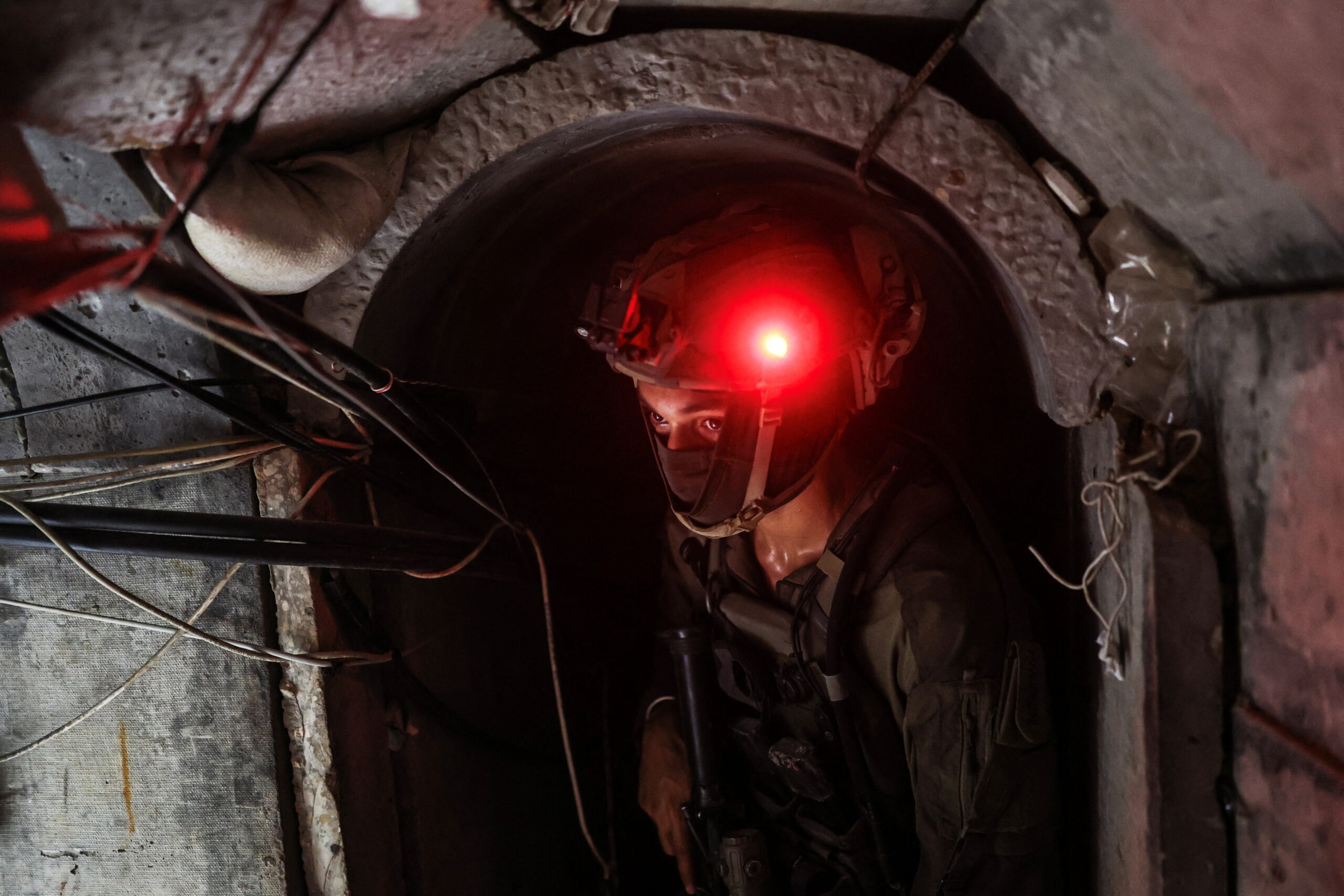
At the onset of the war, the length of Gaza’s “underground” is estimated to have been 500–600 kilometers. It connected all of Hamas’s military installations, headquarters, and facilities throughout the Gaza Strip. It linked them with thousands of shafts that led to combat positions inside buildings in urban areas, as well as to positions used for launching rockets at Israel. Due to the dangers involved in clearing the tunnels, the process is slow, and their destruction requires massive quantities of explosives and other specialized means. The IDF remains far from completing the task of clearing and destroying the entire network. All this is well known.
This brings us to the strategic implications of Gaza’s underground phenomenon. Let us begin by clarifying the difference between Gaza and other arenas where the IDF has operated against guerrilla forces and guerrilla armies. The unique conditions of the Gaza Strip in this context are also well known: its soft sandstone allows for relatively easy subterranean digging, in contrast to the hard limestone terrain in Lebanon and the West Bank. As a result, the IDF’s operations in these areas have had a very different character.
In Lebanon, Hezbollah’s use of subterranean infrastructure was substantially more limited. Hezbollah dug offensive tunnels into Israel (mostly destroyed in December 2018–January 2019) and embedded missile warehouses, ammunition depots, production workshops, and top command posts in carved-out underground sites. Its tactical positions and supply and troop assembly points, both inside and outside villages in southern Lebanon, were often also dug into rock. However, beyond these tactical positions, most of Hezbollah’s “strategic” subterranean systems were limited in location and scope, and were largely known to Israeli intelligence. As a result, when the offensive phase of the campaign against Hezbollah began in September 2024, the Israeli Air Force destroyed most of these systems within hours, days, and a few weeks. Similarly, Hezbollah’s tactical command echelons were comprehensively eliminated either at their operational posts or while moving above ground. During the year of attrition warfare that preceded the full-scale Israeli offensive in the north, IDF special forces operated to expose and destroy Hezbollah bunkers and tunnels in southern Lebanon. However, once the campaign intensified, the role of the ground forces was mostly confined to clearing the areas along the border. Thus, in the Lebanese arena, a decisive victory was achieved relatively quickly, primarily through the combination of air power and intelligence, against an adversary widely regarded as stronger and more dangerous than Hamas.
Indeed, the prolonged campaign in the Gaza Strip, now approaching two years, stems decisively from the challenge of the underground domain. Beyond the issue of the hostages, which significantly restricts IDF operations, the vast underground space in the Gaza Strip enables Hamas to shelter, hide, and disappear. From there, small guerrilla units of the organization emerge from concealed shafts embedded within the built or ruined urban landscape, set up ambushes, launch RPG rockets, and deploy or attach explosive devices. Despite all the experience and skills the IDF has acquired on the subject, there is currently no simple, practical way to neutralize this mode of warfare. Moreover, not only the prolonged nature of the fighting in the Gaza Strip reflects the challenge but also the difficulty in achieving a decisive outcome and the massive scale of forces required—including both regular and reserve brigades and divisions. These stem directly from the limited ability to contend with the subterranean threat. Lacking an effective solution, the IDF is left with little choice but to flood the area with a large number of forces and advance slowly and methodically as the default course of action.
Thus, the long duration of the campaign in the Gaza Strip, the difficulty in achieving a decisive outcome, and the immense scale of forces involved all stem directly from the underground challenge.
The underground is a major component of the low-signature, asymmetric warfare employed by irregular forces in their fight against superior state militaries. The Viet Cong were the first to use subterranean networks extensively against the United States, which struggled to find an effective response. However, the Viet Cong’s tunnel system was likely only half the length of Gaza’s and ran mainly through uninhabited jungle terrain and not dense urban areas. In this sense, Gaza’s network is unique in both scale and implications—not only compared to Lebanon and the West Bank, but also globally. This includes recent American theaters of war such as Afghanistan (against al-Qaeda and the Taliban) and Iraq and Syria (against ISIS). In all these cases, underground systems and tunneling were used, but they were far more limited.
Soil composition is part of the explanation for the differences between these theaters and that of Gaza. But the difference also relates to their vast expanses and the relative sparsity of forces within them—compared to Gaza’s dense environment. The other theaters did not allow irregular forces seeking to control them to rely on underground networks. Moreover, due to the Gaza Strip’s proximity to Israel, its subterranean network also serves as infrastructure for rocket production and fire at Israel and as a base for ground attacks into Israeli territory—a reality found nowhere else in the world in counterinsurgency warfare. Gaza’s underground therefore presents a unique and nearly unprecedented challenge.
Looking Ahead Post-War
This fundamental reality has significant implications not only for the current state of the war in the Gaza Strip but also for the post-war situation. Again, the common comparison to other theaters of war in this context must be examined.
In Lebanon, Hezbollah represents just one of four Lebanese sects, the majority of which want its defeat and weakening. Hezbollah’s commitment to fighting Israel is also far lower than that of Hamas. And finally, as has become clear, Hezbollah is highly vulnerable to IDF strikes, especially intelligence-guided air strikes.
Now to the situation in Judea and Samaria. During Operation Defensive Shield in 2002, the IDF regained control of the area within weeks and at relatively low cost. However, it took another two years before terrorism from the region was completely suppressed and the Second Intifada came to an end. As a result, the Palestinian Authority under Abu Mazen began cooperating significantly—although partially and in a limited manner—with Israel in combating terrorist activities in the area, mainly by Hamas. In this framework, the IDF has carried out effective operations involving rapid, intelligence-directed incursions by both undercover and regular forces into terrorist strongholds, which they surround, arrest, or eliminate.
The situation in the Gaza Strip is fundamentally different. After Israel withdraws from the area, vast segments of Hamas’s subterranean networks are likely to remain intact. Moreover, new tunnels will almost certainly be dug. These networks will pose a continued challenge to the outposts the IDF is building in the security buffer zone along and inside the Gaza border to protect Israeli communities around Gaza, and might even enable raids on the communities themselves. Although not necessarily on the scale of October 7, such incursions would still represent an ever-present security threat. The fierce fighting in recent weeks around the underground system in Beit Hanoun, right on the border, is a living reminder of this.
Most importantly, the remnants of Hamas’s vast underground network that will be rebuilt, even if partially, as well as new branches that will be dug, will continue to serve Hamas in concealing its fighters, headquarters, warehouses, and reconstructed missile workshops throughout the Gaza Strip. The problem for the IDF is how to detect and locate these forces and facilities in the subterranean spaces. Meanwhile, the rocket threat will also resume—for both harassment and deterrence.
This is the difference between the Gaza arena and those of Lebanon and the West Bank, which are often cited as supposedly relevant analogies. A post-war Palestinian government in the Gaza Strip that is not Hamas—whether the Palestinian Authority or a “technocratic government”—is highly desirable for Israel for many reasons. However, such a government’s ability to militarily confront Hamas—even to the extent currently seen in the West Bank—does not really exist, and the subterranean factor compounds the challenge significantly. Israeli airstrikes and ground raids will face similar obstacles to those now seen in the Gaza Strip—and even more so once Hamas regains strength—requiring large-scale campaigns and battles.
All these factors must be considered in any discussion about ending the war in the Gaza Strip and implementing an Israeli withdrawal.
What might improve the situation from Israel’s perspective? The presence of active, real-time human intelligence on the ground, which deteriorated significantly during Hamas’s rule in Gaza, could reduce some of the uncertainties surrounding the underground. Equally important are major advancements in the development, production, and procurement of means to confront the subterranean threat, alongside the creation of units specializing in this task—areas that were not sufficiently emphasized before the war. Within this framework, technological breakthroughs in robotics and sensors hold particular importance. Still, without all these—and perhaps even with them—the underground will remain the most consequential factor shaping the limitations of warfare in the Gaza Strip and sustaining Hamas’s control of the area. Anyone who hopes for a fundamental change in the Gazan reality—one involving deep cultural, ideological, and social transformations, a multi-generational endeavor, to be sure—must take this into account.