


Strategic Assessment
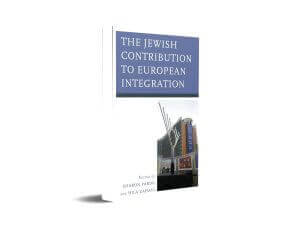
- Book: The Jewish Contribution to European Integration
- By: Sharon Pardo & Hila Zahavi, Editors
- Publisher: Lexington Books
- Year: 2020
- pp: 196
European Jewish communities afford researchers a perspective on complex communities that influence Israel and other communities within and beyond the European arena, and in the global arena. European Jewish communities prior to the Second World War comprised almost 60 percent of the Jewish population worldwide, and today comprise a mere 10 percent (around 1.3 million) (Lipka, 2015). These communities are primarily located in Western and central Europe in member states of the EU, which constitutes a global power with ethical and normative components (Manners, 2002) and extensive international influence, including on Israel.
Historically Israel-EU relations have seen ups and downs, some relating to the continent's gruesome history and some to political disputes in the Mideast, including the issue of Israel's borders (Pardo & Peters, 2010). The history of these relations is multifaceted. Alongside the economic facet, which includes trade and cooperation agreements such as the Open Skies agreement, the agriculture agreement, the Horizon 2020 program, and others is the political facet, which includes the dispute regarding Israel's post-1967 territory (Pardo & Zemer, 2011), and the legal facet, which includes adoption of European legislation by Israel, alongside European rulings that relate to Israeli jurisprudence (Brita ruling, 2010; Psagot wine ruling, 2019).
But does this research include an in-depth look at the importance of the role of European Jewish communities to the overall project of European integration, and for relations with Israel in particular? Jews in the 20th century represented the essence of the cosmopolitan principle in Western Europe and its intellectual basis a concentrated version of communal spirituality (Kundera, 1984.) The iconic nature of European Jewry is a part of the EU narrative. Do these Jewish communities have a strategic advantage in improving and changing Israeli-European relations?
The volume edited by Prof. Sharon Pardo and Dr. Hila Zahavi about the contribution of Jewish communities to European integration seeks to offer an additional perspective on the essence of the Jewish community in this regard, which has thus far not been explored in depth and institutionally through the prism of EU policy. The book is a collection of articles by researchers from Israel and researchers and diplomats from Europe. The editors believe that the Jews in contemporary Europe are the quintessence of the cosmopolitan principle and serve as intellectual glue in Europe an integrative component of the essence of the European Union that must be used strategically. The Jewish communities are considered the new European essence after the Second World War: a Europe that symbolized an era of globalism, anti-nationalism, and of the establishment of a new liberal world order.
The book is divided into three sections. The first section analyzes the challenges of the current reality and discusses the impact of the Jewish communities on various components of the domestic and foreign arenas, including demography, antisemitism, and modern populism. In the opening article of this section, Prof. Sergio Della Pergola, a renowned expert on Jewish demography worldwide and statistics, relates to the demographic importance of European Jews over recent decades and points to growth and stability in West European Jewish communities (whose population today is larger than that of nations such as Malta, Cyprus, or Luxembourg) and to significant decreases in the Jewish communities in Eastern Europe. These changes originate in the extreme transitions in the European political framework, in particular the establishment of the EU and the disbanding of the Soviet Union. These political changes not only deeply influenced the identity of Jewish communities, but also blurred the segregation between Jews and the broader population.
In the article that follows, Prof. Dani Filc presents an examination of populism as it relates to European minorities, as over the last three decades there has been a rise and expansion of populist parties. Prof. Filc believes that minorities have been part of the European narrative since the 16th century, the French Revolution, the Second World War, and the Universal Declaration of Human Rights in the 20th century, up until the recent wave of populism that has reinvigorated hostility toward minorities that appeared to have been forgotten. He contends that the radical right is a prominent political reaction to the fear of Jews and other minorities.
The last chapter of this section, written by Andras Baneth, relates to the issue of antisemitism from an institutional perspective. Recent decades have witnessed an increase in EU policy designed to fight and eradicate antisemitism in Europe, which aims to implement a stubborn battle against historic tendencies, including by eliminating prejudice and discrimination. EU member states today have a framework of legislation that fits the EU charter and seeks to promote tolerance, equality, and the defense of minorities. Nevertheless, Baneth believes that antisemitism is alive and well and the eradication of antisemitism is dependent not only on EU institutions. Indeed, there is difficulty in eliminating this worldview among the public, particularly during times of crisis; the current global pandemic, for example, has increased antisemitism and prejudice toward minorities.
The second section includes a multifaceted analysis of Jews as part of the European identity: what Europe represents for the Jewish communities and what the Jewish communities represent for Europe. The essays here demonstrate the importance of the Jewish communities for the European integration project, examining French, Spanish, and Hungarian Jewry closely. They also demonstrate the importance of the Jewish communities to integration projects on a global and historic scale. Dr. Dov Maimon claims in his article that since the emancipation of minorities in France in the late 18th century, when the Jews in France were granted full civic and political equality with no legal restrictions, Jews began to contribute more and more to wider society, while embedding themselves in the liberal-secular European ethos. Maimon proposes a model that allows the Jewish community of Europe to maintain communal values while integrating into wider society.
Former ambassador Alvaro Albacete, a Spanish diplomat, discusses Spanish Jewry. His article presents an analysis of the descendants of the Jews of Spain and Portugal as an example of territorial coexistence, and discusses the evolution of Spanish Jewry with regard to Europe as a whole, while relating to key events in Spanish history. Spanish Jewry supplies a vantage point on how institutional Europe perceives European Jewry.
Historian Janet Kerekes examines the changes in the assimilation of Hungarian Jewry over two periods: the period of Austro-Hungarian emancipation from 1867-1920, and the communist period in Hungary. Hungarian Jews present a serious challenge for the entire EU and for Israel, both because most live in Budapest (which has the highest concentration of Jews in central and Eastern Europe), and because they symbolize European integration as a microcosm in which Jews move about freely and without fear (synagogues are open to the general public without security).
Michael Mertes, former director of the Konrad Adenauer Foundation in Israel, discusses the Holocaust in a modern perspective. The impact of the Holocaust on the European Union narrative is both direct and indirect; he relates to two periods: post-war (post-1945) and post-1989. The impact of the Holocaust is essential to political and ethical decisions made by European officials. Mertes adds that the EU is still discussing how to deal with Holocaust denial. In many places in Europe, the Holocaust is seen as exaggerated and/or as a myth. In Poland, 35 percent of the public believe that the Holocaust is a myth; in Germany, 26 percent, and in Denmark, 15 percent (the average across the EU is 24 percent.) In the modern era, with the rise of the radical right, populism influences the phenomenon of Holocaust denial.
In the final chapter of the section, Dr. Diana Pinto discusses the opaque approach by Jews toward the integration project. Pinto believes that the Jewish contribution is actually limited, because European Jews no longer have substantial and well-established faith in this project.
The third section is dedicated to the pioneering Jews who contributed to the integration project from within a section referred to as the "unsung heroes": Jews who each in their own way contributed to European cosmopolitanism, including Walter Rathenau, the only Jewish foreign minister of Germany, who served during the Weimer Republic; and Fritz Bauer, a jurist and German Jewish immigrant who on his own defended the rule of law and human rights when he demanded the right to oppose a government that violates human rights, and whose work made the Holocaust became a part of the collective memory of the German public and the entire European community. At the end there is also a chapter dedicated to one of the Jewish women who most influenced the history of the European Union, Simone Veil. The first woman to serve as the president of the European Union Parliament, Veil had Jewish roots that contributed significantly to European normative values, to European integration, and the promotion of peace, democracy, and morality. The chapter dedicated to her is taken from a speech given in her honor by French President Emmanuel Macron in July 2017.
The fact that Israel has in recent years moved closer to countries with a radical-right political, have raised the banner of undermining core liberal values and sought to exclude minorities, is a failure that originates in the communication mechanism between the Jewish communities and the EU.
Many obstacles lie ahead for the EU, including radical populism, the weakening of its internal foundations due to Brexit, increasing immigration, illiberal force, and a crisis of identity. This book presents the importance of the Jewish communities' contribution to European integration, showing their direct and indirect involvement. It offers an important look at the role of European Jewish communities in the European arena and their impact on EU policy toward Israel.
The European Jewish communities on the whole are organized in an outdated manner. The editors posit that this reflects an inconsistency between the communities and the EU itself, a supranational body built in a complex and innovative fashion, with many officials and a substantial bureaucracy. There has been a failure to connect the Jewish communities directly to EU institutions thus far; doing so could strategically improve EU policy towards Israel. The fact that Israel has in recent years moved closer to countries with a radical-right political orientation, who have raised the banner of undermining core liberal values and sought to exclude minorities, is a failure that originates in the communication mechanism between the Jewish communities and the EU.
The editors believe that the communities must be the ones to initiate and plan a strategy of cooperation, which will lead to changes for both sides, so that Europe can strengthen its relations with Israel and its foothold in the Mideast, particularly regarding the Israeli-Palestinian conflict. Strengthening relations with Israel will help improve the relations between Jewish and Muslim communities in Europe, in a manner that would then influence the Mideast arena. The Jewish communities can assist in enhancing the struggle against antisemitism, which has risen sharply in recent years; they can also influence other Jewish communities around the world and promote community values. The editors believe that in order to become more efficient, the communities must establish a political organization that corresponds with EU institutions; the task of the Jewish communal institutions will be to connect EU institutions to the Jewish communities.
Closer relations between Israel and right wing governments in the EU are evident, such as the warm relations with the Hungarian government led by Viktor Orban that harms minorities and has implemented legislation to limit free expression by the press. A further example is Benjamin Netanyahu's warm relations with Czech President Miloš Zeman, who in 2017 held a press conference against freedom of speech during which he was photographed with a fake Kalashnikov rifle on which the words "for journalists" was inscribed (Oppenheim, 2017). This propensity is troubling for Israel, and violates the values and foundations on which it was established, foremost among them the defense of minorities. Right wing radical populism tends to defend Israel and adopt it as an ally, particularly when it is discussing the “Islamization of Europe.” Ironically, right wing parties in Israel are cooperating fully with countries that are increasingly hostile to minorities, where Holocaust denial is among the world's highest (Mautner, 2018). It is thus no surprise that right wing European governments are likely to pick a fight with Israel, such as we have already seen with the Polish Holocaust law, in which Mateusz Morawiecki's government denied all responsibility of the Polish people for the horrors of the Holocaust (Aderet, 2018.) This fragility demonstrates exactly why the European Jewish communities are so important, and the significance of their potential to challenge the limits of European integration for the international arena and Israel.