


Publications
INSS Insight No. 857, September 22, 2016
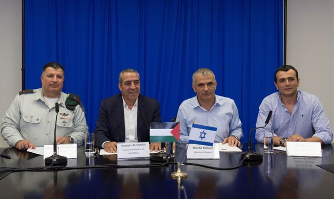
In September 2016, an agreement was signed between the Israeli Ministry of Finance, the Coordinator of Government Activities in the Territories (COGAT), and the Palestinian Authority (via the Minister of Civil Affairs), to regulate Palestinian debt payment to the Israel Electric Corporation. Terms of the agreement included the cancellation of a debt of half a billion shekels and regulation of the PA’s responsibility to collect debts and payments for electricity provided by the Israel Electric Corporation, as well as its responsibility to maintain and develop the Palestinian electricity network in the West Bank. This agreement is the first of its kind and scope in many years. It is also important for its institutionalizing patterns of cooperation between the Israeli government and the PA during a period when the political process is completely frozen.
The electricity agreement has four guiding rationales that are important in general, and specifically at this time, on the political, security, economic, and humanitarian levels:
a. Political rationale: Transferring responsibility for payment collection for electricity provided to Palestinian consumers and for maintenance and development of the Palestinian electricity network will make the PA, for the first time since its establishment, a governmental authority responsible for a very important resource and infrastructure. This responsibility will require the PA to operate collection and enforcement mechanisms, which could serve it in additional areas in the future, and to allocate resources to infrastructure planning on the national level. These responsibilities may help raise the PA’s governing capabilities to a higher performance level, which would undoubtedly have an impact on its stability. It might likewise increase Israel’s flexibility regarding similar agreements in different areas of infrastructure and in transferring more extensive authority to the PA, with the knowledge that there is a responsible and functional party on the Palestinian side.
b. Security rationale: Electricity is an existential resource, required for daily life and proper and regular operation of national infrastructure and critical facilities. Irregular supply or lack of electricity interrupts daily life, and in the Palestinian case, may even lead to unrest and disturbances. Protests could be directed at the Palestinian Authority, mayors, or heads of local councils (as happened in Nablus recently), and escalate into riots that could spiral out of control, become inflamed, and then diverted toward Israel. Violent clashes between Palestinian citizens and the Israeli security forces would constitute a security problem. The agreement decreases the chances of scenarios of this kind being realized.
c. Economic rationale: The electricity agreement is intended to decrease the massive debt of Palestinian consumers to the Israel Electric Corporation. The debt has grown over the years and reached a sum of some two billion NIS, significantly burdening the Israel Electric Corporation. Without an agreement, the Israel Electric Corporation would not have been able to recover the debt, unless the Israeli government had subtracted some or all of the debt from the taxes which it collects for the PA. Such use of taxes could have far reaching consequences, both politically – resulting in international criticism of Israel – and economically, with a negative impact on the PA’s stability and ability to function. Although the agreement signed includes very substantial debt cancellation - some 500 million NIS – it also ensures repayment of the remainder to the Israel Electric Corporation.
d. Humanitarian rationale: The electricity agreement prevents a humanitarian crisis that could have resulted from private and institutional consumers in the PA being disconnected from the electricity supply (as has occurred several times in the past) and ensures a regular electricity supply to consumers, and even future improvement in the Palestinian electricity network infrastructure, in a manner that will enable economic and infrastructure development and meet the needs of the growing population.
The agreement also offsets problematic political statements about the PA and its leader, which maintain that they are the ones blocking political progress. The agreement demonstrates the potential for cooperation between Israel and the PA, and the ability of professionals from both sides to advance significant collaborations, even while the peace process is frozen. This is a flicker of optimism that must be leveraged and developed as a basis for a process of building the Palestinian state and governing institutions and strengthening the Palestinian economy from the bottom up. Capabilities must be developed that in the future could be translated into establishing a functional and sustainable Palestinian state. The agreement proves that cooperation between the sides is possible and that the frozen political process – as burdensome and problematic as it is – does not need to stop what can and must be done immediately for the welfare of the residents of the West Bank.
In addition, the agreement could serve as a model for similar agreements regarding other types of infrastructure, such as water, the environment, transportation, health, and more, and assist in improving Palestinian governance, as well as the welfare and quality of life of the Palestinian population. Additional agreements of this kind could provide an expanded basis for cooperation between the sides, build trust, decrease the potential for escalation, and create better conditions for renewing the peace process. Therefore, the Israeli government would do well to apply the overall rationale of the electricity agreement in additional fields, in a manner that would expand the responsibilities of the PA for the daily life of its citizens and allow it to use existing resources – including the international aid it receives – in a way that improves the critical infrastructure of a functioning Palestinian state the day after its establishment.