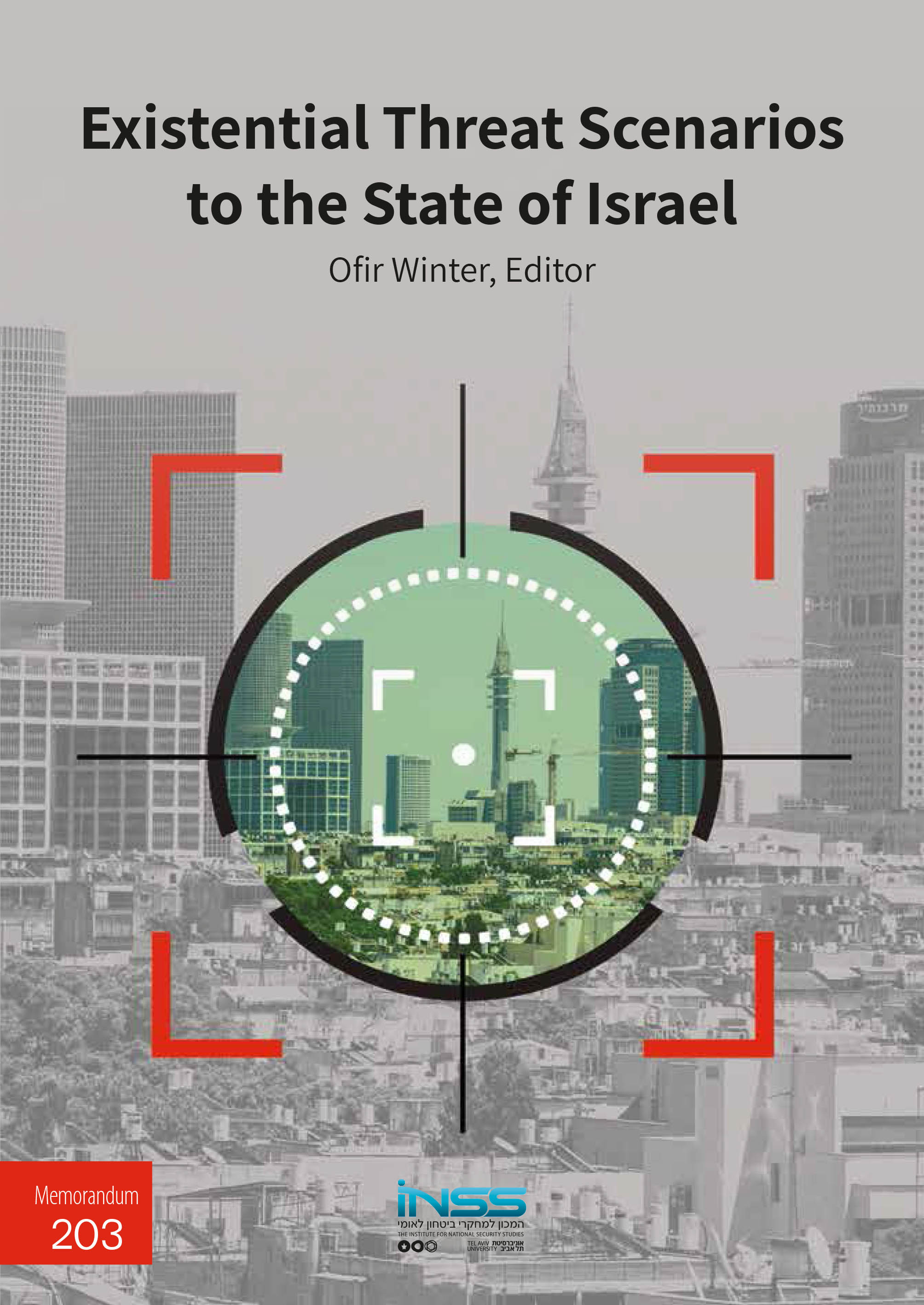
Existential Threat Scenarios to the State of Israel | INSS
go to header go to content go to footer go to search
INSS logo The Institute for National Security Studies, Strategic, Innovative, Policy-Oriented Research, go to the home page
INSS
Tel Aviv University logo - beyond an external website, opens on a new page
  • Campus
  • Contact
  • עברית
  • Support Us
  • Research
    • Topics
      • Israel and the Global Powers
        • Israel-United States Relations
        • Glazer Israel-China Policy Center
        • Russia
        • Europe
        • Antisemitism and Delegitimization
      • Iran and the Shi'ite Axis
        • Operation Roaring Lion
        • Iran
        • Lebanon and Hezbollah
        • Syria
        • Yemen and the Houthi Movement
        • Iraq and the Iraqi Shiite Militias
      • Conflict to Agreements
        • Israeli-Palestinian Relations
        • Hamas and the Gaza Strip
        • Peace Agreements and Normalization in the Middle East
        • Saudi Arabia and the Gulf States
        • Turkey
        • Egypt
        • Jordan
      • Israel’s National Security Policy
        • Military and Strategic Affairs
        • Societal Resilience and the Israeli Society
        • Jewish-Arab Relations in Israel
        • Climate, Infrastructure and Energy
        • Terrorism and Low Intensity Conflict
      • Cross-Arena Research
        • Data Analytics Center
        • Law and National Security
        • Advanced Technologies and National Security
        • Foreign Information Manipulation and Interference
        • Economics and National Security
    • Projects
      • Preventing the Slide into a One-State Reality
      • India-Middle East-Europe Economic Corridor (IMEC)
  • Publications
    • -
      • All Publications
      • INSS Insight
      • Policy Research and Papers
      • Special Publication
      • Strategic Assessment
      • Technology Platform
      • Memoranda
      • Posts
      • Books
      • Archive
  • Database
    • Surveys
    • Spotlight
    • Maps
    • Dashboards
  • Events
  • Team
  • About
    • Vision and Mission
    • History
    • Research Disciplines
    • Chairman of the Board
    • Board of Directors
    • Fellowship and Prizes
    • Annual Reports
    • Internships
  • Media
    • Communications
    • Video gallery
    • Press Releases
  • Podcast
  • Newsletter
  • Campus
Search in site
  • Research
    • Topics
    • Israel and the Global Powers
    • Israel-United States Relations
    • Glazer Israel-China Policy Center
    • Russia
    • Europe
    • Antisemitism and Delegitimization
    • Iran and the Shi'ite Axis
    • Operation Roaring Lion
    • Iran
    • Lebanon and Hezbollah
    • Syria
    • Yemen and the Houthi Movement
    • Iraq and the Iraqi Shiite Militias
    • Conflict to Agreements
    • Israeli-Palestinian Relations
    • Hamas and the Gaza Strip
    • Peace Agreements and Normalization in the Middle East
    • Saudi Arabia and the Gulf States
    • Turkey
    • Egypt
    • Jordan
    • Israel’s National Security Policy
    • Military and Strategic Affairs
    • Societal Resilience and the Israeli Society
    • Jewish-Arab Relations in Israel
    • Climate, Infrastructure and Energy
    • Terrorism and Low Intensity Conflict
    • Cross-Arena Research
    • Data Analytics Center
    • Law and National Security
    • Advanced Technologies and National Security
    • Foreign Information Manipulation and Interference
    • Economics and National Security
    • Projects
    • Preventing the Slide into a One-State Reality
    • India-Middle East-Europe Economic Corridor (IMEC)
  • Publications
    • All Publications
    • INSS Insight
    • Policy Research and Papers
    • Special Publication
    • Strategic Assessment
    • Technology Platform
    • Memoranda
    • Posts
    • Books
    • Archive
  • Database
    • Surveys
    • Spotlight
    • Maps
    • Dashboards
  • Events
  • Team
  • About
    • Vision and Mission
    • History
    • Research Disciplines
    • Chairman of the Board
    • Board of Directors
    • Fellowship and Prizes
    • Internships
    • Annual Reports
    • Privacy Policy and Terms of Use
  • Media
    • Communications
    • Video gallery
    • Press Releases
  • Podcast
  • Newsletter
  • Campus
  • Contact
  • עברית
  • Support Us
bool(false)

Publications

Home Publications Memoranda Existential Threat Scenarios to the State of Israel

Existential Threat Scenarios to the State of Israel

Memorandum No. 203, INSS, September 2, 2020

עברית
Ofir Winter

During its more than seventy years of existence, the State of Israel has developed impressive military, economic, and diplomatic strengths; has become an undeniable fact; and has been recognized by some of its neighbors. Nonetheless, despite its impressive achievements, Israel still continues to cope with security challenges, including enemies who call for and seek its destruction. This study provides a contemporary analysis of the severe potential threats that could endanger the physical existence of the State of Israel, the functioning of its essential systems, and its unique identity of being a Jewish and democratic state.


In the framework of the research, we analyzed five threat scenarios: the formation of a regional military coalition against Israel; multipolar nuclearization in the Middle East; the collapse of the Israeli defense systems due to a large-scale precision-missile attack led by Iran and its proxies; international isolation and a boycott of Israel; the disintegration of Israel’s social cohesion, and the loss of its identity as a Jewish and democratic state. For each scenario, the research teams examined possible causes, accelerating and inhibiting factors, secondary threats that accompany the main threats, and security pillars that need to be maintained and strengthened in order to defend against these threats.


From an analysis of the threat scenarios, the strengths of Israel’s security pillars become clear; however, internal, regional, and international processes are liable to erode and undermine them, disrupting the balance of forces between Israel and its possible adversaries and strengthening the possibility that the potential existential threats will materialize in the future. Given the conclusions of the research, we have made specific and general recommendations for the decision makers, intended to provide a comprehensive response to the threat scenarios, while using the various tools that Israel has at its disposal.


Table of Contents:

Over the seventy years of its existence, the State of Israel has succeeded in developing impressive military, economic, and diplomatic strengths; it has become an undeniable fact on the regional and global map and many of its neighbors have recognized it de facto. Yet despite its impressive achievements, Israel still continues to cope with security challenges, including dealing with enemies who call for—and possibly even seek—its destruction. This study provides a contemporary analysis of the severe potential threat scenarios that could endanger the physical existence of the State of Israel, the functioning of its essential systems, and its unique identity of being a Jewish and democratic state...
Read more

Ofir Winter, Kobi Michael, Assaf Shiloah
The saying “in every generation they rise up against us to destroy us” in the Passover Haggadah reflects the fear that has accompanied the Jewish people since the beginning and—over the course of the two thousand years of exile and persecution—has become an inseparable part of its narrative. The State of Israel, which was established in the shadow of the trauma of the Holocaust, has also faced severe threats since its establishment—some of them existential. Israel is in an ongoing state of existential threat as a small country that seeks to fulfill the right to sovereignty of a national and religious minority, surrounded by states that have refused (and some of which still do) to recognize it and consider it a “foreign implant” in the region. The establishment of the State of Israel has thus been accompanied by constant fears that it would be lost, consequently shining a paradoxical light on the Zionist enterprise: On one hand, its establishment was a historic response to Jewish insecurity; on the other hand, Israel is the modern version of this cognitive state. The centrality of fear to Jewish-Israeli existence has advantages and disadvantages: As an advantage, it fulfills a functional role as a catalyst for advancing mechanisms to defend against real threats. These mechanisms include preparing for threats, taking preventive measures to thwart them, and dealing with efforts to carry them out. As a disadvantage, it includes existential anxiety, which—if it does not reflect a real threat— can be a barrier to rationally analyzing a situation, taking calculated risks, realizing opportunities, and making vital strategic decisions...
Read more

Shlomo Brom, Ofir Winter
In April 2018, the IDF Strategy document was published, which assessed that “in recent years and in looking to the coming years, Israel’s strategic standing is solid and has a ‘positive balance sheet’ that is better than all of its enemies in the region.” According to the document, the implication of such a balance sheet “diminishes the potential for war against a militarypolitical coalition.”...
Read more

Yoel Guzansky, Ron Tira
In recent years, the Iranian nuclear project has been at the center of the world’s attention and has motivated other states to take the nuclear path. Indeed, countries from Turkey and Saudi Arabia to Egypt and the United Arab Emirates are developing nuclear infrastructure and know-how without a possible military dimension (PMD) as far as we know. Of course, Iran’s progress toward nuclear weapons could accelerate these processes and increase the incentive to give these projects a military dimension. While significant research has focused on the nuclearization of Iran and the threat it poses, less attention has been given to the formation of a multipolar regional nuclear system, the inherent risks, and the challenges involved in maintaining nuclear balance. The purpose of this chapter is to analyze the risks inherent in a multipolar regional nuclear system; to review the current nuclear situation in the Middle East; to recognize the accelerating and inhibiting factors in the region’s nuclearization; to identify possible trends of nuclearization that have military dimension; and to recommend an Israeli strategy to counter this threat...
Read more

Udi Dekel
The primary and most severe conventional military threat facing Israel today is a missile attack and aerial munitions aimed at strategic targets—civilian and military—deep inside Israeli territory. Given the adversaries’ buildup of attack capabilities, Israel’s defense establishment has formulated a comprehensive defense doctrine, which should provide an effective, resilient, and continuous response to any threat—strategic or tactical—to the State of Israel. The threat profile described in this chapter is based on the current trends in developing attack capabilities among Israel’s enemy states, mainly Iran and its proxies, and it could escalate, due to a situation in which the Israeli defense system is not prepared and has exhausted its capabilities...
Read more

Oded Eran
Israel’s foreign relations are a crucial pillar of its defense and a significant tool in blocking and reducing potential threats. Israel’s special relations with the United States, its connection with world Jewry, and its efforts to achieve peace have helped to maintain its international support and to fight against attempts to boycott it. Israel’s strategic relations with the Arab states reflect its value as a regional stabilizing force. Israel’s special relations with states in Europe, Asia, Latin America, and Africa are also a significant part of developing its military, diplomatic, and economic capabilities. Therefore, if Israel were to face international isolation and sanctions, this would be a dangerous scenario that would likely weaken it, making it difficult for Israel to protect its essential strategic interests. An extreme scenario—in which an effective international boycott against Israel and international isolation would be accompanied by other military threats or lead to them—could even pose an existential threat to Israel...
Read more

Pnina Sharvit Baruch
Existential threats are not limited to external physical dangers to the state’s existence; they can also be internal threats to the state’s defining character and identity, which are essential both for maintaining its security pillars as well as its resilience in a challenging regional environment. In Israel’s unique context, realizing this threat would signify the loss of the state’s Jewish or democratic character, or it could mean the internal disintegration of Israeli society to the point of deteriorating into civil war...
Read more

This study analyzed the potential existential threats facing Israel, their possible consequences, the security pillars that block them, and the internal and external processes that affect their level of severity. In the study, five existential threat scenarios were examined, of which three had a security/ military nature: the formation of a regional coalition against Israel; nuclear proliferation in the Middle East; and the failure of the Israeli response to a combined precision missile attack led by Iran and its proxies. The two additional scenarios had a political/social nature: international isolation and boycott of Israel; and the disintegration of Israeli society and loss of the internal elements of its strength and of its Jewish and democratic identity...
Read more
The opinions expressed in INSS publications are the authors’ alone.
Publication Series Memoranda
עברית

Events

All events
Iran, US, Israel, and the Global Jewish Community
10 March, 2026
12:00 - 13:00
Shutterstock

Related Publications

All publications
Shutterstock (modified by INSS)
China and the Middle East: On the Eve of and During the War with Iran
Despite the prevailing perception that China retreated from the Middle East in 2025 amid the renewed strengthening of the United States in the region and the absence of significant Chinese involvement in the Israel-Iran war, the reality is more complex. A multi-dimensional analysis of trade, investment, technology, as well as security and diplomatic ties, shows that not only has China not retreated from the Middle East, but it has continued to consolidate and deepen its economic foothold there, maintaining a consistent pattern of conduct: avoiding security commitments while expanding economic influence. The round of confrontation between Israel, the United States, and Iran in early 2026 highlights this trend: China remains a marginal actor in the military arena, yet acts cautiously to leverage the crisis in order to accumulate long-term influence. The central question that remains open is whether and how China will be involved in Iran’s post-war reconstruction—particularly in the rehabilitation of its military capabilities and defense industry. This issue is not merely theoretical. It requires Israel to act in the international sphere alongside regional partners that have also been targeted by Iran, and influence China to refrain from such involvement, particularly with regard to rebuilding Iran’s military capabilities. Furthermore, Israel must prepare for the intensification of great power competition in the Middle East, potentially in a different and more acute form than that seen over the past decade.
19/05/26
Majdi Fathi via Reuters Connect
Local Elections in the Palestinian Authority: Between Procedural Democracy and Clan Politics
What lessons can be drawn from the local elections held in Judea and Samaria and Gaza, looking toward future general elections?
18/05/26
Nir Alon/ZUMA Press Wire via REUTERS
“Operation Roaring Lion”: Summary of the First Phase
“Operation Roaring Lion,” the war against Iran and its proxies, has not yet reached its conclusion. Although the final outcome remains unclear and the current situation may soon shift, the campaign’s distinctive characteristics allow for an interim assessment. This is the most extensive war fought in the Middle East since the Second Gulf War, and the first in which Israel is fighting as an active partner in a coalition with the United States. While its global implications have yet to fully emerge, it is already clear that the war carries significant implications for the Gulf States, the global energy market, Israel’s international standing, and great-power competition.
17/05/26

Stay up to date

Registration was successful! Thanks.
  • Research

    • Topics
      • Israel and the Global Powers
      • Israel-United States Relations
      • Glazer Israel-China Policy Center
      • Russia
      • Europe
      • Antisemitism and Delegitimization
      • Iran and the Shi'ite Axis
      • Operation Roaring Lion
      • Iran
      • Lebanon and Hezbollah
      • Syria
      • Yemen and the Houthi Movement
      • Iraq and the Iraqi Shiite Militias
      • Conflict to Agreements
      • Israeli-Palestinian Relations
      • Hamas and the Gaza Strip
      • Peace Agreements and Normalization in the Middle East
      • Saudi Arabia and the Gulf States
      • Turkey
      • Egypt
      • Jordan
      • Israel’s National Security Policy
      • Military and Strategic Affairs
      • Societal Resilience and the Israeli Society
      • Jewish-Arab Relations in Israel
      • Climate, Infrastructure and Energy
      • Terrorism and Low Intensity Conflict
      • Cross-Arena Research
      • Data Analytics Center
      • Law and National Security
      • Advanced Technologies and National Security
      • Foreign Information Manipulation and Interference
      • Economics and National Security
    • Projects
      • Preventing the Slide into a One-State Reality
      • India-Middle East-Europe Economic Corridor (IMEC)
  • Publications

    • All Publications
    • INSS Insight
    • Policy Research and Papers
    • Special Publication
    • Strategic Assessment
    • Technology Platform
    • Memoranda
    • Database
    • Posts
    • Books
    • Archive
  • About

    • Vision and Mission
    • History
    • Research Disciplines
    • Chairman of the Board
    • Board of Directors
    • Fellowship and Prizes
    • Internships
    • Annual Reports
    • Support
    • Privacy Policy and Terms of Use
  • Media

    • Communications
    • Video Gallery
    • Press Release
    • Podcast
  • Home

  • Events

  • Database

  • Team

  • Contact

  • Newsletter

  • עברית

INSS logo The Institute for National Security Studies, Strategic, Innovative, Policy-Oriented Research, go to the home page
40 Haim Levanon St. Tel Aviv, 6997556 Israel | Tel: 03-640-0400 | Fax: 03-744-7590 | Email: info@inss.org.il
Developed by Daat ,Yael Group.
Accessibility Statement
This site is protected by reCAPTCHA and the Google Privacy Policy and Terms of Service apply.