


Publications
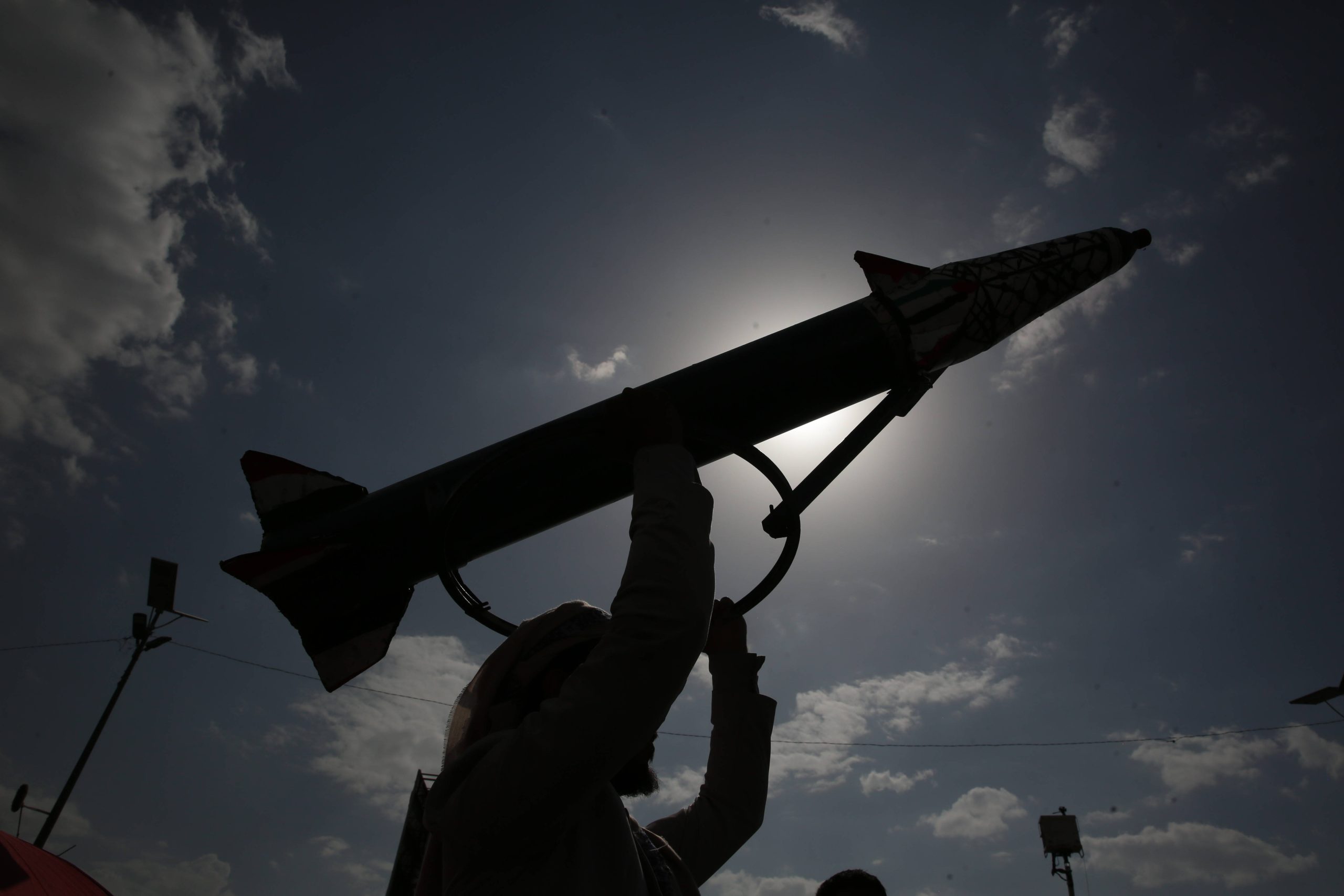
What explains the lack of documented projectile launches from Yemen toward Israel?
INSS Insight No. 2108, March 8, 2026
Contrary to conventional expectations, the Houthis are demonstrating a notable reluctance to intervene in Tehran’s defense. While it remains plausible that the trajectory of the conflict involving Iran and subsequent geopolitical developments in the Gulf could elevate their strategic impetus to engage in hostilities, analysis suggests that – even in such an eventuality – their actions will be highly calculated. Guided by their core strategic interests, it is posited that they would exercise operational restraint to mitigate the scope and severity of any retaliatory countermeasures.
With the central pillar of the Iranian-led “Axis of Resistance” under threat from a joint US–Israeli campaign against the Iranian regime, it is natural to wonder why the Axis’s rising star is sitting on the sidelines in Yemen. The Houthis, after all, present themselves as fearless, deeply radicalized warriors who actively seek confrontation with the United States, Israel, and their regional partners. But a closer examination reveals clear ideological, strategic, and practical reasons why the Houthis are not rushing to Tehran’s defense. While events could develop in ways that increase the Houthis’ incentive to strike, if they do, their core interests indicate that they are likely to do so in a manner that limits the blows they absorb in return.
The Houthis have a locally developed belief system inspired by the 1979 Islamic Revolution in Iran, but it is not dependent on it. They evolved into an armed group in 2004, powered primarily by local grievances and guided by Yemen’s own historical precedent. Insofar as the local supersedes the transnational, Houthi ambitions center on reversing the social order created by Yemen’s 1962 revolution, in which Imam al-Badr was deposed and the Hashemite class (descendants of the Prophet Mohammed) marginalized. Despite the Houthis’ public insistence that they represent a continuation of the Yemeni Republic established in 1962, their sense of legitimacy for ruling Yemen draws far more on the preceding millennium of imamate control in North Yemen than on the past 47 years of theocratic rule in Iran.
This is not to deny that the Houthis have been deeply influenced and heavily armed by the Iranians. Key figures in the movement made numerous trips to Iran when the organization was in its infancy. Founding families, including the al-Houthis, the al-Humrans, and the al-Hamzis, visited Iran well before they first took up arms against the Yemeni government in 2004. Iran’s radical brand of anti-Western, activist Shiite thought helped shape the paranoid and extremist worldview of the movement’s founder, Husayn al-Houthi, whose lectures serve as the ideological basis for the group today. Since Husayn’s death in 2004, these ties have deepened considerably. Over the past decade, Tehran and its axis partners have provided the Houthis with training and advanced weaponry, including ballistic missiles, anti-ship missiles, and long-range drones.
But the Houthis have never viewed Iran as their center of gravity, command-and-control hub, or treaty ally in a mutual defense pact. Instead, they have treated the Islamic Republic as an important ideological and military partner in support of a distinctly Yemeni component of the pan-Islamic “resistance.” The relationship does not carry the kind of obligation that would compel the Houthis to risk their own survival for the sake of their patron.
Even if the ideological case for Houthi involvement were stronger, the current moment is particularly inopportune for the Houthis to take up arms against a powerful US-led coalition. The Houthi-run economy of northern Yemen has been devastated by a perfect storm of pressures, and there are concrete aspects of the crisis that cannot be papered over by ideology or repression.
The destruction of Houthi-run ports by Israeli and American strikes, the decline in foreign aid due to concerns over diversion, powerful sanctions designations from Washington, the relocation of key financial institutions to government-held territory, and the presumably finite degree to which government coffers, banks, and the population can be looted have all contributed to an impending revenue crisis for the regime with no textbook solution in sight. While the Houthis have managed to prop up their regime despite paying public sector employees only a fraction of their owed salaries for years, this does not guarantee that the continuation is tenable. A worsening crisis could push the Yemeni public to a breaking point, cause the regime’s hired guns to stop fighting or even defect, or deprive the group of the materials needed to replenish its arsenal.
Having only recently begun to rehabilitate the seaports upon which their economy depends, it stands to reason that the Houthis are not rushing to provoke another round of strikes which would likely target them. And despite the reputation they have cultivated as perpetually seeking conflict, the Houthis have a well-documented history of accepting strategic pauses when they have lost momentum and need time to rest and rearm before the next round. The group’s strategic calculus pulls heavily toward restraint.
On a purely practical level, the Houthis are also likely sobered by the recent successful American and Israeli decapitation strikes that killed their top military officials in the winter and summer of 2025 and, more recently, senior Iranian leaders during Operation Epic Fury/Roaring Lion. While the Houthi movement has become more institutionalized over time, it remains highly personalized, based on familial ties and personal history and relationships. A campaign of the kind that eliminated multiple layers of senior Hezbollah and Iranian leadership could cause chaos in the Houthis’ internal power dynamics. Managing such a crisis would be all the more difficult at a time when the group already lacks the financial resources typically used in Yemen to co-opt dissenters.
In recent days, Houthi leader Abdelmalek al-Houthi issued a non-committal statement that the group’s “finger is on the trigger” and that they would join the war if events required it. But this vague statement does not provide a clear indicator of their intentions, as could be intended to deter adversaries from capitalizing on the axis’s weakness rather than genuine signaling of intention to join the fight.
Even after Hezbollah entered the war, the Houthis appear content to express solidarity with Iran from a distance. This highlights a key difference: The Islamic Republic’s fight for survival is existential for Hezbollah, a group which is operationally and ideologically inseparable from Tehran. For the Houthis, by contrast, intervention could endanger the survival of their project. While the Houthis mourned Khamenei’s assassination and praised his legacy, they are not beholden to him or the regime he left behind.
That said, Houthi calculations could shift. For example, in a moment of desperation, the Islamic Revolutionary Guard Corps (IRGC) could offer the Houthis major incentives to participate in the fighting, potentially providing a lifeline that would allow them to stave off economic crisis. In that case, or if the Gulf Cooperation Council states become more directly involved in strikes on Iran, the Houthis may try to thread the needle between activism and restraint by striking Gulf targets (rather than American or Israeli ones) in the aim of eliciting a limited response. Regardless of where Houthi policy currently stands, the threat must be watched closely, as one of the key advantages exploited continuously since October 7, 2023, has been surprise.