


Publications
A legal perspective on Iranian activity in the Strait of Hormuz, which is shaking the global economy
INSS Insight No. 2120, March 29, 2026
The developing crisis in the Strait of Hormuz positions the strait as one of the central arenas of friction in the current conflict and as a focal point of a crisis with global implications. A sustained disruption of traffic in the strait, even without a full closure, is not merely a tactical move but a broader blow to the international order. Its strategic importance and unique status expand the arena of friction beyond the direct parties to the current conflict. This means that the struggle over freedom of passage in the strait is not confined to the military dimension but is also conducted in the diplomatic and legal spheres, affecting the scope of international legitimacy for the parties’ actions, particularly their ability to mobilize or restrain the involvement of additional actors.
A Central Flashpoint with Potential for International Escalation
The Strait of Hormuz, which connects the Persian Gulf to the Indian Ocean, is one of the most important strategic assets for global trade and the world economy. In normal times, roughly one-fifth of global seaborne oil passes through it, alongside significant volumes of natural gas, fertilizers, and other goods. This dependence makes the strait a strategic pressure point and therefore highly vulnerable; even partial disruption produces immediate effects on energy prices, maritime insurance, and supply chains.
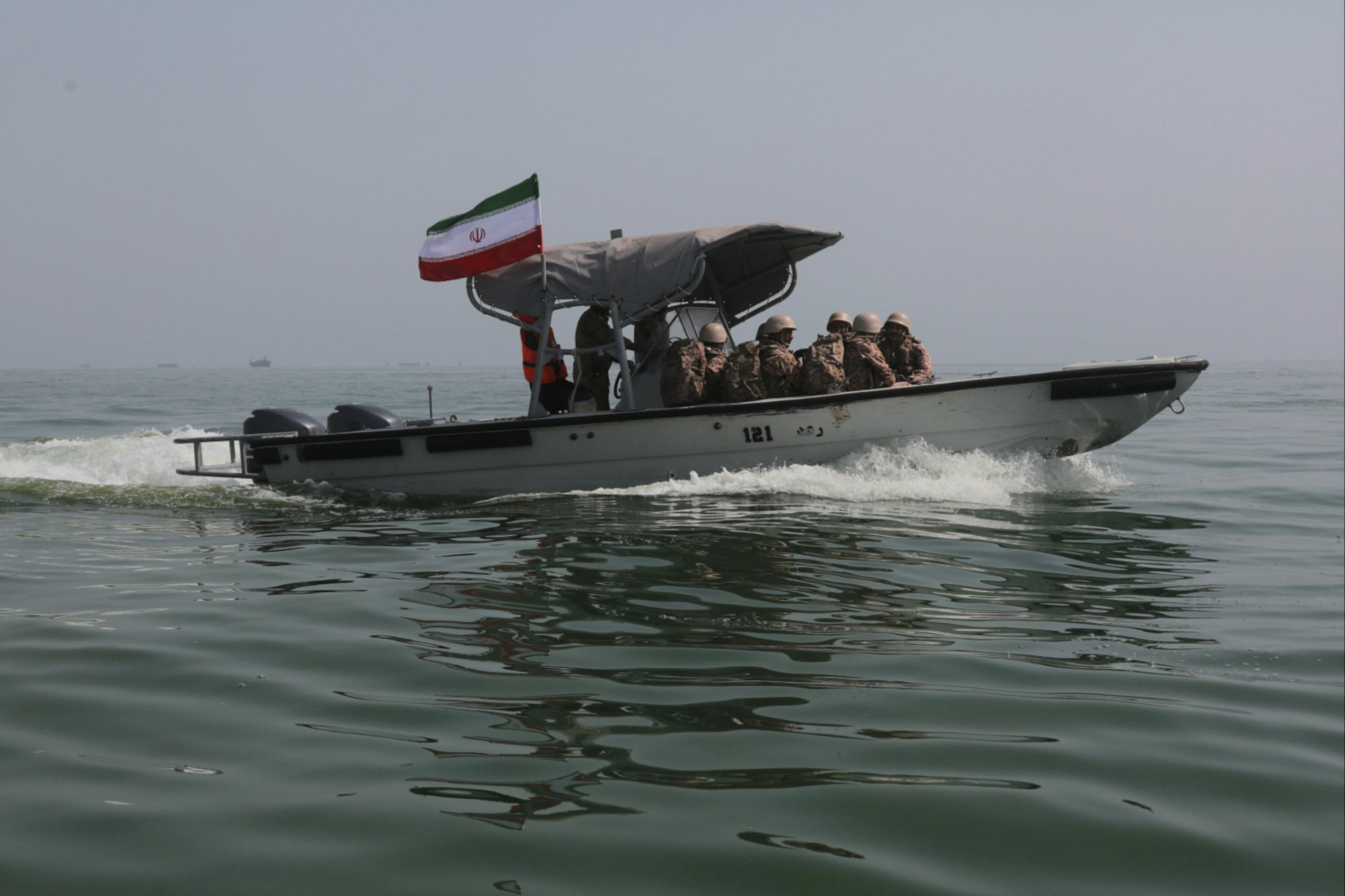
Iran has exploited this dependence and its geographic control over the world’s most important energy chokepoint in an attempt to convert attrition in the military arena into a strategic achievement in the international arena. To this end, it has worked to broadly disrupt freedom of navigation in the strait, as well as traffic to and from it, without declaring a full closure. Within this framework, it attacks commercial vessels, including those flying neutral flags, and employs asymmetric means such as UAVs, unmanned vessels, and naval mines.
In practice, at this stage of the war, Iran holds effective control over passage through the strait. It has declared that the Strait of Hormuz is open to navigation, except for vessels linked to the “enemies of Iran,” and is implementing a selective policy that allows limited and supervised passage for vessels from countries perceived as friendly or neutral, subject to coordination with Iranian authorities and payment to Iran, while other traffic is deterred, delayed, or harmed.
The result of Iran’s actions is an unprecedented disruption in maritime traffic through the strait, with shipping volumes falling by tens of percentage points. This has been accompanied by significant economic consequences, in particular a sharp rise in energy prices and damage to global supply chains. Despite attempts to mitigate the damage through the release of emergency reserves and the development of alternative routes, these are only partial solutions that cannot replace traffic through the strait.
The response by the United States and Israel to Iran’s threat to shipping has focused on systematically degrading Iran’s naval capabilities and efforts to ensure freedom of navigation. This has included significant damage to the Iranian fleet, along with efforts to establish escort and protection mechanisms for commercial shipping. However, despite the erosion of its conventional capabilities, Iran continues to disrupt maritime activity.
The centrality of the strait is underscored by the ultimatum issued by US President Donald Trump, stating that if Iran does not fully and unconditionally open the Strait of Hormuz, the United States will strike its energy infrastructure. In response, Tehran has threatened that such an action would lead to a complete closure of the strait and an expansion of attacks on additional targets.
Looking ahead, the two sides present opposing visions for the future of the strait: Iran signals an intention to shape a “new regime” of control and restrictions, while the United States and Israel have set the goal of denying Iran the ability to use the Strait of Hormuz as a strategic tool in the future.
The Legal Framework
The legal regime applicable to the Strait of Hormuz is grounded in the law of the sea under international law, alongside the laws of armed conflict, particularly those governing naval warfare.
The international status of the strait and the right of passage. The Strait of Hormuz is an international strait, as it is used for navigation between the Persian Gulf and the Gulf of Oman and the Arabian Sea in the Indian Ocean; that is, it connects areas beyond the control of a single state. It therefore enjoys a special status under international law that enshrines freedom of navigation. Under the law of the sea, the right of transit passage applies in international straits, ensuring free, continuous, and unobstructed passage for all ships and aircraft, both civilian and military. This right is anchored in the UN Convention on the Law of the Sea (UNCLOS) and is also considered to reflect customary international law binding on all states. The prevailing view is that the right of transit passage in an international strait cannot be suspended, even during armed conflict. However, the law of naval warfare allows interference with certain maritime traffic, especially that of belligerents or vessels used for military purposes, as discussed below.
This means that under the law of the sea, coastal states, including Iran, have no authority to prevent, restrict, or disrupt the regular passage of vessels, even during hostilities. The prohibition is not limited to a formal closure of the strait but also applies to functional impairment of the right of passage, assessed according to the cumulative effect of a state’s actions. Creating a dangerous environment that deters passage by engaging in attacks, making threats, or using naval mines violates international law, even without an official declaration of closure.
Iran seeks to evade its obligation to respect the right of transit passage in the strait on the grounds that it is not a party to the UNCLOS and due to its persistent objection to recognizing this legal regime as binding customary law. In its view, a regime of “innocent passage” applies in the strait, granting it, as a coastal state, broader authority to supervise traffic, impose conditions on passage, and even restrict it on security grounds. However, this argument is weak, since there is little doubt that this rule of the UNCLOS represents customary law accepted as such by the overwhelming majority of the world’s states.
Attacks on vessels. As a general rule, it is permissible to attack the enemy’s military vessels, but it is prohibited to attack its civilian vessels. This is in accordance with the laws of armed conflict, which require a distinction between military and civilian objectives. However, a civilian vessel could lose its protection and become a legitimate target if it participates in hostilities or makes a direct, substantial, and effective contribution to the enemy’s war effort. Ordinary commercial activity, such as transporting energy, generally does not meet this threshold. As for objects used to finance and sustain the war effort (“war-sustaining objects”), the United States holds an expansive, although contested, position, according to which they may be considered part of the war effort. Accordingly, in its view, tankers carrying Iranian oil that finances the regime may be considered lawful targets.
Restrictions on vessel movement during war. A distinction exists between vessels belonging to the parties to the armed conflict and those of neutral states. Under the law of naval warfare, a belligerent may prevent the passage of enemy merchant vessels and may stop and seize them, even outside its territorial waters. By contrast, it is prohibited to restrict the passage of vessels belonging to neutral states, except to verify their identity and inspect their cargo in order to ensure that they are not carrying goods that could be used by the enemy for military purposes (so-called “contraband”). If such cargo is discovered, the vessel may be seized and, in exceptional cases, even attacked, for example, if it resists inspection or attempts to flee. In this context, the cargo’s destination is a key consideration; it must be destined for territory under enemy control and make a material contribution to the enemy’s war effort.
Use of naval mines. Although the use of naval mines is not prohibited per se, the law of naval warfare imposes strict limitations on their use, including the prohibition of indiscriminate attack, the obligation to take precautions to protect civilian shipping, and the prohibition of blocking international shipping lanes where no practical alternative exists. In the Strait of Hormuz, the prevailing conditions make compliance with these requirements exceptionally difficult, thus limiting the lawful use of naval mines to the point of near-total prohibition. The strait is a vital international shipping route with no functional alternative; traffic is dense, and the ability to distinguish between civilian, neutral, and military vessels is inherently limited. Moreover, in such a narrow and heavily trafficked waterway, the use of naval mines would likely cause widespread disruption and, in practice, amount to blocking an international route. Under these circumstances, it is virtually impossible to employ naval mines in a manner that complies with legal requirements.
The Iranian Framing: Security Enforcement
Iran seeks to frame its actions in the maritime domain as legitimate enforcement rather than violations of international law. It argues that, within the context of its armed conflict with the United States and Israel, it is entitled to act against vessels belonging to its adversaries or those contributing to their military effort. Accordingly, it avoids declaring a full closure of the strait, a step that would be difficult to justify legally, and instead presents delays, inspections, and attacks on vessels as security-related operational measures derived from its right of self-defense. At the same time, it portrays the strait as closed only to “Iran’s enemies” and expresses a willingness to cooperate with international actors to improve maritime safety, provided that they respect its sovereignty and cease actions against it.
However, even in their strongest formulation, these arguments face significant difficulties within the current legal framework. It is difficult to contest that the actions attributed to Iran, particularly attacks on neutral vessels, the creation of a systematic threat to freedom of navigation, and the use of indiscriminate naval mining, raise significant legal concerns and are inconsistent with international law.
Responses in the International Arena
Iran’s obligation to respect freedom of navigation in the Strait of Hormuz received institutional expression in UN Security Council Resolution 2817, adopted on March 11, 2026. The resolution condemns Iran’s attacks on states in the region and determines that they constitute a breach of international law and a serious threat to international peace and security. At the same time, it reaffirms that the navigation rights and freedoms of merchant and commercial vessels, exercised in accordance with international law, must be respected, particularly around critical maritime routes, and underscores the right of states to defend their vessels from attacks and provocations, including those that undermine navigational rights and freedoms. The resolution further condemns any action or threat by Iran aimed at closing, obstructing, or interfering with international navigation through the Strait of Hormuz, or at threatening maritime security in the Bab al-Mandab. It affirms that any attempt to impede lawful transit passage or freedom of navigation in these international waterways constitutes a serious threat to international peace and security, and it calls on Iran to immediately refrain from any such actions or threats.
Accordingly, the resolution not only reaffirms existing norms but also frames the infringement of freedom of navigation as conduct with direct implications for international peace and security, thereby reinforcing the conclusion that Iran’s actions clearly fall outside the bounds of international law.
Following this resolution, the United Kingdom, France, Germany, Italy, the Netherlands, Japan and Canada issued a statement on March 19 condemning Iran’s actions in the Strait of Hormuz. Additional states, including Australia, Norway, the United Arab Emirates, and Panama, subsequently joined this statement, which has to date been endorsed by approximately thirty states. The signatories emphasized that harm to freedom of navigation constitutes a threat to international peace and security and expressed their readiness to support appropriate efforts to ensure freedom of movement in the strait.
One of the measures proposed in response to the Iranian threat is the escort of merchant vessels by naval ships along shipping routes in the Persian Gulf and the Strait of Hormuz. Without addressing the operational feasibility, it should be noted that as long as the war continues, from a legal perspective, there is an advantage to having an escort by ships of neutral states. Under the law of naval warfare, a convoy escorted by warships that belong to a party to the conflict may be considered part of the war effort and therefore may lose their protection from attack, even if the escorted ships are merchant vessels of neutral states. The same applies when warships of neutral states participate in escorting the convoy alongside warships of a party to the conflict. By contrast, when the escort is carried out entirely by vessels of neutral states, the convoy retains its neutral status and enjoys broader protection: It may not be attacked and is entitled to unimpeded passage, provided it does not violate the law of neutrality.
In this context, if states not party to the war assist in ensuring secure passage through the strait, including by providing naval escort, an Iranian attack on such a convoy could be considered an armed attack against the escorting states and a clear violation of the laws of war. In those circumstances, the escorting states would have the right to respond, including through the use of force.
Conclusion
The crisis in the Strait of Hormuz demonstrates that harm to freedom of navigation has become an effective strategic tool. Through sustained disruption without full closure, Iran is effectively influencing one of the world’s principal trade arteries and exerting significant pressure on the international system. In its conduct, Iran disregards the clear legal rules governing the maritime domain, even as it seeks to present legal justifications for its actions.
Iran’s interference with freedom of navigation in the Strait of Hormuz, along with its attacks on commercial vessels of neutral states, creates a strong legal case against it. Yet the international response remains limited and cautious. Nonetheless, Iran’s violations of international law make it possible to mobilize states that do not wish to participate in the military campaign but are nevertheless prepared to contribute to efforts to safeguard navigation in the strait, both during the war and in its aftermath.