


Publications
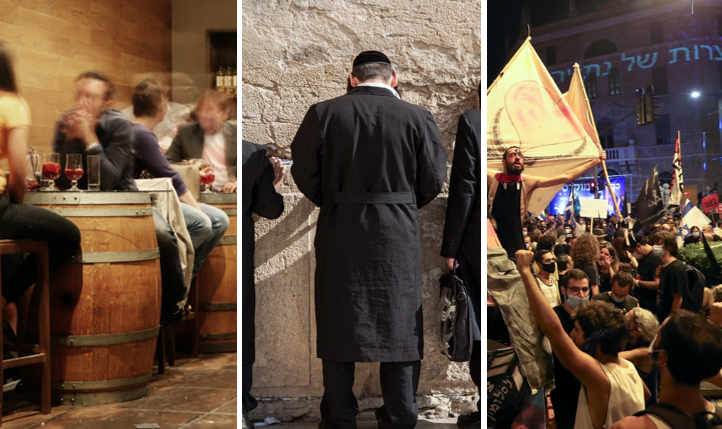
Large prayer gatherings, mass demonstrations, and packed bars and pubs: these recurrent scenes in the days of the Covid-19 crisis reflect poorly on Israeli society. When did Israel lose its sense of social solidarity, and what can be done to restore it throughout the public?
INSS Insight No. 1386, October 6, 2020
Follow us on GoogleEight months after the eruption of the coronavirus pandemic in Israel, and after the imposition of two lockdowns aimed at “flattening the curve of infection,” it is apparent that the root reasons for Israel’s failure to defeat the pandemic do not lie solely in the limited resources of the health system, the country’s economic difficulties, the eroding status of the legislative and the judicial branches, or the narrow coalition considerations designed to ensure the government’s survival. Rather, the main challenge stems from the diminishing social solidarity in Israel. The pandemic and the ensuing crisis reflect poorly on Israeli society, but also offer an opportunity for social transformation through profound explorations concerning what can lead Israel to a renewed sociopolitical structure based on the principles of a revived common purpose.
In the first wave of the coronavirus pandemic in Israel, the focus was mainly on public health. In the second wave, when a second lockdown is in force, it is apparent that the reasons for Israel’s failure to defeat the spread of the virus do not lie solely in the limited resources of the health system. Rather, the main obstacle to contain the spread of Covid-19 is the absence of social resources. The crisis management of dealing with the pandemic is highly affected by the severe political crisis that has led (so far) to three election campaigns in which parts of the political system rely on, exploit, and even foment the polarization in Israeli society. This article focuses on the dwindling of social resources in Israel that adversely affects the current management of the pandemic.
What is a social resource, and how is it that Israel, which was founded on the principles of collective solidarity while absorbing huge waves of Jewish immigration from countries all over the world, finds itself presently lacking this resource? A social resource is a product, service, capital, or asset that broadens the scope of individuals’ access to social and economic benefits, and helps to increase their wellbeing so as to satisfy their needs. An important component of a society’s resources lies in the benevolent relations between different social sectors. It is reflected in feelings of unity based on shared values, goals, interests, and preferences. In a nutshell, it is about social solidarity, and its viability and intensity within a heterogeneous society.
The late political sociologist Baruch Kimmerling described Israel as a “society in struggle,” characterized by the conflict between groups striving to shape the country’s narrative and the rules of the game by means of cultural control (hegemony). According to Kimmerling, between 1948 and 1976, what he defined as the "secular middle class," comprising the generation of “veterans,” held most of the positions in public administration, the economy, the security establishment, the media, and the academy. Their hegemony was weakened after the dramatic election of 1977, which resulted in the victory of the Likud over the Labor Party and its historic socio-political dominance in Israel. However, this political paradigm shift did not lead to the downfall of the said social elite, which retained its hold on many loci of power for decades, with significant cracks emerging in the last two decades.
The political transformation marked the beginning of another major process in Israeli society, in which the traditional social elite evolved from holding a leading position to becoming just another interest group, one of many in the country. The struggle between the various groups over positions of influence and for a larger share of social, cultural, and economic assets has represented the essence of a political conflict that is not necessarily based on party-politics in the conventional sense. Rather, this intensified struggle has evolved from a legitimate ideological-political-partisan controversy between competing standpoints, to a bitter struggle between sectors and tribes over resources and influence. Ostensibly this continuous strife represents a fierce political rivalry. But in fact, instead of a valid debate over the best ways to achieve the common good, there is an ever growing sense that the underlying aim of this conflict is to hurt the opponent. In contemporary times, this translates into efforts to restrict public demonstrations of the secular left, ban communal worship and religious studies of the ultra-Orthodox, curtail wedding celebrations in the Arab sector, and more.
Reference to this strife is evident in two speeches, each in its own way reflecting on Israeli society and the growing alienation between social groups. In 1996, on the anniversary of the assassination of Prime Minister Yitzhak Rabin, then-Chief of Staff, Lt. Gen. Amnon Lippkin-Shahak asserted that “polarization, hedonism, sectarianism, apathy, opportunism, and manipulations have found their way to the consensus.” On June 7, 2015, President Reuven Rivlin delivered what later became known as the “the speech of the tribes,” which he framed as “a warning to Israeli society about its changing posture” and the spread of “the tribal reality.” According to Rivlin, there is growing alienation between each of the social groups and the state, as well as polarization among the tribes, posing a danger to Israeli democracy.
The struggle between groups in Israeli society has assumed the features of a zero-sum game: the image of one group achieving influence, resources, or positions of power necessarily reflects a loss and exclusion of the other groups. Thus, it is hard to obtain any concession, however slight, from one group lest this be perceived as a gain for the opposing group. All this is clearly evident during the Covid-19 pandemic, where haredi worshippers are pitted against secular demonstrators; residents of Bnei Brak against residents of Tel Aviv; Arab society against Jewish society; and so on.
The spread of the pandemic is closely linked to the conduct of every single citizen in the country. Lowering the infection rate requires each individual to change his/her way of life – and not just for his/her own sake, but for the sake of other and unfamiliar people. Individuals are called on to change their lifestyle and daily routine for the general good, that is, for the benefit of other social groups, who may not share the same values, ideology, or fabric of life. This is precisely how social solidarity is measured – the ability (and the will) to demonstrate mutual responsibility (even) with other social groups that are not always understood, or with which there are deep controversies.
The current emergency in Israel, which reflects a multidimensional crisis (affecting healthcare, the economy, and society, along with an ongoing political crisis), demands social solidarity, which means mutual responsibility and personal discipline closely linked to concessions and concern for the other.
The Covid-19 pandemic serves as a kind of X-ray machine, exposing the strengths and weaknesses of Israeli society, its social structure, public system, social and economic security networks, and inequalities. In the current situation, the national public interest seems to have been marginalized, leaving "everyone to do that which was right in his/her own eyes." These result in huge weddings in the Arab community, large prayer services in the haredi community, and crowded bars, parties, and mass demonstrations in the secular population. All these ignore the sheer fact that by failing to comply with guidelines and directives “they place a huge burden not only on their fellow participants, but on society at large” (Rolnick, The Marker, September 18, 2020), to the extent that the struggle waged for positions of strength and for social, cultural, and economic resources leads Israel to “social Darwinism” (Galili, Ynet, September 22).
In conclusion, the Covid-19 crisis may continue to spiral, not only because of hospitals’ insufficiency, but also due to the absence of social solidarity as reflected by the struggle between social groups for positions of power and socio-economic resources. Some would argue that this is an outcome of historical social injustices. In these circumstances each tribe makes its own rules. The ongoing focus on the internal conflicts between sectors and tribes leads to a vicious circle that damages Israel’s dwindling social resources, deepens social divides, weakens national resilience, and might even undermine the country’s ability to weather its challenges. This can happen in many domains, stretching from public health to the economic crisis. This is already evident in how Israel’s leaders (mis)manage the present pandemic.
In order to achieve a sound and prosperous society in Israel that is willing and able to face a range of threats, a new social order must be established, based on an agreed common good, with which the different parts of Israeli society can identify. It will be a major challenge to find such a shared social organizing framework in the short term. However, if all segments of Israeli society are willing to mobilize to achieve this goal, while making concessions, the road will be paved to a revived common purpose.