


An Integrated Political Strategy: Regional, Bilateral, and Independent | INSS
go to header go to content go to footer go to search
INSS logo The Institute for National Security Studies, Strategic, Innovative, Policy-Oriented Research, go to the home page
INSS
Tel Aviv University logo - beyond an external website, opens on a new page
  • Campus
  • Contact
  • עברית
  • Support Us
  • Research
    • Topics
      • Israel and the Global Powers
        • Israel-United States Relations
        • Glazer Israel-China Policy Center
        • Russia
        • Europe
        • Antisemitism and Delegitimization
      • Iran and the Shi'ite Axis
        • Operation Roaring Lion
        • Iran
        • Lebanon and Hezbollah
        • Syria
        • Yemen and the Houthi Movement
        • Iraq and the Iraqi Shiite Militias
      • Conflict to Agreements
        • Israeli-Palestinian Relations
        • Hamas and the Gaza Strip
        • Peace Agreements and Normalization in the Middle East
        • Saudi Arabia and the Gulf States
        • Turkey
        • Egypt
        • Jordan
      • Israel’s National Security Policy
        • Military and Strategic Affairs
        • Societal Resilience and the Israeli Society
        • Jewish-Arab Relations in Israel
        • Climate, Infrastructure and Energy
        • Terrorism and Low Intensity Conflict
      • Cross-Arena Research
        • Data Analytics Center
        • Law and National Security
        • Advanced Technologies and National Security
        • Foreign Information Manipulation and Interference
        • Economics and National Security
    • Projects
      • Preventing the Slide into a One-State Reality
  • Publications
    • -
      • All Publications
      • INSS Insight
      • Policy Papers
      • Special Publication
      • Strategic Assessment
      • Technology Platform
      • Memoranda
      • Posts
      • Books
      • Archive
  • Database
    • Surveys
    • Spotlight
    • Maps
    • Dashboards
  • Events
  • Team
  • About
    • Vision and Mission
    • History
    • Research Disciplines
    • Chairman of the Board
    • Board of Directors
    • Fellowship and Prizes
    • Internships
  • Media
    • Communications
    • Video gallery
    • Press Releases
  • Podcast
  • Newsletter
  • Campus
Search in site
  • Research
    • Topics
    • Israel and the Global Powers
    • Israel-United States Relations
    • Glazer Israel-China Policy Center
    • Russia
    • Europe
    • Antisemitism and Delegitimization
    • Iran and the Shi'ite Axis
    • Operation Roaring Lion
    • Iran
    • Lebanon and Hezbollah
    • Syria
    • Yemen and the Houthi Movement
    • Iraq and the Iraqi Shiite Militias
    • Conflict to Agreements
    • Israeli-Palestinian Relations
    • Hamas and the Gaza Strip
    • Peace Agreements and Normalization in the Middle East
    • Saudi Arabia and the Gulf States
    • Turkey
    • Egypt
    • Jordan
    • Israel’s National Security Policy
    • Military and Strategic Affairs
    • Societal Resilience and the Israeli Society
    • Jewish-Arab Relations in Israel
    • Climate, Infrastructure and Energy
    • Terrorism and Low Intensity Conflict
    • Cross-Arena Research
    • Data Analytics Center
    • Law and National Security
    • Advanced Technologies and National Security
    • Foreign Information Manipulation and Interference
    • Economics and National Security
    • Projects
    • Preventing the Slide into a One-State Reality
  • Publications
    • All Publications
    • INSS Insight
    • Policy Papers
    • Special Publication
    • Strategic Assessment
    • Technology Platform
    • Memoranda
    • Posts
    • Books
    • Archive
  • Database
    • Surveys
    • Spotlight
    • Maps
    • Dashboards
  • Events
  • Team
  • About
    • Vision and Mission
    • History
    • Research Disciplines
    • Chairman of the Board
    • Board of Directors
    • Fellowship and Prizes
    • Internships
    • Privacy Policy and Terms of Use
  • Media
    • Communications
    • Video gallery
    • Press Releases
  • Podcast
  • Newsletter
  • Campus
  • Contact
  • עברית
  • Support Us
bool(false)

Publications

Home Publications INSS Insight An Integrated Political Strategy: Regional, Bilateral, and Independent

An Integrated Political Strategy: Regional, Bilateral, and Independent

INSS Insight No. 664, February 13, 2015
עברית
Gilead Sher
Liran Ofek
The complex reality of the Middle East requires Israel to work proactively and formulate a sophisticated and graduated policy, incorporating a multilateral regional dialogue, bilateral negotiations with the Palestinians, and independent steps to shape the nation’s borders – all the while ensuring the security of its citizens. Such an initiative would allow progress on each of the channels by achieving interim steps and transitional periods designed to advance a partial settlement and the reality of two nation states. Israel’s next government should announce its intention to reach political settlements and promote normalization with neighboring countries. It should revisit  initiatives such as the Roadmap and the Arab Peace Initiative, first proposed over twelve years ago, which can serve – with modifications – as the framework for regional talks.

Prerequisite: Separation from the Palestinians with a Defined Border

Particularly as hundred-year-old borders in the Middle East are rapidly being effaced, more than ever the Jewish people’s national home cannot compromise on its need for secure and recognized borders. Israel’s national interests and its national security, as well as the country’s fundamental Jewish and universal values, demand a political solution to the Israeli-Palestinian conflict. This can be achieved by territorial division of the area between the Jordan River and the Mediterranean Sea into two nation states, preferably by means of a negotiated political settlement.

Israel and the Palestinians: A Situation Assessment

There are at present slim prospects for achieving a permanent agreement that would put an end to the conflict and establish the finality of all claims, for several reasons.  First, the Palestinians have opted to try to gain political achievements via increased use of legal and diplomatic tools instead of negotiations; second, there is mutual distrust between the sides; third, there is currently a massive gap between the sides on the core issues; and fourth, the rounds of violence between Israel and the Palestinians are frequent occurrences.

The lack of negotiations for a permanent resolution undermines the legitimacy of Israel’s political and military actions on many levels in the international arena, among them, diplomatic, legal, and economic. So far, the tainting delegitimization campaign has not achieved any tangible results, but it has a cumulative effect in eroding support for Israeli positions among its friends. The weakened position of Israel’s supporters on the international arena has been manifested in the – albeit non-binding – recognition of a Palestinian state by various European parliaments, despite the absence of Israeli-Palestinian talks. In addition, eight members of the UN Security Council – one vote short of the threshold required for a debate – voted for the resolution submitted by Jordan on behalf of the Palestinians in December 2014, which called for the establishment of a Palestinian state to be forced on Israel within one year and Israel’s withdrawal from the West Bank by late 2017.

Regional Opportunities

In tandem with aptly handling the delegitimization challenge, Israel should explore several interests that it shares with some key Arab nations, namely Egypt, Saudi Arabia, Jordan, and the UAE. These states face common threats, including Iran’s nuclear ambitions; the rise of ISIS and radical Islam; and Hamas and Palestinian terrorism, which includes the need to prevent cross-border smuggling and infiltration. This convergence is local and therefore cannot, in and of itself, lead to overt cooperation, but the underlying principle is that stability, both domestic and regional, is a critical shared interest. Moreover, these states support a regional settlement in the spirit of the Arab Peace Initiative. This plan is in part based on principles that should be seen as positive from the Israeli perspective: acknowledgment of peace as a strategic choice; Arab willingness to hold direct talks with Israel, i.e., recognition of UN General Assembly Resolution 181; an Arab commitment to promote the Initiative within the international community and resolve the conflict with Israel and normalize relations; and achievement of an agreed solution to the refugee problem. All these indicate that there exists an opportunity for enlisting Arab nations to promote an agenda that could potentially advance solutions that are good for Israel with regard to the Palestinian issue, along with other regional issues.

In Practice

The formulation of an integrated political strategy would be based on a three-pronged approach: one, promotion of regional arrangements on all issues of concern shared by Israel, the PA, the moderate Arab states, and the relevant international entities; two, resumption of Israeli-Palestinian negotiations, so as to make gradual progress (i.e., via interim arrangements and partial agreements) toward a two-state reality in the spirit of the 2000 Clinton parameters and the 2003 Roadmap; and three, an implementation mechanism that would change the reality on the ground.

To make this happen, sufficiently flexible terms of reference that are binding and agreed upon by all parties are imperative, so that successes and agreements in any area can allow for the creation of positive momentum, which in turn would contribute toward both progress in the other areas under discussions and effective containment of failures.

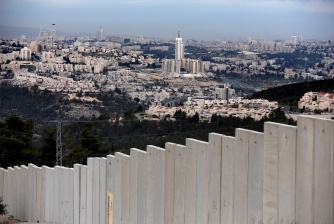
In addition, the Israeli government should prepare itself for the eventuality of a default plan of independently separating from the Palestinians via a provisional border. As long as there is no negotiated settlement, such a step would entail both military and civilian changes to the current situation and allow Israel to hand over control of most of the West Bank to the PA, with the exception of the Jordan Valley and the areas west of the security fence. The move would be effected in coordination with the United States, Jordan, Egypt, and, to the extent possible, the PA. It would also require formulation of a program of the highest national priority to relocate the 100,000 Israelis currently living east of the security fence, and legislation ensuring fair compensation. Furthermore, the government must engage in a dialogue about the move, in particular with the public that would be most affected, but with the greater Israeli public as well. The dialogue would not erase the profound difference of opinion within Israeli society over such a move, but it could help shape the tools necessary for dealing with critical national decisions.

The policy proposed herein depends on elements critical to Israel’s national security that are an inseparable part of any avenue taken. First and foremost, Israel would have to retain full freedom of operation of the IDF and security forces to foil terrorist attacks and prevent the buildup of terrorist groups; control over the airspace and the electromagnetic spectrum; security coordination with Jordan, Egypt, and as much as possible, the PA, particularly in response to violence, both Israeli and Palestinian, resulting from redeployments in the West Bank. Israel should enable the PA to rebuild the normal fabric of life in the West Bank, improve its economic situation, and encourage the construction of institutions according to the Roadmap guidelines.

The next Israeli government must be proactive and formulate a policy that would make it possible to shape a suitable strategic environment for the national home of the Jewish people. A clear border – defensible and largely agreed-upon – would be drawn between the State of Israel and the demilitarized State of Palestine. The border would be based on the 1967 lines, while leaving the large Jewish settlement blocs in Israel’s hands in exchange for land swaps. This would allow a secure, democratic state within Israel’s borders and a state with a Jewish majority, enjoying both internal resilience and international recognition.
______________________________
The authors would like to thank Maya Kornberg, Keren Aviram, and Einav Yogev.
The opinions expressed in INSS publications are the authors’ alone.
Publication Series INSS Insight
TopicsIsraeli-Palestinian Relations
עברית

Events

All events
Iran, US, Israel, and the Global Jewish Community
10 March, 2026
12:00 - 13:00
Shutterstock

Related Publications

All publications
Habbou Ramez/ABACA via Reuters Connect and REUTERS (modified by INSS)
De-Hamasification of the Gaza Strip: Learning from Western and Arab Models of Deradicalization
The radicalization of Palestinian society in the Gaza Strip is not a new phenomenon, but the process has accelerated and deepened dramatically since Hamas’ takeover of the territory in 2007. Under its rule, an extremist religious-nationalist ideology has been systematically embedded across all spheres of Gaza life—from education and religious institutions to welfare and the media—producing a profound “Hamasification” of public consciousness. The war that erupted on October 7 brought unprecedented ruin to the Gaza Strip, both physically and institutionally, posing a monumental reconstruction challenge, but also a rare historic opportunity. This memorandum argues that military disarmament and physical rehabilitation alone will not ensure long-term security and stability, and that a far deeper process of “de-Hamasifcation” is required: dismantling Hamas’ ideological and institutional hegemony and replacing it with a more moderate civic and normative infrastructure. The study presents a comparative analysis of Western and Arab deradicalization models and finds that Western approaches—such as those implemented in Germany and Japan—struggle to provide an adequate response to Gaza’s cultural and political context. Instead, we propose adopting operational principles drawn from contemporary Arab models, particularly the “civic-transformative” model applied in the Gulf states, which combines a firm crackdown on extremist actors with re-education toward religious tolerance and broad-based economic rehabilitation. The paper outlines an integrative strategy encompassing sustained security demilitarization, the mobilization of an Arab coalition to provide religious and political legitimacy, and the establishment of a credible political horizon as a counterweight to the ethos of “resistance.” Only the combination of these elements can generate a viable governing and ideological alternative to Hamas and lead to a more stable long-term security environment for the State of Israel.
05/02/26
REUTERS / Jonathan Ernst
Trump’s Board of Peace: An Initiative for the Gaza Strip or an Alternative to the UN?
What is the mission of the international board established by the US president as part of his plan to end the war in the Gaza Strip—and what are the implications of Trump’s move?
04/02/26
Harun Ozalp / Anadolu via REUTERS
The Transition to Phase II in the Gaza Strip—An Unprecedented Challenge for Israel
What challenges and concerns have arisen—both in Jerusalem and in Ramallah—following the announcement of the transition to the second phase of the Trump plan for stabilizing the Gaza Strip, and how should Israel act?
27/01/26

Stay up to date

Registration was successful! Thanks.
  • Research

    • Topics
      • Israel and the Global Powers
      • Israel-United States Relations
      • Glazer Israel-China Policy Center
      • Russia
      • Europe
      • Antisemitism and Delegitimization
      • Iran and the Shi'ite Axis
      • Operation Roaring Lion
      • Iran
      • Lebanon and Hezbollah
      • Syria
      • Yemen and the Houthi Movement
      • Iraq and the Iraqi Shiite Militias
      • Conflict to Agreements
      • Israeli-Palestinian Relations
      • Hamas and the Gaza Strip
      • Peace Agreements and Normalization in the Middle East
      • Saudi Arabia and the Gulf States
      • Turkey
      • Egypt
      • Jordan
      • Israel’s National Security Policy
      • Military and Strategic Affairs
      • Societal Resilience and the Israeli Society
      • Jewish-Arab Relations in Israel
      • Climate, Infrastructure and Energy
      • Terrorism and Low Intensity Conflict
      • Cross-Arena Research
      • Data Analytics Center
      • Law and National Security
      • Advanced Technologies and National Security
      • Foreign Information Manipulation and Interference
      • Economics and National Security
    • Projects
      • Preventing the Slide into a One-State Reality
  • Publications

    • All Publications
    • INSS Insight
    • Policy Papers
    • Special Publication
    • Strategic Assessment
    • Technology Platform
    • Memoranda
    • Database
    • Posts
    • Books
    • Archive
  • About

    • Vision and Mission
    • History
    • Research Disciplines
    • Chairman of the Board
    • Board of Directors
    • Fellowship and Prizes
    • Internships
    • Support
    • Privacy Policy and Terms of Use
  • Media

    • Communications
    • Video Gallery
    • Press Release
    • Podcast
  • Home

  • Events

  • Database

  • Team

  • Contact

  • Newsletter

  • עברית

INSS logo The Institute for National Security Studies, Strategic, Innovative, Policy-Oriented Research, go to the home page
40 Haim Levanon St. Tel Aviv, 6997556 Israel | Tel: 03-640-0400 | Fax: 03-744-7590 | Email: info@inss.org.il
Developed by Daat ,Yael Group.
Accessibility Statement
This site is protected by reCAPTCHA and the Google Privacy Policy and Terms of Service apply.