


Publications
INSS Insight No. 775, December 6, 2015
Follow us on Google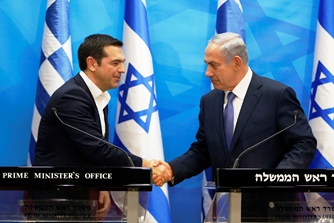
Recent years have witnessed a notable improvement in Israel’s strategic, military, political – and soon, perhaps, economic as well – balance. Partly the result of careful planning, this trend is also due to regional developments that have led Israel’s neighbors to believe that Israel has the ability to promote their interests. Geographically, the new strategic arc spans Egypt in the south to Greece in the northwest. This area is far from monolithic, encompassing different strains and even historical enmities, including the Israeli-Palestinian conflict with its problematic Gaza component, as well as the Arab-Israeli conflict, especially its Lebanese and Syrian aspects.
To Egypt, the regional upheavals, particularly the internal shockwaves as well as its worsening economic woes, have highlighted the importance of cooperation with Israel. Cooperation is critical for security, most notably in terms the regime’s efforts to fight terrorism instigated by domestic and foreign Islamic movements, especially in the Sinai Peninsula. Uprooting terrorism in Egypt and strengthening the regime are patent Israeli interests. Moreover, Egypt and Israel have shared interests regarding the Gaza Strip, although neither nation has succeeded in building a joint strategy that would address the terrorism emerging from Gaza and also create an economic and infrastructural plan that could serve as a framework for a long term solution for that region. Egypt’s need to find an alternate natural gas supplier until its own natural gas reserves are developed is a strong common economic interest. An Egyptian purchase of Israeli natural gas or use by Israel's gas producers of liquefaction facilities on Egyptian soil would greatly help finance and realize Israel’s natural gas potential. Cooperation on gas between Egypt and Israel as well as on economic solutions for the Gaza Strip would also allow good use of the natural gas located in the Gaza Strip’s economic zone.
Because of the rising security and economic importance of the maritime arena, the importance of the nearest island – Cyprus – has also risen. Prime Minister Netanyahu paid the first visit to Cyprus by an Israeli prime minister in 2012, and paid it another, one-day visit in July 2015. Natural gas is a core issue of the bilateral talks, because Israeli companies hold some of the drilling and production concessions in Block 12 in Cyprus’s economic waters, and the natural gas there crosses the line between both exclusive economic zones. In addition to an Israeli-Cypriot agreement to exploit the gas in their joint field, Cyprus may serve as a key component in the natural gas transportation infrastructure in the eastern Mediterranean basin because of its proximity to the region’s nations with natural gas reserves, including Egypt, the Palestinian Authority, Lebanon, and Israel. A robust relationship between Cyprus and those nations would help it play the role of the region’s hub. Cypriot President Nicos Anastasiades said that the discussions with Prime Minister Netanyahu in Nicosia also touched on joint electricity ventures. In 2013, the European Union declared the joining of the electrical grids of Greece, Cyprus and Israel an important project. Such a connection would allow the two-way conduction of 2,000 MW via a 1,580-km. long cable on the ocean floor, and the Cypriot company selected to undertake a feasibility study for such a project has already received EU grants. The EU’s list of energy projects also includes laying a natural gas pipeline from Cyprus to Greece.
The recent visit to Israel by Greek Prime Minister Alexis Tsipras represents another element of Israel’s regional strategy. By all accounts, and certainly his own, Tsipras is a leader of the left. However, he saw fit to visit Israel despite the rising tide of European criticism of the Israeli government for its conduct vis-à-vis the Palestinians, the EU Commission’s instructions on labeling products from West Bank Jewish settlements, and the wave of Palestinian attacks on Israelis. In recent years, Israel and Greece have stepped up security cooperation; in 2015 alone, the Israeli air force carried out two large scale exercises in Greek airspace and in conjunction with the Greek air force involving fighter jets, transport planes, fighter helicopters, and an intelligence gathering plane. The Greek defense minister has said that joint exercises of Israel, Greece, Cyprus, and possibly Egypt will take place in the near future. Tsipras’s visit to Israel resulted in a decision on closer cooperation among the three. It was also decided that a meeting of the three heads of state would take place within the next few weeks and that an expanded meeting involving broader government representation would be made earlier; it is now planned for early 2016.
Although Greece and Cyprus are not leading EU member states, the EU need for consensus in votes on foreign affairs and security matters formally provides them with a status equal to that of the more prominent EU member states. Greek and Cypriot considerations concerning Israel are linked to two key issues: Turkey and the United States. The deterioration in Israeli-Turkish relations since 2009, in particular after the flotilla affair in May 2010, has accelerated the process of nurturing close relations among Greece, Cyprus, and Israel. The differences in the relative importance of Turkey versus Greece and Cyprus notwithstanding, Israel clearly sees Greece and Cyprus as greatly balancing the damage caused by the ongoing depreciation of its relations with Ankara. The fact that Turkey subverts Israeli-NATO cooperation also raises the importance Israel attributes to security and military partners in the eastern Mediterranean basin.
Greece, Cyprus, and to a certain extent Israel should be concerned by the upgrade of Turkey’s status in the eyes of the European community, which stems from the role Europe expects Turkey to play in the war in Syria, especially in stopping the flow of refugees crossing Turkey and its territorial waters as they flee for Europe. At the meeting between the heads of EU member states and the Turkish President on November 29, 2015, the Europeans already made a down payment on Turkey’s willingness to play this role in the form of speeding up talks on Turkey joining the EU. These talks officially began in 2004-2005, but the ongoing conflict in Cyprus, the Turkish government’s conduct on issues important to Europe, including human rights violations and infringements on the freedom of the press, and particularly the EU’s growing opposition to the inclusion of a Muslim nation that, were Turkey to join the EU, would become its largest member, doomed Turkey’s hopes for joining the EU. At the same time, the renewal of the talks, scheduled for mid-December, and the plan to accelerate them in the first quarter of 2016 by no means assure Turkey’s acceptance into the EU. A statement issued on November 29, 2015 said that the renewal of the talks would be effected “without prejudice to the position of Member States” – a broad hint to Greece and Cyprus and perhaps also to leading EU members such as France and Germany. Every EU member has veto rights, and public opinion polls that would precede Turkey’s formal acceptance as an EU member are liable to indicate massive opposition to so dramatic a step. But one cannot dismiss the possibility that, as part of an overall deal with Turkey that would not include full EU membership, the EU would exert much pressure on its two Hellenic members to soften their stance on the resolution of the conflict in Cyprus in the spirit of the Turkish position. For now, the acceleration in talks with the EU has satisfied the needs of both sides: from the EU’s perspective, Ankara has demonstrated its willingness to cooperate, and from Turkey’s perspective, it has proved its importance and vitality, especially internally.
Nevertheless, it is important that Israel not abandon the effort to repair relations with Turkey and continue to be a major player in its neighbor’s immediate environment. The effects of Turkey’s activities within Muslim populations – negative, from Israel’s perspective – are striking. There is no doubt Turkey will play a central role in shaping the future regime in Syria. Turkey is also important to Israel economically, not only because of their extensive commercial relations but also because it is a bridge for the oil flowing to Israel from central Asia and is an important potential natural gas customer. Even if the current crisis between Russia and Turkey is resolved soon, Turkey will continue to stand in Russia's way, as it reaches for further influence in Israel’s close proximity; despite Israel’s important relationship with Russia, Israel would like to see Russia’s influence in the region curtailed. Hence another aspect of the importance of Turkish-Israeli relations: it is clearly difficult to balance the need for improving their relations on the one hand, and the need to preserve and develop relations with Greece, Cyprus, and even Egypt, which finds itself in a crisis with Turkey, though under control, on the other hand. But that is exactly the test of dynamic foreign relations, whose goal is to create the optimal strategic sphere.