


Publications
INSS Insight No. 564, June 23, 2014
Follow us on Google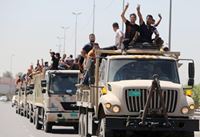
Recent events in Iraq are liable to give new impetus to the ideas and the path that ISIS represents, which are shared by many terrorist organizations operating in the Middle East and beyond. Its strong economic capacity could be exploited to support and acquire influence over the operations of terrorist organizations that share its ideas. In addition, enormous quantities of high quality weapons, many of them Western, have fallen into ISIS hands, and they will certainly find their way to terrorist organizations operating in combat zones in the Middle East and even beyond. Like many other countries in the world, Israel is watching the development of the battle in Iraq with great interest. While it appears that at this stage there is no immediate threat to Israel’s security from the events in Iraq, the resulting atmosphere could strengthen global jihadi elements operating in countries near Israel.
Since the announcement that the Iraqi city of Mosul fell to the Islamic State of Iraq and al-Sham (ISIS), the media has abounded with apocalyptic scenarios whereby all of Iraq falls into the group’s hands. According to media reports, the organization will soon conquer Baghdad and thus complete its takeover of the entire country. It has also been reported that Jordan, Kuwait, and other Gulf states are anxious about facing a similar fate at the hands of this powerful organization, as if it were an emerging superpower. Yet while given its local accomplishments and its murderous actions the threat posed by ISIS is not to be dismissed, its achievements and its strength must be evaluated in a wider context.
An important initial point concerns the group’s affiliation with al-Qaeda, mentioned frequently in the media. ISIS is indeed part of the global jihad movement, which seeks to establish a Taliban-style caliphate under Islamic law in the Levant region. However, the serious conflict between ISIS leader Abu Bakr al-Baghdadi and al-Qaeda leader Ayman al-Zawahiri has resulted in the group’s expulsion from the alliance established by al-Qaeda and several of its main affiliates. Therefore, the widespread use of the term “al-Qaeda forces in Iraq” does not suit the situation, and it certainly enhances the reputation of al-Qaeda unjustifiably, whose strength is glorified to an unwarranted degree.
Furthermore, ISIS victories in Iraq result more from Shiite Prime Minister al-Maliki’s lack of public legitimacy, the weakness of the Iraqi army, and the failed leadership of its commanders, than from unprecedented military power and talent. Until recently, a considerable portion of the group’s operations in western Iraq involved hit-and-run raids, token demonstrations of a military presence in places it had conquered, and demonstrative military parades. ISIS succeeded in hanging its flags primarily in areas that evinced a lack of interest and resistance by the local populace, which sometimes even assisted the group because of their repudiation of al-Maliki, perceived as a corrupt tyrant who blatantly discriminates against Sunnis. This resentment concerning the Shiite regime has led residents of the areas conquered in western Iraq to perceive ISIS, at least thus far, as the lesser of all evils. The inevitable confrontation between the organization and the local population once it attempts to impose its rigid, extremist Islamic way of life on the residents - as it did previously in Iraq and in the past year in Syria - is postponed to the future.
The arrogance displayed by ISIS and the media circus surrounding it far exceed what warranted by its size. First, the numbers floated in the media about the exact number of troops available to the organization in Iraq are not necessarily credible. However, even if we take them seriously, the estimate does not exceed some 10,000 men, some of them foreign volunteers. It is clear that this is not sufficient to capture and manage Iraq’s capital, Baghdad, which the al-Maliki government has a fundamental interest to protect as part of the defense of the integrity of Iraq. Furthermore, in practice, ISIS lacks the ability to fully control and manage the other regions it has conquered in Iraq, and even more to force the residents of these areas to accept the government under the fundamentalist Islamic law to which it aspires. In Syria, too, the organization is far from controlling large parts of the country, and it is mainly making do with control of the Raqqah region and parts of Deir ez-Zor.
The concern in the countries bordering Iraq, mainly Iran, Turkey, and Jordan, can be expected to pose an obstacle to continued ISIS success. Thus if ISIS nevertheless continues to surprise and achieve significant territorial gains in Baghdad and become a direct threat to its neighbors’ national security, it will encounter resistance in the region and probably US intervention, even if limited because the United States fears additional entanglement in the investment involved in a massive military presence in Iraq. Iran would certainly mobilize to aid the Shiite al-Maliki government, which it considers its ally, in order to maintain its influence over the Iraqi regime. It will also use force to prevent the danger of a hostile Sunni, jihadi Islamic regime on its borders. Presumably Turkey will not sit idly by either if such an extreme scenario is close to being fulfilled.
Nonetheless, the danger posed by recent events in Iraq is that they are liable to give new impetus to the ideas and the path that ISIS represents, which are shared by many terrorist organizations operating in the Middle East and beyond. The main danger comes from the enormous economic capital the organization accumulated in Iraq when it took over the banks in areas abandoned by the Iraqi army - and which the local police failed to protect. In addition, the group boasts considerable income from its takeover of the oil and energy reserves. This strong economic capacity could be exploited to support and acquire influence over the operations of terrorist organizations that share its ideas. In addition, enormous quantities of high quality weapons, many of them Western, have fallen into ISIS hands, and they will certainly find their way to terrorist organizations operating in combat zones in the Middle East and even beyond.
Like many other countries in the world, Israel is watching the development of the battle in Iraq with great interest. It will need to increase its intelligence focus on ISIS and its ties to organizations operating along Israel’s borders in order to prevent the deterioration the group is liable to ignite. At this stage, while it appears that there is no immediate and direct threat to Israel’s security from the events in Iraq, the resulting atmosphere could strengthen global jihadi elements operating in countries near Israel. Indeed, from Syria, it appears that the potential threat to Israel is actually from Jabhat al-Nusra, which is present, alongside members of the Islamic Front, in the Syrian Golan Heights and on the border with Jordan. Thus far, these organizations have not turned their weapons against Israel, and they cannot be directly linked to most of the incidents of sporadic firing and sabotage carried out against Israel from the Syrian side of the border. However, the potential for escalation in this sector exists. The ideological and rhetorical approach of ISIS, Jabhat al-Nusra, and al-Qaeda, which have publicly declared their intention to attack Israel, strengthens the assessment that in the future, these groups will attempt to carry out their threats. Indeed, ISIS was tied to certain foiled terrorist: a group with operatives from East Jerusalem and Jenin planned, with supervision from Gaza and guidance from Pakistan, to join ISIS operatives in Syria and carry out suicide attacks in Jerusalem and Tel Aviv. It is not clear whether this indicates a trend toward infiltration of Israeli territory by ISIS or whether it was an isolated attempt. In any case, the self-confidence the organization has gained from its achievements in Iraq and Syria and the tremendous capital at its disposal, which has made it quite wealthy, cannot help it conquer Iraq. However, they are most likely to spur the group to exploit these resources to expand its operations to other arenas, including Israel, and even to help fund the operations of its ideological affiliates.
The opinions expressed in INSS publications are the authors’ alone.
Publication Series INSS Insight