


The Next Battle for Artificial Intelligence: Should Israel Become a Chip Manufacturing Powerhouse?
Shutterstock
Shutterstock
Policy Paper, July 29, 2026
Hadas Lorber
Executive Summary
The global race for artificial intelligence is fundamentally reshaping how states perceive technological infrastructure. While competition in recent decades revolved around control over data, digital platforms, and AI models, it has become clear that a nation’s strategic advantage will now largely be determined by its control over the physical AI value chain—spanning critical minerals, advanced chip manufacturing, high-performance computing (Compute) infrastructure, data centers, energy, and frontier models. The competition is no longer over a single component of the AI system, but over the ability to hold significant stakes across the entire AI Stack.
This evolution is also driving a shift in U.S. policy. The CHIPS and Science Act marked the beginning of an effort to reshore semiconductor manufacturing capabilities to the United States and its allies. In recent years, however, this approach has expanded into a broader concept of geographic supply chain diversification. The Pax Silica initiative led by the United States reflects a pivot from a strict focus on export controls and restricting access to advanced technologies toward building a global “Trusted AI Ecosystem” of reliable partners capable of ensuring operational continuity, geopolitical strength, and production capacity during times of crisis.
Against this backdrop, Israel’s position on the global chip manufacturing map warrants re-examination. To date, Israel has been viewed as a global powerhouse in chip design, but there has been virtually no strategic debate on whether it should also become an advanced chip manufacturing hub. This paper examines whether geopolitical shifts necessitate a new strategy for Israel—one aimed at deeper integration into the semiconductor manufacturing supply chain. Within this framework, establishing an advanced fabrication facility (fab) in Israel is analyzed as a potential strategic alternative.
Israel’s advantage extends beyond a high-quality talent pool and a mature innovation ecosystem—traits shared by other nations. Its uniqueness lies in the extraordinary density of all components of the AI value chain within a small geographic footprint: R&D centers for NVIDIA and other leading chipmakers, a world-class chip design ecosystem, an academic research community, a booming startup sector, cyber and defense capabilities, unprecedented investments in AI infrastructure and the national supercomputer, alongside close government-industry collaboration. This combination positions Israel as one of the few nations capable not only of developing technology, but also hosting significant portions of the global value chain.
From the U.S. perspective, integrating Israel into the Pax Silica chip production network could enhance the resilience of Western supply chains, reduce dependence on a single geographic concentration in East Asia, and add a vital new dimension to the U.S.-Israel strategic partnership. For Israel, this represents an opportunity to transition from an “innovation powerhouse” into an “infrastructure powerhouse,” securing long-term access to advanced chips, deepening its integration into the global AI ecosystem, and establishing a strategic asset of profound economic, defense, and geopolitical significance for decades to come.
However, constructing an advanced fab does not, by itself, guarantee access to chips in times of crisis. Achieving this requires complementary mechanisms, including capacity agreements, priority access rights, strategic inventories, intergovernmental partnerships, and supply source diversification, alongside addressing the significant economic, infrastructural, and defense challenges involved.
Ultimately, if Israel successfully integrates into the chip manufacturing layer, it will become one of the very few countries in the world holding a comparative advantage across multiple core links of the AI value chain. In such a position, Israel would no longer be merely a consumer of infrastructure or a source of innovation, but a strategic player in the underlying infrastructure upon which the global economy rests.
Background: The AI Revolution Is Reshaping Chip Geopolitics
Artificial intelligence is rapidly altering how states perceive power and define strategic assets. While over the past few decades the discussion primarily centered around access to data, algorithm development, or building advanced models, it has become clear today that a nation’s competitive advantage increasingly rests on the physical manufacturing infrastructure of AI. Advanced chips, High Performance Computing (HPC) capabilities, energy, data centers, and communication networks have all become interconnected components of a single strategic architecture. Controlling this system will determine a country’s standing in the global economy and international arena for decades to come.
This shift reflects a fundamental transition from Global Value Chains, which focused on maximizing economic efficiency through the geographic dispersion of manufacturing stages, to Trusted Value Chains, where considerations of national security, geopolitical influence, and operational continuity are just as critical as economic cost. The COVID-19 pandemic, the global chip shortage, the war in Ukraine, tensions surrounding Taiwan, and the escalating AI race between the United States and China have all demonstrated that concentrating critical capabilities within a single country or region creates an unacceptable strategic vulnerability.
In this sense, chips have become the geopolitical equivalent of oil in the previous century. Just as countries historically invested in building strategic energy reserves, securing maritime shipping routes, and diversifying fuel supply sources, they are now acting to secure uninterrupted access to compute capacity and advanced chips. Unlike natural resources, however, manufacturing advanced chips depends on an exceptionally complex matrix of knowledge, equipment, human capital, capital investment, and infrastructure—one that only a select handful of nations can assemble.
At the center of this ecosystem stands TSMC, which manufactures the majority of the world’s most advanced chips and serves as the primary supplier for companies such as NVIDIA, Apple, AMD, Qualcomm, Broadcom, and others. For years, concentrating such immense capability in a few production sites in Taiwan was viewed as the ultimate expression of the economic efficiency of geographic specialization. Today, however, that same concentration is considered one of the most critical strategic risks facing the global AI economy. Any disruption to TSMC’s manufacturing capacity—whether caused by a security conflict, natural disaster, cyberattack, or escalation in the Taiwan Strait—could directly impact the development of AI models, technology industry supply chains, and the strategic advantage of the United States.
Against this backdrop, the United States has been spearheading a new vision in recent years: controlled geographic diversification of the chip value chain. Massive investments in Arizona, the expansion of TSMC operations into Japan and Germany, and the policy framework of the CHIPS and Science Act are not merely attempts to bring back manufacturing jobs or boost domestic production. They are designed, first and foremost, to mitigate the single-country concentration risk and establish a resilient global network of production hubs located in trusted, stable, and allied nations.
Yet even these measures fall short of fully addressing the challenge brought about by the rise of artificial intelligence. Unlike previous generations of chips, advanced AI chips evolve on exceptionally short timelines, and the gap between the design phase and the manufacturing phase is rapidly narrowing. Any incremental optimization in the manufacturing process, yield improvement, or interaction between development teams and production lines can generate hundreds of millions of dollars in economic value per year. Consequently, geographic proximity between chip design centers and manufacturing plants is shifting from a merely operational factor into a strategic factor.
It is precisely at this juncture that the question regarding Israel comes into sharp focus. For decades, Israel established its standing as a global powerhouse in chip design while almost entirely refraining from investing in advanced manufacturing facilities. However, in a reality where a nation’s competitive advantage is increasingly determined by its command over the AI value chain, it is time to reevaluate whether this model still serves Israel’s national interests, or if the time has come to integrate manufacturing capability as a core component of its national strategy for the AI era.
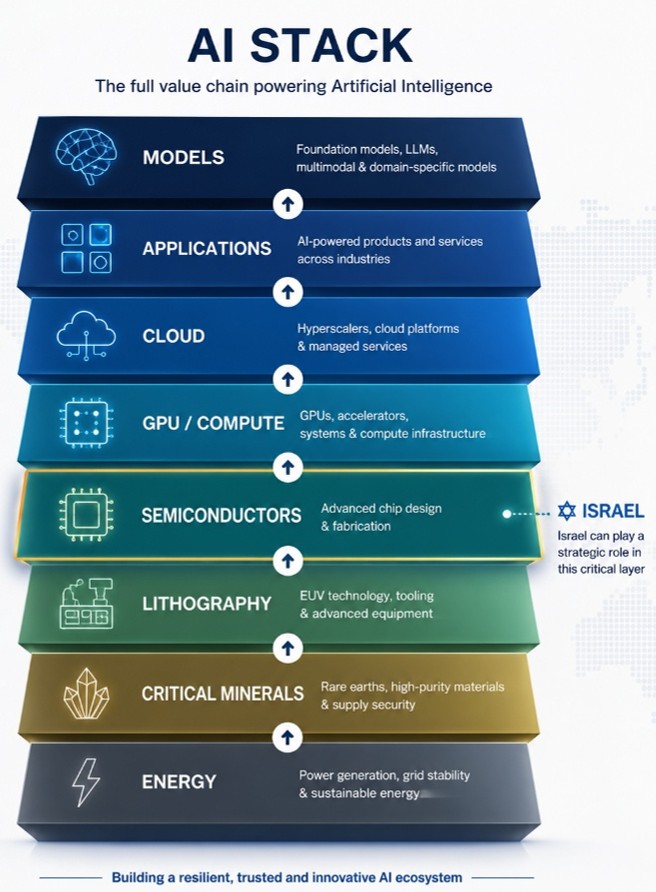
Israel as a Strategic Junction in the AI Value Chain
The debate over where to locate advanced chip manufacturing plants typically revolves around three core variables: cost, government incentives, and access to target markets. In the age of AI, however, these variables are no longer sufficient. As development cycles shorten, engineering complexity increases, and the transition between design, manufacturing, and optimization becomes more seamless, a fourth variable—one often underweighted—takes center stage: the technological ecosystem within which the manufacturing plant operates.
In this regard, Israel offers a rare convergence of capabilities found in almost no other country. For three decades, Israel has solidified its standing as a global powerhouse in chip design. R&D centers for NVIDIA, Intel, Apple, Amazon, Google, Qualcomm, Marvell, Broadcom, and others operate in Israel, employing tens of thousands of engineers. Indeed, a significant share of the architectures and technologies underlying today’s AI industry were developed, and continue to be developed, in Israel. NVIDIA’s acquisition of Mellanox turned Israel into one of the company’s most critical development hubs outside the United States, occurring precisely as NVIDIA became TSMC’s largest client for AI chips.
This point fundamentally changes the way the location of an advanced manufacturing fab must be examined. In contrast to previous generations of the semiconductor industry, where it was possible to separate the design phase from the manufacturing phase through a global supply chain, advanced AI chips require continuous interaction among design teams, production teams, and validation teams. Every small improvement in yield translates into immense economic value. In the industry, it is widely estimated that an improvement of just a few percent in the manufacturing process can generate additional revenues of hundreds of millions of dollars a year and, in a fab producing bleeding-edge chips over a lifespan of 15–20 years, this amounts to a cumulative value of billions of dollars. Therefore, physical proximity between development engineers and production lines is not merely a question of operational convenience; it becomes a factor of business and strategic significance.
From this perspective, Israel enjoys a unique comparative advantage. Its compact territory allows for nearly continuous interaction among design centers, research institutions, developing companies, and manufacturing facilities. Instead of dispersing the value chain across multiple countries or time zones, it is possible to concentrate chip design, integration, testing, validation, and a significant portion of manufacturing within the same geographical space, thereby significantly shortening development cycles and accelerating the pace of innovation.
Another key advantage lies in the fact that Israel is not starting from scratch when it comes to AI infrastructure. In recent years, major pillars of a national AI ecosystem have taken shape in Israel: the national supercomputer, private investments in GPU infrastructure, advanced research centers, world-class AI companies, and a startup scene widely considered one of the most innovative globally. At the same time, collaboration between the government and the private sector—particularly through the Israel Innovation Authority—has established a distinct model of public-private partnership, where the state does not replace the market, but rather serves as a catalyst for building national infrastructure. This model is well-suited for an advanced chip fabrication plant, which demands massive capital investments alongside regulatory certainty and long-term planning.
The implication is that Israel does not merely offer land for a new fab; it offers an entire ecosystem of innovation where all links in the AI value chain—from chip design to high-performance computing, from cloud infrastructure to applications—already exist today. In a world where nations are actively seeking to diversify risk and build reliable manufacturing hubs outside East Asia, such a combination could transform Israel into much more than just another production site: it could become a central junction in the global AI value chain.
Technological independence does not require executing every single link of the value chain inside Israel. The semiconductor industry is inherently global, and today virtually no single country possesses total self-sufficiency across every stage—from design, equipment, and raw materials, to manufacturing, packaging, and testing. Therefore, the realistic goal for Israel is not technological autarky, but rather selective strategic autonomy: cultivating independent capabilities in a targeted set of critical links where Israel holds a comparative advantage or a national security imperative, while simultaneously forging partnerships and long-term agreements to secure access to components, equipment, knowledge, and manufacturing capacity that do not exist domestically. This approach balances strengthening national resilience with deep integration into global value chains.
Pax Silica and the Transition from a Supply Chain to a Strategic Value Chain
The Pax Silica initiative, which began as a framework for cooperation between the United States and its allies in the field of AI infrastructure, reflects a profound shift in how Washington perceives its technological competition with China. While over the past decade U.S. policy focused primarily on restricting adversaries’ access to advanced technologies—through export controls, sanctions, and limits on technology transfer—a far broader approach is emerging today. This new strategy seeks to build a Trusted AI Ecosystem among reliable nations that will distribute the components of the AI value chain among themselves, ensuring operational continuity even in crisis scenarios.
The expansion of Pax Silica to nations beyond the traditional technological partners of the United States demonstrates that the primary criterion is no longer merely a country’s level of technological development, but its potential contribution to the future AI value chain. Thus, alongside world leaders in research and technology, countries possessing other strategic assets—such as critical minerals, energy infrastructure, geographic positioning, manufacturing capacity, or access to regional markets—are also joining the fold. In other words, Pax Silica does not require every country to execute every stage of production, but rather that each provides the component where its comparative advantage is highest.
From this perspective, the relevant question is not whether Israel can compete with the United States or Taiwan, but rather what unique role it can fulfill within such an ecosystem. Over the years, Israel has established itself as a global hub for chip design, research, algorithms, and AI systems development. However, the pivot toward the AI Stack framework raises the distinct possibility that Israel could also become a significant link in the manufacturing phase of advanced chips, thereby closing one of the primary remaining gaps in its local ecosystem.
A systemic view of Pax Silica may lead to a new division of labor among the partners. The United States will continue to lead scientific innovation, architectures, and technological strategy; Israel will serve as a hub for advanced chip design and manufacturing and for the development of critical AI components; the Gulf states will contribute their advantage in energy, land, and the establishment of large-scale server farms, while additional countries will complete the chain through raw materials, logistical infrastructure, and complementary manufacturing capabilities. Such a model creates a distributed system in which each of the partners strengthens its comparative advantages, while also reducing the risk stemming from dependence on a single manufacturing site or a single country.
In this context, an advanced TSMC fab in Israel should not be viewed merely as a local industrial project, but as part of a broader architecture for Western technological security. Just as the United States has dispersed its defense industries across various partner states over decades, the advanced chip industry today requires a controlled distribution—one grounded in allied nations with stable institutions, high-caliber human capital, and the capacity to protect critical infrastructure.
From an Israeli point of view, integrating into such a process could fundamentally transform the country’s standing. Israel will no longer be merely the “Start-Up Nation,” supplying innovation to international companies, but will become one of the central nodes of the global artificial intelligence supply chain. The significance is not solely economic. Countries that hold critical links in the value chain also enjoy a different political standing, a broader capacity to influence the shaping of the rules of the game, and higher resilience against geopolitical shocks.
In this context, one can even consider expanding the concept of the Strategic Compute Reserve, which has begun to appear in American discourse around AI infrastructure. Similar to strategic reserves of oil or critical minerals, one can imagine a mechanism in which a portion of advanced chip production lines or a portion of manufacturing output would be allocated in advance for emergency use by the United States and its partners. Beyond a more stable access to advanced stages during a crisis, such an arrangement would also grant Israel a new role in the West’s technological resilience framework.
This approach aligns seamlessly with the overarching logic of Pax Silica: building a decentralized, trusted, and flexible ecosystem in which each partner state not only reaps the benefits of innovation, but also holds a strategic asset upon which the entire system relies. For Israel, this represents a transition from a state that merely integrates into the AI value chain to one that actively helps shape it.
Strategic Alternatives for Israel’s Integration into the AI Value Chain
The debate over Israel’s place in the AI value chain should not be reduced to a question of whether it is possible or desirable to establish an advanced chip fab in Israel. The semiconductor industry consists of numerous links—design, manufacturing equipment, raw materials, fabrication, packaging, testing, integration, and deployment of chips into computing systems—and virtually no single country maintains complete independence across all of them. Israel must therefore evaluate a portfolio of strategic alternatives that would allow it to strengthen its security of supply, maximize its comparative advantages, and deepen its integration into the technological ecosystem of the United States and its allies.
The choice among the alternatives is not necessarily binary. It is possible that the appropriate strategy for Israel will be a combination of independent capabilities in several critical areas, investment in links where Israel possesses a comparative advantage, and reliance on international partnerships with respect to components for which establishing full local capacity is neither worthwhile nor feasible. Therefore, each alternative must be examined according to its contribution to security of supply, technological advantage, national resilience, and the ability to operate in times of crisis.
Establishing an Advanced Fabrication Facility in Israel
The most ambitious alternative is establishing a leading-edge fab in Israel, operated by TSMC or another global semiconductor manufacturer. A fab of this caliber could bridge the primary gap in the Israeli ecosystem—which currently relies predominantly on design and development—and create a direct connection between the design centers of leading technology companies and the manufacturing lines themselves.
The main advantage of this option is that it would transform Israel into a significant link in the supply chain for advanced AI chips. It could shorten development cycles, foster tighter collaboration between design and manufacturing engineers, attract additional operations from multinational corporations, and elevate Israel’s strategic standing relative to the United States and its allies.
However, this is an exceptionally expensive and complex alternative. It requires investments of tens of billions of dollars, large-scale power and water infrastructure, dedicated personnel, a long-term regulatory framework, and significant defense for a facility that will become a strategic asset and a potential target for attack. Furthermore, the mere location of a fab in Israel does not guarantee that its output will be available to the state during an emergency. To that end, explicit contractual and intergovernmental arrangements would be required, including capacity allocation, rights of first refusal, and the regulation of priorities.
Manufacturing Mature or Specialized Technologies
A second alternative is to expand in Israel manufacturing capabilities for chips that are not necessarily at the technological bleeding edge, but are essential for defense, industrial, and civilian systems. This category includes analog chips, communications components, sensors, chips for the automotive industry, power components, photonic chips, and components resistant to radiation, heat, and extreme environmental conditions.
The advantage of this route is that it directly aligns with Israel’s immediate national needs. Defense systems do not always require the smallest or most advanced chips; rather, they demand reliable, secure components with long lifecycles that can be produced consistently over many years. Establishing domestic capacity in these domains could reduce reliance on foreign suppliers, mitigate the risks of production lines being discontinued, and enhance the operational continuity of the defense industry.
In addition, the construction and operation costs of facilities utilizing mature technologies are relatively low compared to a fab at the bleeding edge of technology, and the competition for them may be more moderate. This alternative can also build upon capabilities that already exist in Israel and expand them gradually, rather than establishing a new industry almost from scratch.
Specialization in Advanced Packaging and Chiplets
A third alternative is to turn Israel into a leading hub in the field of advanced packaging, integration, and chiplets. As the ability to continue shrinking transistors becomes more expensive and complex, the chip industry is gradually shifting toward architectures based on combining multiple dedicated components in a single package. Fields including advanced packaging, interconnection between computing and memory chips, 3D integration, testing, validation, and thermal management are becoming critical links in the performance of AI
Israel holds compelling potential advantages in this arena, driven by its combined expertise in chip design, systems engineering, high-speed interconnects, photonics, thermal management, testing, and cybersecurity. The barriers to entry are significantly lower than those for building a leading-edge fab, while the technological and strategic value continues to expand.
Specialization in advanced packaging may allow Israel to hold a critical link in the value chain without bearing the full costs of manufacturing at the bleeding edge of technology. It may also create a direct affinity between the local design industry and global manufacturers, and position Israel in a field where the distinction between design, manufacturing, and integration is increasingly blurring.
Expanding the Existing Advantage in Chip Design
A fourth alternative is to deepen Israel’s existing advantage in chip design, rather than attempting to replicate manufacturing capabilities that already exist elsewhere. Today, Israel is one of the world’s leading centers for processor architectures, connectivity technologies, high-speed communications, hardware security, AI accelerators, memory technologies, and photonics.
A targeted national strategy could reinforce focus areas such as EDA (Electronic Design Automation) tools, chiplet-based architectures, specialized accelerators, energy-efficient chips, advanced memory systems, integrated photonics, and inter-accelerator communication components. This can be accomplished through investments in R&D, establishing shared design infrastructure, expanding access to costly software tools, subsidizing tape-outs for early-stage startups, and strengthening collaborative ties between academia, industry, and the defense establishment.
The key advantage of this option is that it builds on an asset Israel already possesses. Rather than competing against countries with decades of lead time in mass manufacturing, Israel can double down where its relative contribution is highest. However, expanding design capabilities alone does not resolve the challenge of manufacturing access. Consequently, this alternative would need to be complemented by supply agreements, access to fabrication facilities, and priority mechanisms for times of crisis.
Securing Access Through Strategic Partnerships and Supply Agreements
A fifth alternative focuses not on establishing full onshore manufacturing capacity, but on securing reliable access to fabrication capacity in partner countries. Under this framework, Israel could pursue agreements with the United States, Taiwan, Japan, South Korea, and European nations, encompassing capacity allocations, supply commitments, emergency priority access, and participation in joint manufacturing programs.
Such agreements can include Capacity Reservation mechanisms, advance payment for future capacity, long-term Offtake contracts, a right of priority to purchase critical chips, and quota allocations for defense and national industries. It is also possible to examine establishing strategic inventories of critical components, substrates, memories, and communications components, alongside arrangements for the continued manufacturing of dedicated chips over time.
The advantage of this alternative is that it may provide security of supply at a significantly lower cost than establishing an advanced fab in Israel. It also reflects the global nature of the chip industry, in which complete independence is not a realistic goal. However, agreements of this type depend on the reliability of the partnership, political stability, and the willingness of private companies and foreign governments to honor commitments during a crisis. For this reason, preference should be given to intergovernmental agreements with clear execution mechanisms, rather than settling for general commercial understandings.
A Regional Model for Division of Labor
A sixth alternative is developing a regional model based on a strategic division of labor between Israel and additional countries, particularly the Gulf states. Under this framework, Israel would focus on its comparative advantages—chip design, R&D, cybersecurity, testing, validation, advanced packaging, and systems integration—while partner nations would contribute abundant energy, land, capital, computing infrastructure, and the capacity to build mega-scale facilities.
Such a model could leverage the framework of the Abraham Accords and tap into shared interests in building a regional AI ecosystem. It could feature design and R&D centers in Israel, regional packaging and testing facilities, data centers in countries with competitive energy advantages, and coordinated procurement or manufacturing agreements with Asian and American partners.
The benefit of this model is that it allows each country to specialize where its comparative advantage is highest, creating a complementary regional matrix. It could also strengthen diplomatic ties and forge a shared interest in safeguarding critical technological infrastructure. At the same time, such an approach would require a high degree of mutual trust, formal frameworks governing technology transfer, effective intellectual property protection mechanisms, and careful navigation of U.S. export controls on advanced technologies.
Between Independent Capability and Comparative Advantage
The totality of alternatives demonstrates that the strategic question is not whether Israel should achieve complete independence in chip manufacturing, but in which links it must hold independent capability, in which areas it should maximize its comparative advantage, and for which components it can rely on international partnerships.
Regarding critical defense components, chips with a long life cycle, and capabilities essential for operational continuity, domestic capability or direct control over manufacturing capacity may be required. In areas where the cost of establishment is particularly high and the Israeli advantage is limited, it is possible to rely on supplier diversification, supply agreements, and priority mechanisms. In areas where Israel already possesses a distinct advantage—design, connectivity, photonics, cyber, packaging, and integration—it is correct to deepen investment and transform existing advantages into strategic assets.
Therefore, the desirable policy is not selecting a single solution, but rather building a tiered approach: strengthening design and packaging capabilities, expanding dedicated manufacturing for critical needs, creating access and capacity agreements with partners, and concurrently conducting an in-depth economic and security examination of the possibility of establishing an advanced manufacturing fab in Israel in the future. Such an approach will allow Israel to increase its security of supply without attempting to replicate the entire value chain within its borders, and establish a significant standing in a global system relying on specialization, trust, and controlled interdependence.
How Can Access to Advanced Chips Actually Be Guaranteed in Practice?
One of the central issues in any national semiconductor strategy is the distinction between the presence of manufacturing capability within a country’s territory and effective control over access to its output. Establishing a foreign company’s fab in Israel may contribute to employment, innovation, knowledge transfer, and the country’s strategic standing, but it does not in itself guarantee that, in times of emergency, the chips produced in it will be at the disposal of the Israeli government, the defense establishment, or essential industries.
A private chip company operates within a complex web of obligations. It is bound by long-term contracts with global customers, regulatory constraints, export controls, agreements with its home country, and commercial considerations regarding profitability, reputation, and supply continuity. Therefore, even if an advanced fab were established in Israel, a significant portion of its output might be committed in advance to foreign commercial customers, and could not be diverted to meet Israeli needs without a clear legal, contractual, and diplomatic framework.
In other words, hosting a foreign-owned fab in Israel is not equivalent to sovereignty over its output. Without contractual, regulatory, and intergovernmental mechanisms, it might continue to serve global customers first and foremost in accordance with existing agreements. For this reason, any move to establish manufacturing capability in Israel must be accompanied from the outset by a framework that will guarantee not only the existence of the fab, but also Israel’s access to its output in situations of shortage, crisis, or conflict.
Potential Mechanisms for Guaranteeing Access
- Contractual Priority Rights in Times of Emergency
Contracts with the manufacturer could grant priority access to the State of Israel, the defense establishment, or designated critical industries in the event of a global supply disruption, severe shortage, or national emergency. Such rights should be clearly defined in advance, including the conditions under which they may be invoked, the share of production capacity to be allocated, pricing mechanisms, and their relationship to existing commitments to other customers.
- Designated Allocation of Manufacturing Capacity for National Needs
As a condition for receiving government grants, tax incentives, infrastructure support, or state guarantees, manufacturers could be required to reserve a specified portion of their production capacity for Israeli needs. This allocation could be permanent or activated only during emergencies. The principal advantage is the certainty it provides in advance; its drawback is the economic cost of maintaining production capacity that may remain underutilized during routine times.
- Capacity Reservation
Within the framework of this mechanism, the state or Israeli corporations pay in advance for reserving future manufacturing capacity. The payment is not necessarily for chips that have already been ordered, but for the right to utilize defined manufacturing capacity during a specific period. In this way, availability can be ensured even when demand exceeds supply. This mechanism is particularly suitable for critical chips, for which manufacturing lead times might be long.
- Long-Term Offtake Agreements
Israel can promote long-term procurement agreements between chip manufacturers and defense industries, infrastructure companies, and government entities. These agreements grant the manufacturer demand certainty and the customer supply certainty. They can incorporate commitments to minimum quantities, price ranges, adaptation of products to Israeli needs, and the continued manufacturing of long-lifecycle components.
- Strategic Inventory of Critical Components
Not every supply challenge requires local manufacturing capability. For certain components, it is possible to establish a national inventory of chips, substrates, memories, communications components, and complementary materials. Such an inventory should focus on components that lack readily available replacements, have long lead times, and are critical for defense, healthcare, energy, transportation, and communications systems. Its management requires an ongoing refreshment mechanism, as some of the components become obsolete rather quickly.
- State Rights in Exchange for Public Support
When the state grants significant subsidies, land, infrastructure, tax benefits, or guarantees, it is possible to consider receiving special rights in return. These rights may include an observer seat, a limited veto right in decisions regarding the closure of production lines, the transfer of activity, the sale of strategic assets, or altering the fab’s intended purpose. In certain cases, a Golden Share-like mechanism can be examined, subject to local law, international obligations, and the willingness of the company and the partner country. However, such mechanisms should be narrow and precise. Excessively broad intervention in the company’s management might deter investors, impair the fab’s competitiveness, and create conflicts with foreign shareholders and regulators.
- Intergovernmental Agreement with the United States
Due to the centrality of the United States in the chip value chain, a commercial arrangement alone may not suffice. Israel can work toward an intergovernmental agreement that will grant it the status of a preferred partner in the Western supply chain. Such an agreement can include priority in joint manufacturing programs, participation in allocation mechanisms during a crisis, access to production lines supported by the United States government, and the integration of Israel into emergency supply chain planning. Such an agreement may be particularly significant when the manufacturer or the fab is subject to conditions arising from American subsidies, export controls, or national security policy. It may also reduce the risk that private commercial obligations will override Israel’s strategic needs.
- Regulation of Defense Supply and Prioritization in Advance
It must be defined in advance which systems and components will be considered critical during an emergency, who is authorized to activate the priority mechanism, and what the order of priority is among the defense establishment, national infrastructure, the healthcare system, and civilian industry. Without such regulation, even when available output exists, delays, disputes, and bureaucratic encumbrance may arise precisely when a rapid response is required. Concurrently, it is necessary to examine which components can be manufactured on conventional civilian production lines and which require secured production lines, physical separation, personnel vetting, and heightened protection of intellectual property.
- Supplier Diversification and Geographic Diversity
One of the most important principles is avoiding the replacement of one dependency with another. Even an advanced fab in Israel should not become the country’s sole source. A chip access policy should rely on multiple manufacturers, multiple countries, different technologies, and alternative production lines. As much as possible, the option to transfer production between fabs should be planned in advance, avoiding the design of components dependent on a single manufacturing process that has no alternative. Such diversification may include manufacturing in Israel alongside agreements with fabs in the United States, Europe, Japan, Taiwan, and South Korea. It can also include designing chips in such a way that they can be manufactured in more than one Fab, even at the cost of a certain compromise in performance.
Transitioning from Industrial Presence to Security of Supply
The strategic question is not simply whether a fab will be established in Israel, but what rights Israel possesses to access its output, under what circumstances, and according to what order of priority. Consequently, the government must explicitly tie any public funding or support to measurable, unambiguous frameworks: the precise volume of reserved capacity, the duration of commitments, emergency activation protocols, mandatory reporting requirements, dispute resolution mechanisms, and enforceable sanctions for non-compliance.
In addition, a distinction must be made between different types of chips. Regarding defense chips, communications components, sensors, and components for critical infrastructure, more direct control over capacity, inventory, or the manufacturing process may be required. Regarding bleeding-edge AI accelerators, the more effective answer may be a combination of capacity agreements, partnership with the United States, and supplier diversification, rather than an attempt to maintain full independence.
Therefore, security of supply does not stem from the mere existence of a fab in Israeli territory, but from a combination of manufacturing capability, contractual rights, intergovernmental partnerships, strategic inventories, and source diversification. Only such a combination can ensure that a large-scale industrial investment will also become an asset of national resilience and not remain primarily a global commercial enterprise located in Israel.
Is an Advanced TSMC Manufacturing Fab in Israel a Feasible Strategic Move?
Despite the growing strategic logic in diversifying the semiconductor value chain, it must be acknowledged that establishing an advanced TSMC manufacturing fab in Israel is not a self-evident move. For decades, the Taiwanese government has consistently refrained from transferring its most advanced manufacturing capabilities outside the island, based on the perception that the concentration of the semiconductor industry constitutes a central component of Taiwan’s national security and strategic standing in the international arena. This approach, often dubbed the “Silicon Shield,” relied on the assumption that the dependence of the world’s leading economies on chips manufactured in Taiwan increases their willingness to defend the island in the event of a conflict with China.
However, in recent years, a significant change has occurred in this policy. Under American pressure and with the aim of reducing the risk of concentrating chip manufacturing in a single country, TSMC has begun establishing manufacturing fabs in Arizona, in Kumamoto, Japan, and in Dresden, Germany. Although these fabs do not constitute a full substitute for the manufacturing capabilities in Taiwan, their very establishment indicates that Taiwan itself recognizes that geopolitical reality requires a certain degree of decentralization of manufacturing capabilities, particularly when it comes to allies of the United States.
The relevant question, therefore, is not whether TSMC will leave Taiwan—a scenario that is currently not on the table—but whether the decentralization process will continue in the coming years and whether Israel might become one of the possible destinations for its expansion. In this context, Israel offers a unique combination of advantages that is difficult to find in other countries.
First, Israel is one of the few countries with such a high concentration of advanced chip design activity. For TSMC, proximity to its largest customers is not only a commercial consideration, but also an engineering one. In a world where development cycles for AI chips are shortening, continuous collaboration between design teams and production lines becomes a significant component in improving yield, shortening development times, and reducing costs. In this context, the concentration in Israel of NVIDIA’s development centers alongside extensive activity by additional companies may transform geographical proximity itself into an economic asset.
Second, Israel enjoys one of the densest innovation ecosystems in the world. Unlike countries where development, research, manufacturing, and computing activities are dispersed across different regions, in Israel it is possible to maintain daily interaction among all players in the value chain—from academia, through design companies, to operators of AI infrastructure. This advantage is expected to strengthen as high-performance Computing Clusters become an integral part of the development process of advanced chips, requiring tight integration between manufacturing and the development and testing environment.
Third, establishing such a fab could integrate into a broader trend of strengthening regional cooperation within the framework of the ‘Abraham Accords.’ At a time when the Gulf states are investing unprecedented resources in establishing server farms, energy infrastructure, and AI centers, Israel could offer the manufacturing and development component of the value chain. Such a model does not require all system components to be concentrated in a single country, but rather is based on a division of labor between strategic partners, where each specializes in the field in which its comparative advantage is highest.
However, the challenges cannot be ignored. Establishing an advanced manufacturing fab at the scale of two nanometers and even less requires tens of billions of dollars in investments, a stable supply of electricity in exceptional volumes, water infrastructure, dedicated human resources, and a supportive regulatory framework over many years. In addition, Israel’s security environment will almost certainly stand at the center of any such discussion. Missiles, cyberattacks, and regional threats will be presented as significant counterarguments by international actors.
Yet, in this context as well, a broader view is required. First, none of the existing alternatives are risk-free. Taiwan faces a growing military threat from China; Japan is exposed to earthquakes and regional tension; in Europe there is concern regarding geopolitical instability from the direction of Russia (where its infrastructure lacks an effective defense strategy), and Arizona faces water and energy constraints. Second, Israel possesses one of the most advanced multi-layered defense systems in the world and extensive cumulative experience in protecting critical infrastructure. In a reality where threats to manufacturing fabs are becoming an integral part of the global strategic environment, the question is not whether a threat exists, but in which country the highest capability exists to cope with it and ensure operational continuity even during a crisis.
Therefore, the question is not whether Israel can replace Taiwan. It cannot, nor does it need to. The question is whether Israel can become one of the pillars of a decentralized, reliable, and secure manufacturing network that will allow the United States and its partners to reduce risks, strengthen supply chains, and ensure that the artificial intelligence era will no longer depend on a single manufacturing site.
From a Chip Fab to a Strategic Partnership: An Opportunity for a New Israeli Policy
If a new global paradigm is indeed emerging in which countries’ strategic advantage is determined by their ability to integrate into the AI value chain, then the central question for Israel is not whether TSMC can be persuaded to establish an additional fab, but how to position Israel as an essential strategic partner in building the value chain of the West. In other words, an advanced chip manufacturing fab should be seen not as a goal in itself, but as an expression of a much broader move to position Israel as one of the pillars of the artificial intelligence infrastructure of the United States and its allies.
In this context, Pax Silica may constitute a particularly suitable policy framework. As the initiative evolves from a framework of technological cooperation into a broader geoeconomic mechanism, the understanding sharpens that its success depends not only on establishing data centers or deploying AI accelerators, but also on the ability to ensure a continuous supply of the system’s most basic component—the advanced chips. In this sense, the artificial intelligence value chain does not begin in the data center, but in the manufacturing fab.
This means that Pax Silica countries should not be examined separately, but as a complementary system. The United States brings the advantage in research, architectures, systems design, and the capital market; Israel brings one of the most advanced chip design communities in the world, the human capital, and the innovation ecosystem; the Gulf states provide a comparative advantage in energy, land, and the deployment of computing infrastructure on a massive scale; and additional countries contribute critical minerals, complementary manufacturing, or a strategic geographic location. This is effectively a new division of labor, in which each of the countries strengthens its comparative advantage, but also creates collective resilience for the system as a whole.
And so, a new model of an AI Stack Alliance can be examined, under which each of the partners will bear responsibility for a different component of the value chain. Such a model will allow the United States to reduce its dependence on single production concentrations in East Asia, strengthen the West’s supply chains, and ensure operational continuity even in extreme scenarios. For Israel, the significance is a shift from the role of an innovation provider to the role of an industrial and strategic partner in the global artificial intelligence system.
One of the practical implications of this concept is the possibility to examine new mechanisms of a Strategic Compute Reserve. If, in the industrial era, countries held strategic oil reserves, then in the artificial intelligence era countries may also be required to possess the ability to ensure continuous access to advanced chips and computing power. Within the framework of such an arrangement, one can consider allocating part of the output of strategic fabs or creating a right of priority to purchase chips for partner governments during an emergency. Such a move does not express isolationism or technological nationalism, but rather a mechanism for security of supply, similar to existing arrangements in the fields of energy, pharmaceuticals, and defense.
From Israel’s point of view, this concept may also bestow a new dimension upon strategic relations with the United States. Over the years, the alliance between the countries has rested on three central pillars: security, innovation, and shared values. In the coming decade, a fourth pillar may be added—artificial intelligence infrastructure. The more the United States views Israel’s manufacturing, computing, and development capability as part of Western technological resilience, the deeper Israel’s place in the American strategic architecture will become.
From this perspective, an advanced chip manufacturing fab is not merely an industrial investment. It may become a strategic asset, with an impact on national security, foreign policy, U.S.-Israel relations, and Israel’s standing in the global AI economy. Precisely because of this, it should be seen as part of a much broader discussion on Israel’s role in shaping the technological architecture of the West in the coming decades.
Strategic Implications of Establishing an Advanced Manufacturing Fab in Israel
Alongside the strategic potential inherent in establishing an advanced chip manufacturing fab in Israel, such a move also involves costs, constraints, and risks that require a systemic examination. Economically, this is a significant public investment that must be examined against alternatives such as investing in human capital, computing infrastructure, advanced packaging, or other areas where Israel has a comparative advantage. Additionally, one must take into account the number of direct jobs that will be created, the rapid rate of obsolescence of manufacturing technologies, and the dependence on global demand and anchor customers.
At the infrastructure level as well, significant challenges exist, including continuous power consumption in large volumes, high-quality water supply, establishment of transmission infrastructure, handling of hazardous materials, and dependence on equipment and raw materials originating outside Israel.
At the strategic level, an advanced fab may strengthen Israel’s status as a key partner of the United States in the artificial intelligence value chain, but also turn it into a strategic asset of growing importance—and accordingly, a preferred target for political pressure and harm during times of crisis. Likewise, one must take into account the implications of the move on Israel’s relations with the United States, Taiwan, and additional partners in the supply chain.
Finally, establishing a fab of this type also has significant security implications. Beyond the need for physical, air, and cyber defense of critical infrastructure, solutions must be provided for the risks arising from concentrating strategic capability in a single site, ensuring operational continuity during emergency times, and strengthening supply chain security against infiltration, espionage, and sabotage. Israel’s many years of experience in protecting national infrastructure shows that a large portion of the risks can be reduced through appropriate planning. Among other things, a model of dispersing capabilities among several sites can be adopted, backup systems for power and water can be established, critical components can be hardened, highly available core teams can be ensured, a strategic inventory of spare parts and materials can be maintained, and a recovery site in a partner country can be integrated as part of the production system. Alongside this, it is appropriate to anchor insurance mechanisms, state guarantees, and joint operational continuity drills with the manufacturer, aiming to ensure operational resilience even in emergency scenarios. Therefore, the security constraint does not necessarily constitute an absolute barrier to establishing an advanced manufacturing fab in Israel, but it requires advance planning, investment in resilience mechanisms, and risk management as an integral part of the economic and strategic feasibility of the move.
An examination of the totality of these aspects is essential for reaching an informed decision regarding Israel’s place in the global semiconductor value chain.
Policy Recommendations for Israel
Recent developments in the chip market and the international system require Israel to broaden its conception of its place in the AI economy. For years, Israel was perceived as an innovation, research, and development powerhouse, but in an era where AI infrastructure is becoming a strategic asset, this advantage alone is no longer sufficient. Countries that succeed in integrating research, design, manufacturing, computing, and energy infrastructure will be those that enjoy broader strategic influence, and Israel’s status will be largely determined by its ability to integrate into the full value chain of artificial intelligence.
Against this backdrop, the following policy recommendations are proposed:
- Designate Advanced Chip Manufacturing as a National Strategic Goal
So far, Israel’s innovation policy has focused mainly on encouraging research, development, and human capital. In the coming decade, this concept must be expanded to also include the advanced manufacturing component as part of the country’s economic and technological security infrastructure. Similar to energy, water, and communications infrastructure, advanced chip manufacturing capabilities should also be perceived as a strategic asset with implications for national resilience.
- Advance an Israel-U.S. Strategic Partnership in Chip Manufacturing
Israel should propose a dedicated framework to the U.S. administration for cooperation in advanced chip manufacturing, as part of expanding the strategic cooperation between the countries in the AI era. This partnership could be integrated into the next security Memorandum of Understanding (MOU) between Israel and the United States and expand cooperation beyond the traditional security dimension to include AI infrastructure, computing, and chips.
- Integrate the Semiconductor Field into the Pax Silica Framework
If Pax Silica seeks to build an ecosystem of reliable AI infrastructure, it must expand the discussion beyond data centers and computing power. Israel can propose adding an advanced chip manufacturing layer to the initiative, enabling the partnership to encompass the entire AI value chain—from critical minerals and chip manufacturing to computing infrastructure and the deployment of models on a global scale.
- Explore the Establishment of a Joint Strategic Compute Reserve
Israel and the United States should examine a new model of a strategic reserve for advanced chips and computing capabilities, which will ensure the availability of critical components during times of crisis. Similar to strategic oil reserves, arrangements can be explored that will guarantee the allocation of part of the manufacturing capacity or a right of priority to purchase chips for strategic partners in the event of global disruptions.
- Create a Dedicated Incentive Package for Advanced Chip Manufacturing
Establishing an advanced manufacturing fab requires unprecedented investments and competition against countries offering significant incentives. Israel must formulate a policy package including tax benefits, acceleration of planning and licensing procedures, investments in energy and water infrastructure, workforce training, and removal of regulatory barriers, aiming to make Israel a competitive destination for investments of this type.
- Strengthen Israel’s Semiconductor Talent Base
Israel’s advantage in the chip field rests first and foremost on its human capital. Alongside expanding training programs in the field of artificial intelligence, a national plan should be formulated to increase the number of engineers, researchers, and technicians in the semiconductor field, in cooperation with academia, industry, and the Innovation Authority.
- Advance Regional Cooperation Within the Framework of the ‘Abraham Accords’
Instead of viewing the countries of the region as competitors, a model of regional division of labor should be examined: Israel will lead the fields of chip design and advanced manufacturing, while the Gulf states will contribute their advantage in energy, land, and computing infrastructure. Such a model could turn the Middle East into one of the most important AI hubs in the world, while strengthening strategic ties between the countries.
Conclusion
The coming decade is expected to reshape the technological power map of the world. If, in the past, the power of nations was measured by their control over natural resources, industry, or energy, then in the artificial intelligence era it will also be measured by their place in the AI value chain. Advanced chips, computing power, and cloud infrastructure are no longer merely commercial products; they are gradually becoming geostrategic assets, affecting national security, economic growth, and the political freedom of action of countries.
In this reality, Israel faces a rare opportunity. The combination of extraordinary human capital, a leading ecosystem for chip design, the development centers of the world’s leading technology companies, advanced AI infrastructure, and the close strategic partnership with the United States places it in a unique position to integrate into the next stage of the artificial intelligence revolution—not only as an innovation powerhouse, but also as an infrastructure powerhouse.
The establishment of an advanced manufacturing fab in Israel should not be perceived as a goal in itself, nor even as a specific industrial project. It should be seen as a potential component of a broader effort, within the framework of which Israel will become one of the central junctions of the global artificial intelligence value chain. If the United States indeed seeks to build, through Pax Silica, a distributed, resilient, and reliable system of technological partnerships, then Israel may well be one of the most important components in that system.
The challenge facing decision-makers in Israel is therefore much broader than the question of whether it is possible to attract a particular fab or another. The real question is whether Israel seeks to remain content with its traditional role as the “Start-Up Nation,” or to leverage the window of opportunity that has opened in order to become one of the cornerstones of the technological infrastructure upon which the West’s artificial intelligence economy will rely in the coming decades.