Resolving the Israeli–Palestinian Conflict: The Viability of One-State Models | INSS
go to header go to content go to footer go to search
INSS logo The Institute for National Security Studies, Strategic, Innovative, Policy-Oriented Research, go to the home page
INSS
Tel Aviv University logo - beyond an external website, opens on a new page
  • Campus
  • Contact
  • עברית
  • Support Us
  • Research
    • Topics
      • Israel and the Global Powers
        • Israel-United States Relations
        • Glazer Israel-China Policy Center
        • Russia
        • Europe
        • Antisemitism and Delegitimization
      • Iran and the Shi'ite Axis
        • The Campaign Against Iran and the Shiite Axis
        • Iran
        • Lebanon and Hezbollah
        • Syria
        • Yemen and the Houthi Movement
        • Iraq and the Iraqi Shiite Militias
      • Conflict to Agreements
        • Israeli-Palestinian Relations
        • Hamas and the Gaza Strip
        • Peace Agreements and Normalization in the Middle East
        • Saudi Arabia and the Gulf States
        • Turkey
        • Egypt
        • Jordan
      • Israel’s National Security Policy
        • Military and Strategic Affairs
        • Societal Resilience and the Israeli Society
        • Jewish-Arab Relations in Israel
        • Climate, Infrastructure and Energy
        • Terrorism and Low Intensity Conflict
      • Cross-Arena Research
        • Data Analytics Center
        • Law and National Security
        • Advanced Technologies and National Security
        • Foreign Information Manipulation and Interference
        • Economics and National Security
    • Projects
      • Preventing the Slide into a One-State Reality
      • India-Middle East-Europe Economic Corridor (IMEC)
  • Publications
    • -
      • All Publications
      • INSS Insight
      • Policy Research and Papers
      • Special Publication
      • Strategic Assessment
      • Technology Platform
      • Memoranda
      • Posts
      • Books
      • Archive
  • Database
    • Surveys
    • Spotlight
    • Maps
    • Dashboards
  • Events
  • Team
  • About
    • Vision and Mission
    • History
    • Research Disciplines
    • Chairman of the Board
    • Board of Directors
    • Fellowship and Prizes
    • Annual Reports
    • Internships
  • Media
    • Communications
    • Video gallery
    • Press Releases
  • Podcast
  • Newsletter
  • Campus
Search in site
  • Research
    • Topics
    • Israel and the Global Powers
    • Israel-United States Relations
    • Glazer Israel-China Policy Center
    • Russia
    • Europe
    • Antisemitism and Delegitimization
    • Iran and the Shi'ite Axis
    • The Campaign Against Iran and the Shiite Axis
    • Iran
    • Lebanon and Hezbollah
    • Syria
    • Yemen and the Houthi Movement
    • Iraq and the Iraqi Shiite Militias
    • Conflict to Agreements
    • Israeli-Palestinian Relations
    • Hamas and the Gaza Strip
    • Peace Agreements and Normalization in the Middle East
    • Saudi Arabia and the Gulf States
    • Turkey
    • Egypt
    • Jordan
    • Israel’s National Security Policy
    • Military and Strategic Affairs
    • Societal Resilience and the Israeli Society
    • Jewish-Arab Relations in Israel
    • Climate, Infrastructure and Energy
    • Terrorism and Low Intensity Conflict
    • Cross-Arena Research
    • Data Analytics Center
    • Law and National Security
    • Advanced Technologies and National Security
    • Foreign Information Manipulation and Interference
    • Economics and National Security
    • Projects
    • Preventing the Slide into a One-State Reality
    • India-Middle East-Europe Economic Corridor (IMEC)
  • Publications
    • All Publications
    • INSS Insight
    • Policy Research and Papers
    • Special Publication
    • Strategic Assessment
    • Technology Platform
    • Memoranda
    • Posts
    • Books
    • Archive
  • Database
    • Surveys
    • Spotlight
    • Maps
    • Dashboards
  • Events
  • Team
  • About
    • Vision and Mission
    • History
    • Research Disciplines
    • Chairman of the Board
    • Board of Directors
    • Fellowship and Prizes
    • Internships
    • Annual Reports
    • Privacy Policy and Terms of Use
  • Media
    • Communications
    • Video gallery
    • Press Releases
  • Podcast
  • Newsletter
  • Campus
  • Contact
  • עברית
  • Support Us
bool(false)

Publications

Home Publications Memoranda Resolving the Israeli–Palestinian Conflict: The Viability of One-State Models

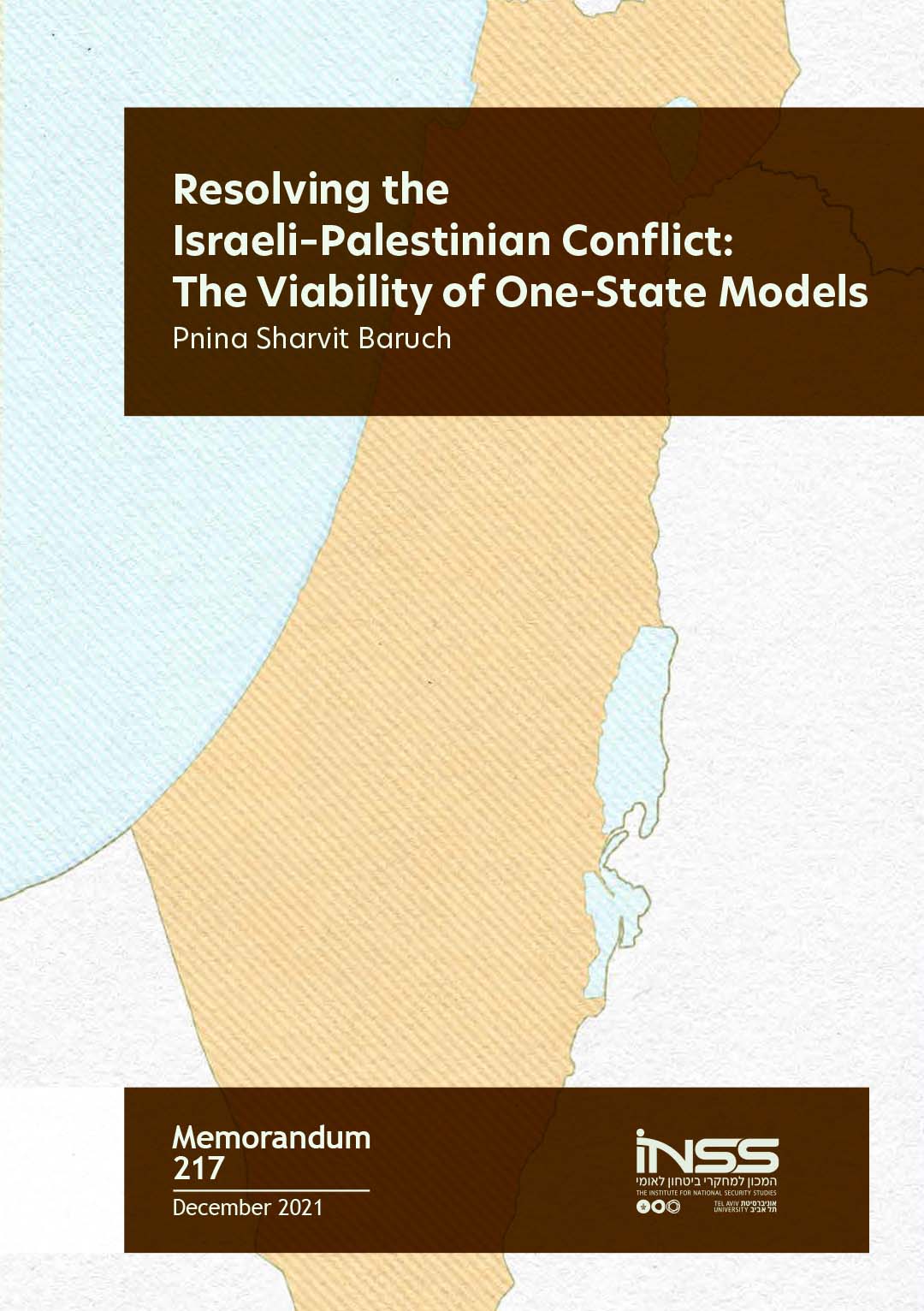
Resolving the Israeli–Palestinian Conflict: The Viability of One-State Models

Memorandum No. 217, December 2021

Follow us on Google
עברית
Pnina Sharvit Baruch

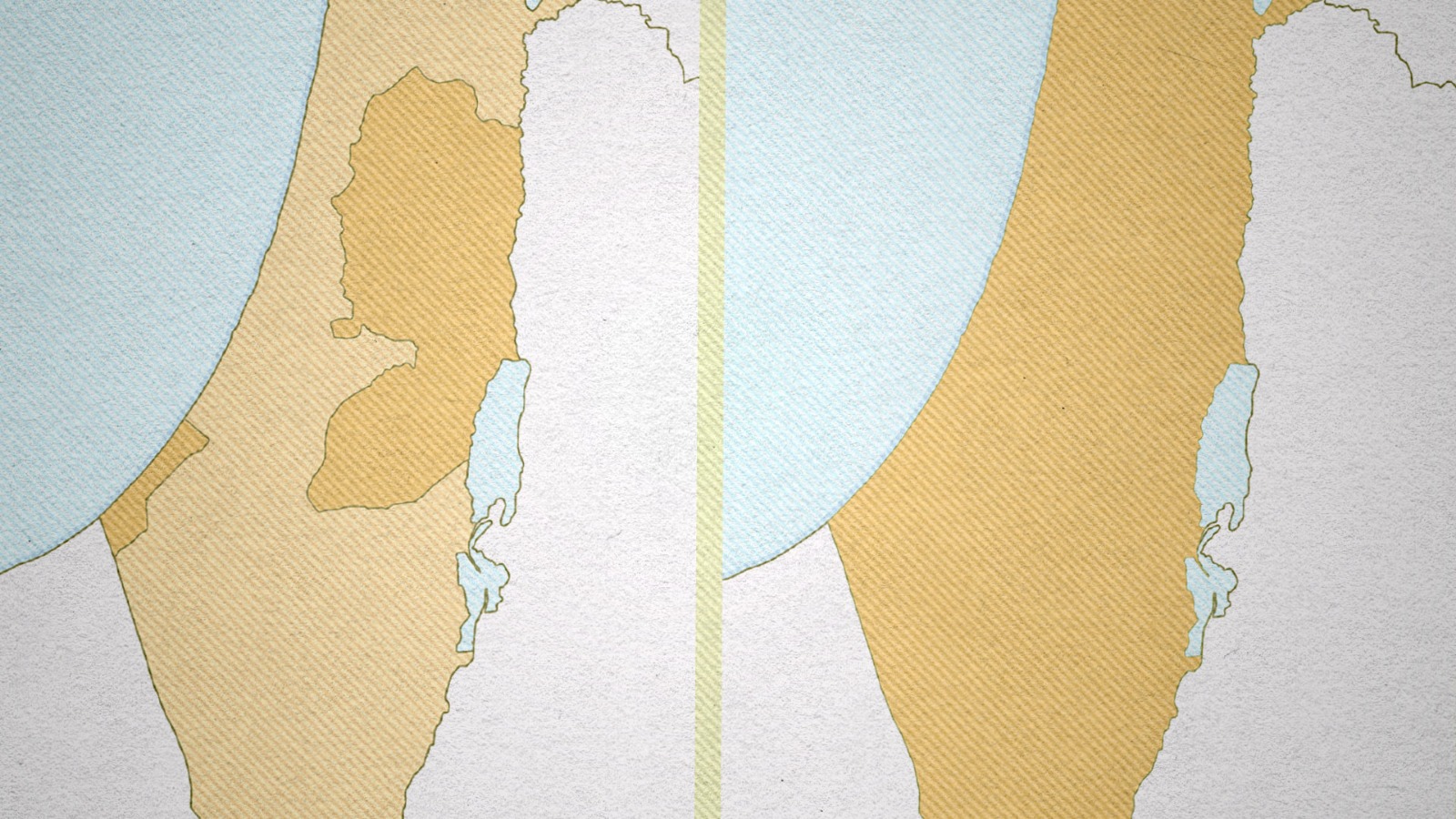
In recent years, there has been an increasing tendency to speak of the “demise of the two-state solution” and to replace it with one state from the Mediterranean Sea to the Jordan River as a solution to the Israeli−Palestinian conflict. The proponents of the one-state model claim that the two states solution is no longer feasible, given that the Green Line has been blurred and Judea and Samaria (the West Bank) is connected to the State of Israel by extensive Israeli settlements and activity−both military and civilian.


Is the one-state solution to the Israeli−Palestinian conflict an implementable solution? This memorandum examines four models: a unitary state that includes the entire territory between the Mediterranean Sea and the Jordan River; a Palestinian autonomous area within the West Bank as part of the State of Israel; a federation divided into Jewish and Palestinian districts; and an Israeli−Palestinian confederation. Public discourse focuses on the question of whether a single state that is both Jewish and democratic is possible. The memorandum also assesses how such a state will operate on the practical level and whether it can serve as a feasible solution to the conflict.


To this end, this memorandum discusses a variety of parameters for each model: the territorial division; the status of the settlements; the status of Jerusalem; aspects of citizenship and residency; governmental authority; the involvement of the Palestinians in government; freedom of movement within the state; the refugee issue; security aspects; social aspects, economic and civil aspects; preservation of the state’s Jewish character; preserving the democratic and liberal character of the state; the implications for Israel’s Arab citizens; the implications for the Palestinian Authority; the status of the Gaza Strip; the execution of the model; and the feasibility of the model. Based on the analysis of these parameters, the likelihood of the model’s success as a permanent solution to the Israeli−Palestinian conflict is examined.
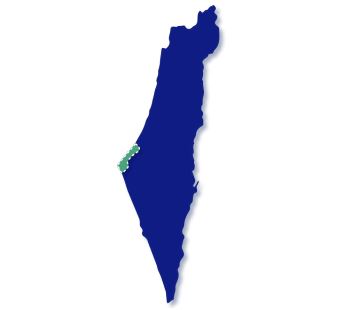
Table of Contents:

In recent years, there has been increasing talk of the “demise of the two state solution” and its replacement with a one-state framework. This single state, which would span the area from the Mediterranean Sea to the Jordan River, is posited as a solution to the Israeli–Palestinian conflict. Proponents of this idea claim that the two-state solution is no longer feasible, given that the Green Line has been blurred and Judea and Samaria (the West Bank) is inextricably connected to the State of Israel by extensive Israeli military and civilian activity. From a demographic perspective, adding the Palestinians living in Judea and Samaria to Israel’s population would mean that almost 40% of Israel’s residents would be Palestinian, doubling the current number of Israeli Palestinians residing in the state (including East Jerusalem). If the Gaza Strip is also included, then almost half of the state’s population would be Palestinian...
Read more

For many years, the leading solution to the Israeli-Palestinian conflict in the public discourse has been the two-state solution—a Palestinian state alongside an Israeli state. Most of the Israeli public has expressed support for such a solution. This is also the accepted solution among most countries and international organizations, as can be seen in the numerous resolutions of the UN Security Council and General Assembly...
Read more

דשדש
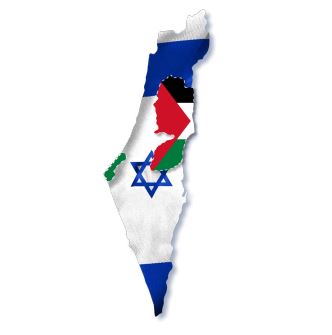
Israel is a single undivided state established on the entire territory, encompassing the existing territory of Israel and the West Bank and potentially also the Gaza Strip...
Read more

דשדשגג
Israel is a single state on the entire territory of Israel and the West Bank (and potentially the Gaza Strip) that includes within it a Palestinian autonomous area...
Read more

דבב
A single state with a central federal government that is composed of federative districts—some districts having a Jewish character and others having a Palestinian character. The division can involve just one Jewish district and one Palestinian district or several districts of each type...
Read more

ססב
Two states, the State of Israel and the Palestinian state, separated by a border based on the Green Line, no physical barrier, free movement, and a joint confederative government...
Read more

On the basis of the analysis of each model, it is possible to summarize their characteristics in respect to each of the parameters...
Read more

The parameters that were analyzed for all the models are summarized in a table below, facilitating comparison between the models...
Read more
The opinions expressed in INSS publications are the authors’ alone.
Publication Series Memoranda
TopicsIsraeli-Palestinian RelationsPreventing the Slide into a One-State Reality
עברית

Events

All events
Iran, US, Israel, and the Global Jewish Community
10 March, 2026
12:00 - 13:00
Shutterstock

Related Publications

All publications
Anadolu via Reuters Connect
Fatah’s Eighth Conference – Abbas’s Attempt to Leave a Final Mark
The gains, disappointments, implications, and conclusions for Israel following Fatah’s highly anticipated conference
16/06/26
REUTERS / Mohammed Salem
The Gaza Strip: Possible Directions for Breaking the Stalemate
How should Israel implement the necessary effort to disarm Hamas?
14/06/26
REUTERS
Alternatives for the Gaza Strip Following the Campaign Against Iran
As the campaign against Iran winds down, attention is expected to return to the Gaza Strip. In the meantime, Hamas is exploiting the strategic vacuum to rehabilitate its governance and military capabilities. Simultaneously, the Trump framework remains stalled, and the “Board of Peace” faces professional, operational, and budgetary difficulties in advancing its declared objectives. The issue of demilitarization remains trapped between Israel’s demand for the complete and immediate disarmament of Hamas and the organization’s stalling tactics. Israel faces three main alternatives: (1) Renewal of efforts to fully implement the Trump framework across the Strip, a course that carries the risk of “mock demilitarization” and depends on Hamas’s consent; (2) Gradual stabilization and reconstruction of areas cleared of Hamas while continuing to erode its control in areas still under its rule. This option is vulnerable to violent disruption and could entrench the Strip’s division; (3) A return to war and the reoccupation of the Gaza Strip, which would entail extremely heavy military, economic, and diplomatic costs for Israel. The key recommendation is to avoid perpetuating the status quo, which establishes Hamas’s rule, and instead adopt a proactive approach. Israel should allow the implementation of the Mladenov framework for gradual demilitarization, beginning with heavy weapons, while coordinating with the Trump administration regarding scenarios that would justify use of force. If Hamas obstructs the process, Israel should implement a differential alternative: the entry of a civilian committee and Palestinian police into “green zones” cleared of Hamas (alongside increasing Israeli security responsibility modeled on Judea and Samaria). Simultaneously, Hamas’s capabilities and governance in the “red zone” should be systematically degraded, including the gradual erosion of its territorial control. The alternative of returning to war and military occupation should remain a last-resort alternative, contingent on the formulation of an exit strategy and a designated body to assume civilian responsibility.
10/06/26

Stay up to date

Registration was successful! Thanks.
  • Research

    • Topics
      • Israel and the Global Powers
      • Israel-United States Relations
      • Glazer Israel-China Policy Center
      • Russia
      • Europe
      • Antisemitism and Delegitimization
      • Iran and the Shi'ite Axis
      • The Campaign Against Iran and the Shiite Axis
      • Iran
      • Lebanon and Hezbollah
      • Syria
      • Yemen and the Houthi Movement
      • Iraq and the Iraqi Shiite Militias
      • Conflict to Agreements
      • Israeli-Palestinian Relations
      • Hamas and the Gaza Strip
      • Peace Agreements and Normalization in the Middle East
      • Saudi Arabia and the Gulf States
      • Turkey
      • Egypt
      • Jordan
      • Israel’s National Security Policy
      • Military and Strategic Affairs
      • Societal Resilience and the Israeli Society
      • Jewish-Arab Relations in Israel
      • Climate, Infrastructure and Energy
      • Terrorism and Low Intensity Conflict
      • Cross-Arena Research
      • Data Analytics Center
      • Law and National Security
      • Advanced Technologies and National Security
      • Foreign Information Manipulation and Interference
      • Economics and National Security
    • Projects
      • Preventing the Slide into a One-State Reality
      • India-Middle East-Europe Economic Corridor (IMEC)
  • Publications

    • All Publications
    • INSS Insight
    • Policy Research and Papers
    • Special Publication
    • Strategic Assessment
    • Technology Platform
    • Memoranda
    • Database
    • Posts
    • Books
    • Archive
  • About

    • Vision and Mission
    • History
    • Research Disciplines
    • Chairman of the Board
    • Board of Directors
    • Fellowship and Prizes
    • Internships
    • Annual Reports
    • Support
    • Privacy Policy and Terms of Use
  • Media

    • Communications
    • Video Gallery
    • Press Release
    • Podcast
  • Home

  • Events

  • Database

  • Team

  • Contact

  • Newsletter

  • עברית

INSS logo The Institute for National Security Studies, Strategic, Innovative, Policy-Oriented Research, go to the home page
40 Haim Levanon St. Tel Aviv, 6997556 Israel | Tel 03-640-0400 | Fax 03-744-7590 |
Developed by Daat ,Yael Group.
Accessibility Statement
This site is protected by reCAPTCHA and the Google Privacy Policy and Terms of Service apply.