


Publications
INSS Insight No. 633, November 25, 2014
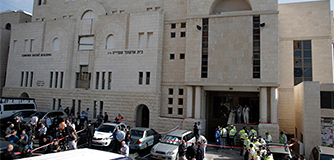
The terrorist attack carried out on November 18, 2014 in a synagogue in the Har Nof neighborhood of Jerusalem, which killed four men during their morning prayers and an Israeli policeman trying to stop the attack, was another step in an emerging trend whereby the Israeli-Palestinian conflict is liable to evolve from a national struggle into a religious war.
In recent months, the main Palestinian area of concern has been the struggle over Jerusalem, inflamed by Fatah through the inciting label of “the war for Jerusalem” and by Hamas’ rhetoric of “the al-Aqsa intifada.” Debate of the issue is rife with religious extremism, manifested in the social media discourse, which stresses repeatedly that the only alternative for a change in the status quo is religious in nature. The effort to enlist popular Palestinian support for the immediate need to defend al-Haram al-Sharif (the Temple Mount) and the al-Aqsa mosque is heightened by attempts by certain Israeli interest groups and Knesset members to change the status quo on the Temple Mount. The Israeli government’s hesitant response to these attempts is seen by the Palestinian public as yet another manifestation of Israel’s doctrine of “establishing facts on the ground.” According to Palestinians propaganda, the next Israeli objective is the takeover and destruction of the al-Aqsa mosque. In the eyes of the younger Palestinian public, because the rest of the Muslim Arab world is preoccupied by infighting in many arenas, there is no one to protect al-Haram al-Sharif other than the Arabs of East Jerusalem, who enjoy the significant advantage of freedom of movement within Israel.
The religious aspects of regional conflicts and the phenomenon of Islamic wars of jihad, which are part of the backdrop to the current tension, have permeated the Israeli-Palestinian conflict. This trend is evident in the use of images of the Islamic State organization (ISIS) and adulation of the organization’s limitless zeal for carrying out barbaric terrorism, including the beheadings it has publicly glorified. By and large, the Palestinians – with the exception of the radical fringe – do not currently uphold the radical religious ideologies of ISIS, but they have embraced the tool used by ISIS to maximize exposure of terrifying images in order to enlist supporters and activists. The two largest social media campaigns in the current Palestinian arena are “Ada’es” (from the word “to run over,” which also sounds like “Da’esh,” the Arabic acronym for ISIS) and “Aten” (from the word “to claim,” which means “stabbing”; the symbol for this campaign is a picture of Palestinian youths wielding axes in order to decapitate). The campaigns, through minimal effort and without a necessary critical mass of volunteers, aim to produce a psychological effect of terror and undermine the Israeli public’s sense of safety. The terrorists who carried out the synagogue attack did not murder in the name of the Islamic State or for its sake, but there can be no doubt that the pictures and videos in the social media fueled their fanaticism and motivated them to act in similar fashion. The addition and emphasis of inter-religious strife to the roots of the Israeli-Palestinian conflict, joining the songs of praise in the Gaza Strip and West Bank for the “shahids” who perpetrated the horror, only add fuel to the fire.
In the social media, young Palestinians call the terrorist acts in Jerusalem “fedayeen” operations by “the defenders of Jerusalem.” This group is keeping its distance from the veteran, institutionalized political movements – Hamas, Fatah, and Islamic Jihad – that bear the stigma of failure as a result of their lack of significant achievements over several decades. Unlike the young people, the political movements are trying to ride the current wave of terrorism, attribute their own influence to it, and use the image of “jihad on behalf of Jerusalem” as well as descriptions such as “the Jerusalem intifada” and “the Jerusalem uprising.”
Although one could point an accusing finger at the Palestinian Authority and President Mahmoud Abbas for inciting the atmosphere by calling on people to defend Jerusalem, in practice there is no evidence for organized activity. There is no responsible party in charge dispatching the terrorists; recent acts have been the result of personal initiative. Moreover, the terrorists who carried out the synagogue attack embarked on their mission from areas under Israeli security control, not from the PA. In the social media in the Gaza Strip and West Bank, President Abbas is presented as a collaborator with Israel, and often called “traitor” and “the Zionists’ dog.” According to the more vocal members of this discourse, Abbas’ influence in East Jerusalem is nonexistent, and there are even social media campaigns calling for his assassination. The fact is that Abba is not interested in the outbreak of a violent, terrorism-infused intifada, because he believes it would not serve the Palestinian cause. To date, Abbas has believed that controlled escalation in Jerusalem supports the strategy pursued by the PA in recent years, a diplomatic strategy that turns to the international community for recognition of a Palestinian state within the 1967 borders as part of a binding UN Security Council resolution that stipulates two years for implementation. Stressing Israel’s failure to provide freedom of access and worship at the holy sites in Jerusalem is designed to promote the strategy. However, it seems that Abbas has begun to understand that he and the PA are losing control of the situation and the escalation. Under pressure from US Secretary of State John Kerry, Abbas condemned the attack, but his influence on the Palestinian public is in any case limited and seems to be shrinking.
The Israeli government’s attempt to place responsibility for the current escalation in Jerusalem on Abbas stems from the fact that Israel knows how to operate against a specific, defined address. Absent such an address, there is no one to blame for the sequence of attacks and disturbances other than the usual suspect. Furthermore, the continuity of events is interpreted as Abbas’ hesitation in stopping them; hence the notion that damaging Abbas’ image and status, by accusing him of fomenting terrorism, will undermine the Palestinian political option of appeal to the UN for recognition of a Palestinian state.
Following the synagogue attack, the world expressed momentary empathy with Israel, but one mustn’t err in reading the international community’s take on the situation. The basic attitude reflects the assessment that the escalation is the result of the deadlocked political process, which nurtures hopelessness among the Palestinian public. Israel is viewed as the main culprit for this state of affairs.
In light of recent events, the Israeli government must make an updated strategic assessment to formulate new methods of coping with the worsening challenge. We are witnessing the collapse of the strategic approach that saw Israel as a “villa in the jungle” and maintained that it was possible to isolate Israel from the events occurring in the region and view them from a standoff position without the wave of regional events spilling across its borders. But the policy of response without being proactive on the political front is no longer effective. Therefore, what Israel needs is a formative policy that will use the current period of time to change the paradigm of the Israeli-Palestinian conflict. This change should focus on promoting transitional arrangements in conjunction with the Arab world under the umbrella of Arab Peace Initiative, and the formulation of regional guarantees for implementing political agreements with the Palestinians.